
Trusted Writing on History, Travel, and American Culture Since 1949
SEARCH 75 YEARS OF ESSAYS!
October 2007
Traveling through the beautiful Cumberland Mountains in northeastern Tennessee, we took the Caryville exit off I-75 to look for lodging. We discovered an inn that defines hospitality—and contains an intriguing memento of a very dark moment in its owners’ past.
Following the signs, we ascended a steep driveway beside an eclectic display of lawn sculptures and vintage farm equipment that once belonged to Alex Haley, the author of Roots. Llamas grazed on the hillside behind the inn. Guests lingered near bench swings with a view of pristine Cove Lake beneath a horizon of pine-covered mountains. One could imagine the place before man carved into it.
On the morning of October 25, 1812--195 years ago today--the USS United States was sailing southwest in the Atlantic Ocean, about 500 miles southeast of the Azores. As dawn broke, the lookout spotted a ship some twelve miles away. The captain, Stephen Decatur, recognized the approaching vessel: It was HMS Macedonian, a Royal Navy frigate. Decatur not only knew the ship; he was good friends with its captain, John S. Carden. The two men had dined together repeatedly when Macedonianwas in port at Norfolk, Virginia, just nine months earlier. Back then, America and Britain were on friendly terms, and at one point the two captains jokingly bet a beaver hat on the outcome of a future battle between their ships. But in July Congress had declared war, and now the two men's joke was about to become deadly serious.
History teaches—and what it teaches most of us is that the opinions we already hold are correct. A case in point: For roughly half of Americans (and probably 90 percent of Europeans), every modern war is Vietnam all over again. For the rest, every modern war is World War II. Is there no middle ground between these two extremes? In fact, there is, in both time and ideology: the Korean War.
On the one hand, it worked. The United States intervened in an overseas civil war, successfully defeated a dangerous and unstable dictator, and went on to build a thriving and prosperous democracy. Can anyone picture Kim Jong Il in control of the entire Korean peninsula without giving thanks for America’s intervention? On the other hand, consider this: The Korean War also had a clear and inarguable casus belli, was sanctioned by the United Nations, involved an ethnically homogeneous country (though one with class and regional frictions), and boiled down to defending a compact and clearly defined border. Take away those things, and what do you have left? Vietnam.
A seismic event occurred in 1919 whose fractures still cleave the world today. It was the moment that created Iraq with all its fissures, and the violent patchwork of a nation known as Yugoslavia. The disruptions radiating from this critical moment in history are still felt across Asia, throughout Palestine, with remnants still lingering from Central Europe across China to Vietnam. I am not a believer in any single-causation theory of history, but because the Peace that ended the First World War today is such an overlooked yet defining moment, I’ve just published a book about it, A Shattered Peace: Versailles 1919 and the Price We Pay Today (Wiley, 336 pages, $25.95). It’s an effort to draw some lessons from the mistakes of those powerful, single-minded leaders of the empires that had just ended what was called the Great War, so that we may not be condemned to repeat them.
More than a million Americans sailed to Europe in 1917 and 1918 to fight in the Great War. Only three of them, all well over 100 years old, are alive today. And of all who fought, just one emerged as the exemplary doughboy—Alvin York. On this date in 1918, York performed a feat of bravery and military skill that would amaze his countrymen, change his life, and etch his place in the history books. When all the participants in the epic conflict are gone, very soon, their stories preserved only in books, handed-down memories, and granite inscriptions, Alvin York’s name will live on.
In late September 1918, the Allies had begun a massive offensive intended to end the war before winter. During that campaign, a battalion of about 600 Americans was surrounded near the Argonne Forest in northeastern France. An attempt had to be made to relieve the force, which became known as the Lost Battalion. Corporal York’s unit, part of the 82nd Infantry Division, was ordered to push back the Germans and cut a rail line as part of the action. York and his companions had endured the trenches since June, but they had so far seen little action.
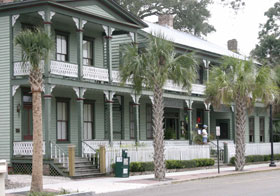
Virginians, especially in this quadricentennial year, like to remind us that Jamestown was the first English settlement in the New World, having been founded in 1607, 13 years before the Pilgrims went ashore at Plymouth Rock. Pardon me, Floridians hasten to point out, but St. Augustine is the oldest permanent European settlement in the continental United States, from 1565. Yes, but the Spaniards founded St. Augustine only to counter the French, who had first planted their flag in 1562 a few miles north, on Amelia Island, near what is now the Georgia state line.
On the night of October 4, 1957—50 years ago today—Americans watched with rapt attention and deep unease as a small, shiny point of light moved quickly across the night sky. Looking like a little shooting star, it was a tiny satellite launched that day by the Soviet Union. It was the first manmade object to reach space. Sputnik, as it was called, a name meaning “companion,” orbited the earth once every 96 minutes and emitted sound signals at regular intervals from the two radios it carried. Those bleeps, used to monitor Sputnik’s location and progress, sounded as an alarm bell to Americans. The Russians were demonstrating in the most public possible way that they were ahead of the United States in claiming space. This shocked and terrified Americans.
Twenty-five years ago today, on October 1, 1982, the much-anticipated EPCOT Center opened at Walt Disney World, in Orlando, Florida. It was a massive 260-acre park packed with technology and cultural exhibits that cost more than $1 billion to build. But it was a mere shadow of what Walt Disney had dreamed of.
Why? The answer goes back to when Disney himself first envisioned EPCOT, in the early 1960s. His original concept, for an Experimental Prototype Community (or sometimes City) of Tomorrow, went far beyond a simple theme park. He wanted to build a real-life, ideal, futuristic city—a city in which he, Walt Disney, would hold supreme authority.
The science-fiction writer Ray Bradbury once asked him if he might ever run for mayor of Los Angeles. Disney replied, “Why should I run for mayor when I am already king?” But by the late 1950s the success of Disneyland, his first theme park, in Anaheim, California, had changed his perspective. He was no longer merely a maker of brilliant animated movies but a visionary builder as well.