
Why England Is the Key to Understanding the United States
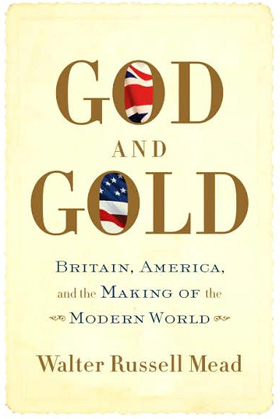
Walter Russell Mead, the Henry A. Kissinger Senior Fellow for U.S. Foreign Policy at the Council on Foreign Relations, is what is nowadays called a public intellectual, which means someone who writes and talks about big issues, and not only on college campuses. He teaches American foreign policy as a visiting professor at Bard College and writes books on that subject. He has just published a new one, God and Gold: Britain, America, and the Making of the Modern World(Knopf, 464 pages, $27.95), and in it he argues that Americans once knew but have forgotten or don’t want to admit something extremely important: that the overwhelming historical influence on our culture is Britain, and that only by studying British history can we fully understand our own society and how our nation should behave.
He hammers this home at some length, and he can be forgiven for most of the hammering, because when an important thing once known by almost everyone becomes unsayable by almost anyone, hammering is probably in order. He repeats (and repeats) that the big story of the last four centuries or so is not the rise and fall of Europe; it is rather the rise and rise of what he calls the “Anglosphere,” the English-speaking societies founded and shaped by Britain, most especially the United States, which have altogether gone from success to success over that period. He points out that neither the United States nor Great Britain has ever lost a major war, and in the only case that comes close, Britain lost but the United States was created, so that one wasn’t an Anglosphere defeat.
The order devised in and by Britain and America, which Mead calls the maritime model, involves a commercial society engaging in free trade, ruled by a representative democracy running a relatively weak government accompanied by a strong civil society, the latter significantly more religious than are many less successful modern societies. He writes that in terms of creating wealth and winning wars, the maritime system is the most formidable set of arrangements the world has ever seen and is still on the rise. It lets societies survive the extreme stresses of modernity without succumbing to radical and vicious kinds of anti-modernist politics. It is widely hated because it is simultaneously alluring and repellent to those it encounters and vanquishes. Mead thinks the Anglosphere’s citizens often don’t understand why this is so or realize what they can and can’t do about it.
He is generally and often persuasively optimistic. The coming end of the Anglosphere’s unipolar moment, with the accelerating rise of China and India, probably means nothing more onerous than the task of maintaining the maritime system by attending to the balance of power, he says; this worked well for Britain for a few centuries, and it will likely work well for the United States too. His sense of how the Anglosphere looks to a lot of Muslims is more persuasive than his sometimes platitudinous advice about what we should do about it (such as talk less, listen more). His tone and his examples can seem to point in opposite directions, and sometimes they appear reducible to “the Anglosphere is inhabited by murderous and thieving hypocrites, who always win, and a good thing too.” But his argument is not so easily reduced, and it is worth reading in full.
He is particularly interesting, if not always persuasive, on the importance of religion. He thinks that the form of Christianity that became the Church of England rested on a system of thought that veered between tradition, revelation, and reason, and he believes that the thought of the Anglosphere veers between these same three poles to this day; when it comes too close to one of them, it recoils. He likens the process to a gyroscope atop a pyramid. He knows more theology and church history than do most public intellectuals, and more Anglo-American history than do many of the more theologically learned; this makes for an interesting combination. He contends that Abrahamic religion, meaning Christian, Muslim, and Jewish monotheism, which makes God an active force in history, is the key link between a variety of intellectual systems too often considered in isolation from one another, for example, Marxism, Islamism, and the Anglo-American faith in progress. This was once known to more people than seem to know it now. His focus on the importance of religion can sometimes seem too old-fashioned, though; the German sociologist Max Weber’s theory that Calvinism is a precondition for capitalism, which Mead endorses, was once far more widely accepted than it is now.
Mead has other weaknesses too. One is wanting to have it both ways. He has written a celebration of the fact and moral import of the Anglosphere’s victories over its successive enemies but often jokily deprecates the Anglosphere’s hypocrisy and demonization of its adversaries. That demonization doesn’t look so bad when the subject is Adolf Hitler or Joseph Stalin, and he may be going too far when he implies that something close to hypocrisy was part of the decision to abolish slavery. In any case, the Anglosphere does not have anything like a monopoly on hypocrisy, and it is clear that Mead knows it. And once a public intellectual gets a job at a college, he may be tempted to occasionally genuflect before the idols of the tribe.
He also has a weakness for cracking wise. For example, he imagines Oliver Cromwell saying Reagan-like to the King of Spain, “Don Felipe, tear down that wall!” He not merely reads Lewis Carroll’s “The Walrus and the Carpenter” as an elaborate allegory of the history of Great Britain and the United States but repeatedly uses walruses, carpenters, oysters, and sand in an almost endless conceit. There is a lot of whimsy here, and it can be exasperating, but there is a lot of wisdom too, some of it once but no longer proverbial, and there’s a good amount of learning.
The philosopher Jeremy Bentham once described an instance of ludicrous thought loftily expressed as “nonsense upon stilts.” Mead comes closer to common sense upon stilts. Stilts rarely make for a graceful gait, and no one ought to use them to look taller than God made him. But to quote from the brilliant 1066 and All That, published in 1930 and never out of print since—Mead quotes from it with affection—common sense is “A Good Thing.” So, on balance, is Walter Russell Mead.