
Travel: A Place That Makes Jamestown Look New
Virginians, especially in this quadricentennial year, like to remind us that Jamestown was the first English settlement in the New World, having been founded in 1607, 13 years before the Pilgrims went ashore at Plymouth Rock. Pardon me, Floridians hasten to point out, but St. Augustine is the oldest permanent European settlement in the continental United States, from 1565. Yes, but the Spaniards founded St. Augustine only to counter the French, who had first planted their flag in 1562 a few miles north, on Amelia Island, near what is now the Georgia state line.
The French were Huguenots who hoped to establish a colony where they could live peacefully apart from Catholics. After touching land at Amelia Island, they left soon afterwards and landed in what is now South Carolina. Two years later, however, another party of Huguenots built Fort Caroline in what is today Jacksonville; the Spanish, not tolerant of Protestants, destroyed it and killed many of them in 1565. That leaves St. Augustine as the oldest surviving European settlement in the United States, but possibly only because of a storm that gave the Spanish the upper hand in the fight against the French.
While such quibbles about which place is most historic may sound like fleas debating who owns the dog, pedigree is an important matter to tourism officials; they love to hang their hats on “oldest,” “largest,” and other superlatives. After all, some travelers will detour just to see the world’s largest ball of twine. And 13-mile-long Amelia Island is not an oddity or a footnote. Its substantial assets have been attracting visitors for more than four centuries, from colonists and pirates to present-day vacationers.
Initially the attraction was a deep harbor with plenty of fresh water for provisioning ships, close to the Gulf Stream trading route. Today the harbor’s location on the Intracoastal Waterway continues to make it an important shipping point. Meanwhile, Fernandina Beach, the settlement that sprouted around the harbor on the north side of the barrier island, is a lovely seaport village. In 2002 it was named one of the annual top 12 “distinctive destinations” by the National Trust for Historic Preservation. Fernandina Beach has not only a colorful history but also extensive Victorian architecture, an Old Florida pace of life, an appealing downtown retail district, a multicultural heritage, and delicious fresh local shrimp in its restaurants.
With the deepest natural harbor in the South, Fernandina Beach in its early years was one of the busiest ports in the New World. Spanish galleons, some loaded with gold, rode the currents along the Florida coast on their return route to Europe; pirates and privateers, in turn, followed them to the harbor.
Later, as a border town between Spanish Florida and American territory, Fernandina Beach boomed when Thomas Jefferson closed U.S. ports with the Embargo Act of 1807, in retaliation for Britain’s impressment of American seamen. Bordellos thrived as the harbor became a smuggling center for slaves, liquor, and luxury goods.
As the Spanish began to lose their grip on Florida, a succession of three ragtag groups of revolutionaries and adventurers seized the border town and raised their flags before Spain ceded Florida to the United States, in 1821. Consequently, Amelia Island is the only location in the U.S. that has been governed under eight flags (including the Confederacy’s). As the locals say, the French visited, the Spanish developed, the English named, and the Americans tamed.
Not surprisingly, Fernandina Beach, which has a population of 10,700, claims to be the oldest tourist town in the state. The Florida House Inn there is the state’s oldest surviving hotel. It has been playing host to travelers since 1857, including President Ulysses S. Grant and José Martí, who plotted a Cuban revolution in it. Carnegies, Rockefellers, and Fords dined at the inn, though they may not have feasted on today’s popular all-you-can-eat Southern fried chicken lunch, served boarding-house style.
David Yulee, one of Florida’s first pair of U.S. senators and the nation’s first Jewish senator, was one of Fernandina Beach’s most memorable entrepreneurs and politicians. On the eve of the Civil War, he built what was then the state’s longest rail line, connecting the Atlantic and Gulf coasts. He expected his railroad, which eliminated a 1,000-mile sea voyage around the state, to make Fernandina Beach an even more prosperous transportation hub. But most of the line was destroyed by the war. He never became a true tycoon, but in the 1840s he did help get statehood for Florida. Rail passenger service to Fernandina Beach ended completely in the 1930s, but you can still admire the handsome 1899 train depot, now the visitor center, at the foot of Centre Street, downtown’s main artery.
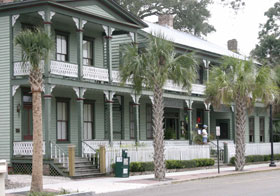
Attracted by the climate and luxury hotels, New Yorkers steamboated to the village in the 1880s, even as Henry Flagler (John D. Rockefeller’s partner at Standard Oil) built his railroad to St. Augustine, bypassing Fernandina Beach, its longtime rival. So the snubbed port town escaped modern development pressures and still has a 55-block registered historic district of “painted ladies” as well as Queen Anne, Gothic Revival, Italianate, and other styles of buildings. During its post–Civil War golden age, the village was known as the Newport of the South and had direct steamship service to Great Britain.
Walking tours of the historic district, and into some of its most exemplary homes, are offered daily by the Amelia Island Museum of History, a few blocks from Centre Street. The museum is in an 1878 jailhouse that held convicts as late as 1978, when the jailer and his family still lived there and his wife cooked for the prisoners.
The museum paints a comprehensive picture of the island’s history, beginning with the pre-colonial Timucuan Indians, who adorned themselves with multicolored tattoos. The story continues with Spanish missions and English plantations on the island; power struggles under the eight flags; the Civil War; and the town’s nineteenth- and twentieth-century development as a port and resort community. Most of the points of interest described are within walking distance or a bike ride.
Centre Street once was home to about 20 bars that served seamen on shore leave. Today its most notable watering hole is the Palace Saloon, which bills itself as the state’s oldest continuously operating tavern. Opened in 1903, it was designed in consultation with Adolphus Busch, the co-founder of Anheuser-Busch, who was a friend of the first owner. It was nearly destroyed by a fire in 1999 but was restored and still has the elegant features that made it a ship captain’s destination—mosaic floors, tin ceilings, mahogany caryatids, murals, and a 40-foot bar lit by gas. Its clientele included Rockefellers, Du Ponts, and Carnegies, over from the Carnegie estate on nearby Cumberland Island.
Teetotalers will also enjoy Centre Street. Lined with low-rise multicolored nineteenth-century brick buildings, palm trees, flowers, and gas-lantern replicas, it is a pleasant place to stroll, with an imposing Italianate post office, boutiques, galleries, restaurants, and an assortment of shops selling antiques, collectibles, and books.
At the end of Centre Street is the waterfront that was the birthplace of the modern shrimp industry, where for decades trawlers have been returning to the docks at sunset. And a local firm is still one of the world’s largest producers of hand-sewn shrimp nets. Since 1964 the village has hosted the Isle of Eight Flags Shrimp Festival, which, despite the name, is primarily an art and antiques event and draws 100,000 visitors. It’s held on the first weekend in May, and it’s the place for a harborside feast of jumbo Atlantic white shrimp prepared in, for instance, Southern–style shrimp pie.
The town owes a measure of its prosperity to Northern occupation during the Civil War. The Union Army plundered but didn’t burn the village in 1862, after what was then the largest amphibious invasion in U.S. history. The invaders’ objective was on the outskirts of town: Fort Clinch, which the Confederates wisely abandoned without a fight. The occupiers controlled the town throughout the rest of the war, and they enjoyed their long and quiet time there. When they went back home, they told their friends about the place, and many returned to settle and start businesses. The vets who put down roots included members of the First South Carolina Volunteers, the first official black regiment in the Union Army, which was formed with escaped slaves from Florida, particularly from the Amelia Island area, as well as South Carolina. They were the first black unit to engage the Confederates, not far from the island, paving the way for others, including the Massachusetts regiment of free blacks heralded in the movie Glory.
If you enjoy camping or RV-ing, you can report for easy duty at Fort Clinch. It is now the centerpiece of a 1,100-acre state park, with a half-mile-long fishing pier, hiking and biking trails, and two campgrounds, one on the oceanfront and the other in an oak hummock near the Amelia River. The fort provides an inexpensive base from which to explore the island and is one of the best-preserved nineteenth-century fortifications in the country. It was deemed indefensible by Gen. Robert E. Lee, but it survived to play a supporting role in the Spanish-American War and World War II. Reenactors there give daily tours.
If you prefer a plusher vacation style, stay at one of the several large resorts on the southern end of the island. The most famous of them, the upscale Amelia Island Plantation, went up in the 1970s and began the refurbishment of Fernandina Beach’s reputation for high style. The 1,350-acre resort complex has world-class golf courses, a spa, luxury condominiums, on-site shopping, and fine dining. Its best feature, though, is that it was conceived as one of the country’s first “green” resorts. The developer preserved 70 percent of the tree canopy covering the postcard-perfect site. The evidence is, literally, striking: Narrow lanes twist around live oak trees, many of them scarred by car bumpers. Staff from the resort’s nature center give marsh tours, and as a guest you can kayak the Intracoastal Waterway or silently explore the property on a Segway.
About 35 years before the Plantation was built, another distinctive resort broke ground on the island. Abraham Lincoln Lewis, the founder of the Afro-American Life Insurance Company and Florida’s first black millionaire, established American Beach, the oldest continuously black-owned seacoast resort in the United States. In the 1930s beaches in the South were segregated, of course. Lewis addressed that offense with a half-mile-long beachfront property that became the largest and most popular beach for blacks in the area. It also drew celebrities from afar, such as Hank Aaron, Joe Louis, and Ossie Davis, and its nightclubs featured headliners like Ray Charles, Cab Calloway, and Duke Ellington. Following a damaging hurricane and the Civil Rights Act of 1964, which opened up other beaches, American Beach declined. It is now a registered national historic district.
That’s reason enough for Amelia Island to be a stop on Florida’s Black Heritage Trail, but the place also made important African-American political history: Fernandina Beach was the first town in the South to hold a municipal election open to black voters, on May 1, 1865, after federal authorities threw out a whites-only vote.
Most visitors don’t go to Amelia Island to make history or to explore it. They go to enjoy the sun and surf, the natural beauty, leisurely walks under live oaks dripping with Spanish moss, an evening cruise, good food, and attractive accommodations. In these simple respects, tourists this winter will be no different from those who flocked to the island aboard steamships more than a century ago.
For more information, visit www.ameliaisland.org or call 800-2AMELIA. The Amelia Island Museum of History is at www.ameliamuseum.org or 904-261-7378; Amelia Island Plantation is at www.aipfl.com or 904-261-6161; and Fort Clinch is at www.floridastateparks.org/fortclinch/ or 904-277-7274.