
January 2011

A few weeks before Pearl Harbor, the highest ranking officer in the Armed Forces, General George C. Marshall, described as our main contribution to modern war a new, small, bouncy army vehicle with the official designation of truck, quarter-ton, four-by-lour, but better known to practically everyone, then and now, as the jeep.

No one is certain exactly where the name “jeep” came from. The most widely accepted theory is that it originated in the pronunciation of the army designation G. P., meaning “general purpose,” but at one time or another it has been used to refer to an experimental railroad engine, a three-ton tractor, an autogyro, and a careless soda jerk. The question is further confused by the fact that in the prewar army, especially in the Armored Force, the quarter-ton four-by-four was called not a “jeep” but a “peep,” the former term being reserved for a larger command-and-reconnaissance car.
A fter two hundred years upland New England still bears his imprint: in a college town of western Massachusetts; at Lake Amherst, Vermont, not far from Calvin Coolidge’s birthplace; in New Hampshire’s Amherst on the old Boston Post Road. North from Charlestown, New Hampshire—the eighteenth-century military base that was once Fort Number Four—one can still trace the indentations of his 1759 Crown Point Military Road as it twists across into the Vermont hill country and on toward Lake Champlain.

The road and seaway from Myra in Asia Minor to your street corner and chimney at Christmas is a long one, and was long in the building. Nevertheless, it is there, and one traveler voyages the incredibly long and circuitous route each year. He is somewhat metamorphosed, to be sure, as a result of the journey, but he is still one and the same: St. Nicholas and Santa Claus.

Tradition has it that a certain Nicholas was born in Patara in Lycia, that he led a holy life even as a youngster, was imprisoned and tortured for the faith under the reign of the Emperor Diocletian, but released under the more tolerant Constantine. He attended the Council of Nicaea as the Bishop of Myra, and died on December 6—his saint day—343 A.D. Two sentences with the conjectured “facts.” Beyond that nothing, except for the cult and the legend.

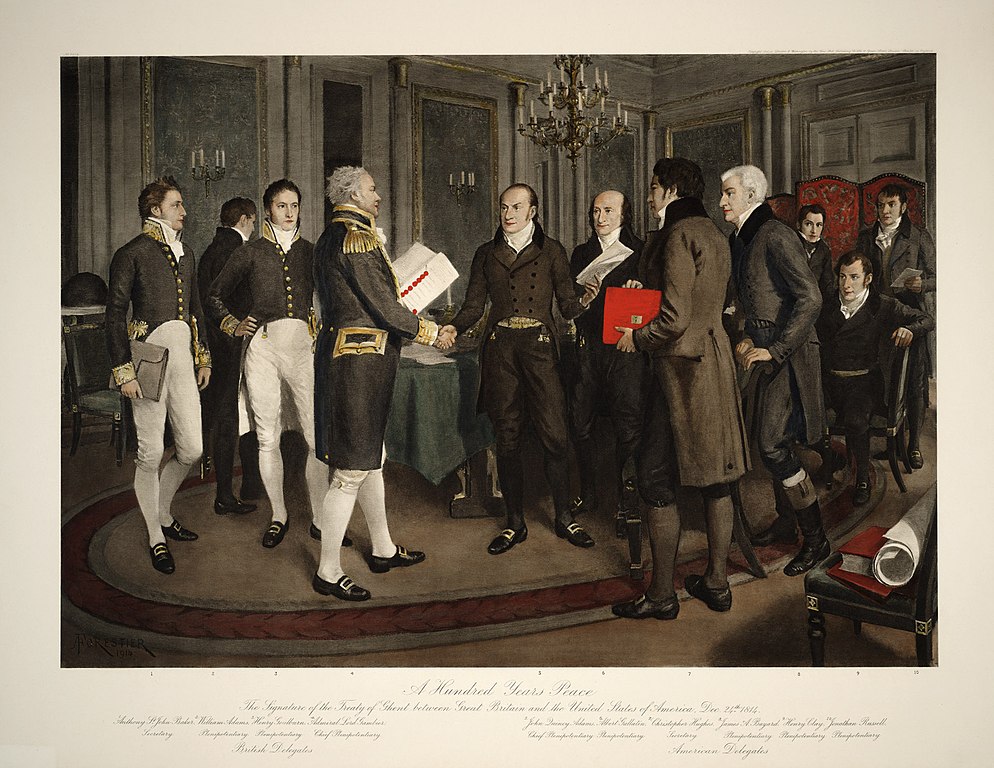
treaty of ghent
An 1815 painting by Amédée Forestier depicts British and American diplomats signing the treaty in Ghent, Belgium. Library and Archives Canada

It was St. John’s Day, a gentle introduction to summer, and the road, Lowered by leafing elms and poplars and oaks, carved through lush grain fields and meticulous flower gardens. The two reluctant traveling companions had set out from Antwerp at nine that morning. For more than an hour they had been delayed at the River Scheldt, a crowded anchorage for British men-of-war, while petty officials bickered over their tolls, but by early afternoon they were hallway to Ghent, the old Flemish capital, where they were to seek peace with the British.

A crude boat carrying forty exhausted Spaniards drifted close to the long Texas beach. “Near dawn it seemed to me that the tumbling roar of the sea could be heard. Surprised, I called the boatswain and he replied that we were near the coast. We sounded and found ourselves in seven fathoms. It seemed to the boatswain that we ought to keep to sea until sunrise and I took an oar and pulled on the land side until we were a league off-shore. Then we turned the stern to the sea. Near the land a breaker took and threw the boat the cast of a horseshoe out of the water. With the violent blow almost all the men, who were like dead, came to themselves and seeing the beach near the) began to climb from the boat and crawl on hands and knees to some ravines where we made fire and toasted some corn that we had brought and drank some rain water that we found. The heat of the fire restored the men and they began somewhat to exert themselves. The day that we arrived here was the sixtli of the month of November.” The year was 1528.

Both Parkman and Melville looked for and found the authentic frontier. Parkman saw it at first hand on the western plains, and then went back to an eastern frontier (“mousing in the archives”) and breathed life upon it. Melville found it on the high seas, on whaling ships and on the Navy’s cruisers, and struck sparks from it, making a light for more settled folk in the eastern cities. Each one touched base with something fundamental to the American consciousness, because the frontier for many generations laid its imprint on what the American people thought and did.

Dr. Oliver Wendell Holmes walked down Broadway one day in 1860 on an unorthodox errand for that distinguished physician, poet, and essayist. The Autocrat of the Breakfast Table had a gadget to sell—a contrivance he had made himself—a stereoscope. Readers of the Atlantic Monthly were familiar with the fact that Dr. Holmes had become fascinated by the three-dimensional photography which had been introduced from England a few years before. He had published in June, 1859, an article explaining the theory of the stereoscope and describing his collection of pictures. “I pass, in a moment,” he wrote, “from the banks of the Charles to the ford of the Jordan and — in spirit I am looking down upon Jerusalem from the Mount of Olives.”

But he was so dissatisfied with the efficiency of the viewing instruments he was then able to get that he designed and constructed for himself a simpler one—the stereoscope we remember from childhood.

Help us keep telling the story of America.

Now in its 75th year, American Heritage relies on contributions from readers like you to survive. You can support this magazine of trusted historical writing and the volunteers that sustain it by donating today.

Donate