
Trusted Writing on History, Travel, and American Culture Since 1949
SEARCH 75 YEARS OF ESSAYS!
January 2011
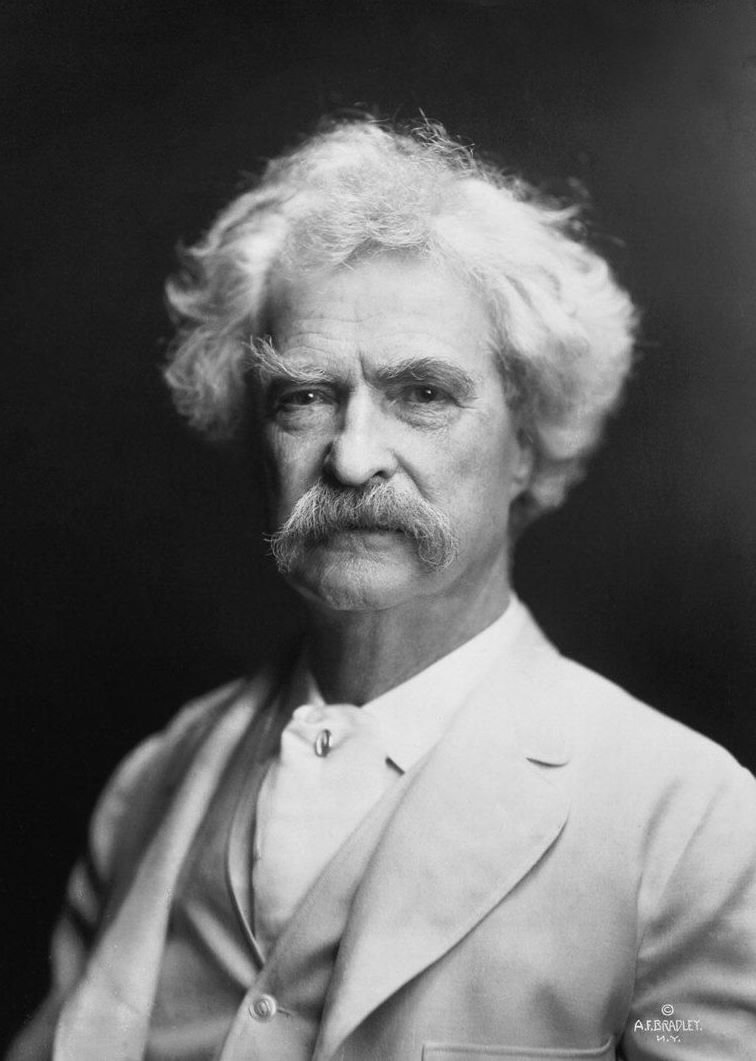
Samuel Clemens, better known by his pseudonym 'Mark Twain', was an American author and humorist. He wrote such classics as The Adventures of Tom Sawyer and The Adventures of Huckleberry Finn, as well as many other essays and books.
“If you don’t like the weather in New England, just wait a few minutes.”
“More than one cigar at a time is excessive smoking.”
“My books are water; those of the great geniuses are wine. Everybody drinks water.”
“Good breeding consists in concealing how much we think of ourselves and how little we think of the other person.”
“What a good thing Adam had—when he said a good thing he knew nobody had said it before.”
In November, 1901, the little town of Sonoma, California, a few miles north of San Francisco, lay dreaming in the haze of Indian summer. There were few guests in the town hotel, and only two were strangers. One of them was a small man with bright, beady eyes above a huge mustache; he looked like Ren Turpin with his eyes uncrossed. The other was big and broad-shouldered; he had a head of thick, curly black hair and a luxuriant mustache and Vandyke beard that, in pictures of him, give an irrepressible impression of being glued on.
Today, thirty-two years after Nicola Sacco and Bartolomeo Vanzetti were executed for the murder of a paymaster and his guard in South Braintree, Massachusetts, the ghosts of the cobbler and the fish-peddler are not at rest. As recently as last year a joint senate-house committee of the Massachusetts legislature was asked to recommend that the governor issue posthumous pardons, thus correcting “an historical injustice which had besmirched the reputation and standing of Massachusetts in the eyes of the entire world.” No pardons were forthcoming.
In October of 1958 AMERICAN HERITAGE published an article about the case entitled “Tragedy in Dedham,” whose author, Francis Russell, concluded that the two men were innocent of the Braintree crime. Recently we received a letter in reply from Mrs. Dorothy G. Wayman, now a librarian at St. Bonaventure College in upper New York State, but formerly a newspaperwoman who covered the SaccoVanzetti trial. It is published here in the interests of historical fairness, with a brief defense of his original thesis by Mr. Russell.
—Ed.
In 1896, the depression which had followed the Panic of ’93 was in its third year. Debt, business failure, unemployment, and labor unrest were spreading; to many, revolution seemed just a step away. This was the setting for the bitter presidential contest between Republican William McKinley and Democrat William Jennings Bryan, and the great debate between the advocates of “sound money” and the supporters of the inflationary panacea, free silver. In a chapter from her long-awaited new book, In the Days of McKinley , Pulitzer prize-winner Margaret Leech tells how McKinley and his famous manager, Marcus Alonzo Hanna, conducted and won a campaign in which the candidate never left home. The book is published by Harper & Brothers.
He could never resist an old book, a young girl, or a iresh idea. He lived splendidly, planned extensively, and was perpetually in debt. Believing perhaps, like Leonardo, that future generations would be more willing to know him than was his own, he wrote his delicious, detailed diaries in code. Only now that they have been translated, and time has put his era in perspective, do we see what William Byrd of Westover was: one of the half-dozen leading wits and stylists of colonial America.
During the reign of Elizabeth I, as the interest in and knowledge of America gathered momentum, so their reverberation in literature and the arts became louder, more frequent, and more varied.
To its first colonists, Virginia presented an aspect less idyllic, if no less strange, than it held for their compatriots back home in England. On the following pages are photographs of the area near Jamestown, taken by Bradley Smith, which show as closely as possible how the landscape would have looked to Captain John Smith and his companions, when they came here to plant a colony, and look for gold, in 1607. The quotations that accompany them are taken from Edward Arber’s edition (1884) of Smith’s Works , which includes not only his own writings but various letters and accounts by his fellow adventurers.