Trusted Writing on History, Travel, and American Culture Since 1949
SEARCH 75 YEARS OF ESSAYS!
February 2007
There’s a story that shortly after he won election against California’s popular incumbent governor, Ronald Reagan was asked how he planned to tackle all the problems facing the nation’s most populous state. “I don’t know,” he said solemnly. “I’ve never played a governor.” John Patrick Diggins, the author of Ronald Reagan: Fate, Freedom, and the Making of History (W. W. Norton, 493 pages, $27.95), likes that anecdote but also views the actor-turned-politician as a serious thinker, who “unnerve[d] America with words and ideas.” He sets out in his ambitious volume to situate Reagan in a long line of popular democratic theorists.
If you’ve gone to Hawaii only once, you’ve probably visited Oahu, Maui, or the Big Island. These destinations are lovely, of course, but more and more they are likely to elicit the "I wish I'd come here 20 years ago" response. Kauai, however, still has that Old Hawaii charm. Basically it’s a matter of scale. Oahu and Kauai are about the same size, but Kauai has only about 60,000 residents to Oahu’s 900,000.
The island, roughly round and 33 miles across at its widest point, is nearly ringed by a two-lane coastal highway that connects a string of small country towns, where you’ll see ranchers driving muddy pickups with a dog in the back. The first plantation in the islands was established on Kauai, and agriculture on its emerald coastal plains and valleys remains a key part of its identity.
Only one plantation is still operating, but the locals still hunt wild pigs in the abandoned sugar cane fields and in the mountainous interior, which is too rugged for roads. Wild roosters seem to be everywhere, and hotels taller than a coconut tree (four stories) are not allowed.
Ten years ago this week, in late February 1997, word began to spread of a seemingly fantastical advance in biological science. Working in secrecy at the Roslin Institute in Scotland, a small team of research scientists, led by Ian Wilmut and Keith H. S. Campbell, had managed to produce the first living clone of an adult mammal. They had made nearly 300 attempts, and one successful cloning had taken place. The result was a sheep named Dolly, whose DNA exactly replicated that of another sheep six years her senior.
The official announcement of this achievement took the form of an academic paper published in the British journal Nature, titled “Viable Offspring Derived From Fetal and Adult Mammalian Cells.” With this paper Dr. Wilmut and his colleagues took a major step forward for science and technology—and sparked an international debate about the ethics of modern biology.
In 1950 the sociologist Robert E. Park introduced the concept of the “marginal man” into academia. What he meant was “a cultural hybrid, a man living and sharing intimately in the cultural life and traditions of two distinct peoples; never quite willing to break, even if he were permitted to do so, with his past and his traditions, and not quite accepted, because of racial prejudice, in the new society in which he now sought to find a place.” A classic example: the Jew almost anywhere—“the individual with the wider horizon, the keener intelligence, the more detached and rational viewpoint.” In other words, a man wise because he’s in his surroundings but not ofthem.
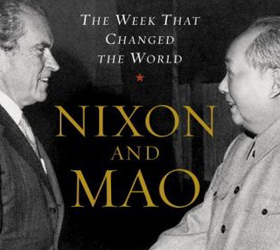
International diplomacy can sometimes come down to the most mundane details. On February 21, 1972, President Richard Nixon prepared to get off his plane in Beijing and he was faced with a crucial decision. Should he take off his overcoat or leave it on? When his staff informed him that Chou En-lai, the Chinese premier, was waiting on the tarmac with his coat securely on, Nixon decided not to remove his own. He hardly wanted to be showing off American superiority in braving the cold. And so Nixon descended from Air Force Oneto begin a diplomatic visit that would reshape the state of international affairs.
The second generation of America’s post–World War II intelligence experts—the ones who inherited the mantle from the WASPs depicted in Robert De Niro’s The Good Shepherd(which opened in December)—were mostly Roman Catholic, the spiritual children of the CIA’s cofounder William Joseph “Wild Bill” Donovan. Most of them, from what we have been able to gather, were devout and patriotic, but more than a few “bent” and ended up selling secrets to the enemy.
In the mid-nineteenth century Delmonico’s, in New York City, was the most famous and probably best restaurant in America. It was the birthplace of chicken marengo, eggs benedict, lobster newberg, and, of course, Delmonico steak. In 1852, near the peak of its fame, it acquired a Swiss-born chef, Louis Fauchère. Around the same time, Louis Fauchère’s family built a small summer hotel in Milford Pennsylvania, near where that state meets New Jersey and New York, and he became its chef. Sarah Bernhardt and Andrew Carnegie and August Belmont and Theodore Roosevelt dined at the place. It stayed in the family for generations and hung on until the 1970s. Now it has reopened, meticulously restored and brought up to date, and with a superb dining room that pays sophisticated homage to the kind of food Fauchère cooked.
The Civil War battle for Fort Donelson, fought 145 years ago today, on February 15, in 1862, was not the largest or most memorable engagement of that long conflict. But it was consequential for two reasons. It marked the first significant Union success after ten frustrating months of bungling by overly cautious and inept generals. And, more important, it launched the career of the man who was to ascend from years of failure to lead the Northern armies to ultimate victory.
In January, Brig. Gen. Ulysses S. Grant had pressed a plan on his superior, Maj. Gen. Henry W. Halleck. Grant thought that his forces, stationed in Cairo, Illinois, could attack south along the Tennessee and Cumberland Rivers into the Confederate heartland (the two rivers intersected with the Ohio just above Cairo). The Confederates had strongly fortified the Mississippi, but those two waterways were guarded by forts that Grant thought vulnerable. Halleck didn’t trust Grant, who had resigned his commission in 1854 with a reputation as a drunk. He refused the request.
It’s known worldwide as a day of hearts, Cupids, and flowers—and big business. Each year, 875 million Valentine’s Day cards are bought in the United States, generating more than $925 million in sales. You could almost think the holiday was created to boost sales. But in fact its roots extend back at least to medieval times and perhaps earlier.
Early Christianity supplied the stories that led to the holiday as we now know it. There were a number of Christian martyrs named St. Valentine, but the day most likely gets its name from an obscure Roman priest named Valentinus, who was active in the second half of the third century. According to the legend that spread during the Middle Ages, Valentinus was imprisoned by the Roman emperor Claudius II for giving aid and comfort to persecuted Christians. After renouncing the Roman gods and even attempting to convert the emperor to Christianity, Valentinus was condemned to death—a gruesome death involving beating, stoning, and beheading.