
At the Movies: Breach
The second generation of America’s post–World War II intelligence experts—the ones who inherited the mantle from the WASPs depicted in Robert De Niro’s The Good Shepherd(which opened in December)—were mostly Roman Catholic, the spiritual children of the CIA’s cofounder William Joseph “Wild Bill” Donovan. Most of them, from what we have been able to gather, were devout and patriotic, but more than a few “bent” and ended up selling secrets to the enemy.
The strangest of them was the FBI’s Robert Hanssen, who was arrested in February 2001 and sentenced to life imprisonment in May 2002. Hanssen’s security breach was the most serious in U.S. history, and had his conviction not come in the wake of 9/11, the investigation and trial probably would have been front-page news.
In Breach, the director Billy Ray, who wrung pulse-racing suspense from the relatively trivial story of a discredited journalist in Shattered Glass, has a great subject in Hanssen, who slipped vital information to the Russians for nearly 22 years. (Among his nuggets were the traveling plans of U.S. Presidents and the identities of American agents abroad, several of whom were later executed.) Ray, working with the scriptwriters Adam Mazer and William Rotko and Hanssen’s former assistant and colleague Eric O’Neill, has crafted a film more focused than the ambitious The Good Shepherd, and it supplies the dramatic punch that that film lacked.
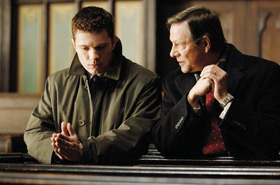
Hanssen, played by Chris Cooper, is a riot of contradictions, all hidden from view by a stony demeanor. Cooper’s Hanssen gives out religious advice faster than a TV evangelist while posting his sexual fantasies on the Internet and attends Mass by day while carrying on an affair with a stripper. He also has had hidden cameras installed in his own bedroom to record himself and his wife. All the while, he confesses regularly to his parish priest.
It’s too bad the FBI didn’t bug the confessional booth. What a treasure trove of secrets those tapes might have divulged, including whether or not Hanssen told his priest about his treason. Such tapes might have provided us with insight into Hanssen’s mind that Breach, sober and well made as it is, simply cannot attain. Like Hanssen, Breach shuts us out. The man is a sphinx without a riddle—or, rather, one with so many riddles that they cancel one another out. His treachery apparently had little or nothing to do with greed; though the Russians paid him well over a million dollars, much of the money was kept in an overseas bank account that he never touched. One is tempted to write him off as a lapsed Catholic, like the former altar boy Christopher Boyce portrayed by Timothy Hutton in The Falcon and the Snowman, someone whose idealistic worldview, when shattered, turned vengeful. But Cooper’s Hanssen seems far too worldly at the start of the movie to have ever been so naive.
Cooper often hints at megalomaniacal madness, suggesting that Hanssen’s real motive may simply have been to prove that he was not only smarter than the Russians but smarter than his own people as well. By all accounts he was a superb agent when not undermining his own work with the other side’s. But the actor is forced to do here what the script doesn’t, namely to supply us with the shading and nuance that would suggest Hanssen’s motives.
Part of the problem is that Cooper is the only major character in Breach. As O’Neill, Ryan Phillippe isn’t given enough to do. Though he shadows Hanssen relentlessly, O’Neill is never established as a character except through occasional contact with his superior and adversary. Laura Linney, a superb actress, has even less to do as another FBI agent. (If the scriptwriters had turned this into a fictional account, sparks would have flown between Cooper’s Hanssen and Linney’s Kate Burroughs.)
Tak Fujimoto’s color photography is subdued and somber, appropriate to its subject, and Mychael Dana’s stark, piano-highlighted score serves as an aural complement to the cinematography. Breach is intelligent, and it’s far from dull. But you may leave the theater feeling about Robert Hanssen the way Churchill felt about the Soviet Union. He’s a riddle wrapped in a mystery inside an enigma.