
Nixon in China: His Finest Moment?
International diplomacy can sometimes come down to the most mundane details. On February 21, 1972, President Richard Nixon prepared to get off his plane in Beijing and he was faced with a crucial decision. Should he take off his overcoat or leave it on? When his staff informed him that Chou En-lai, the Chinese premier, was waiting on the tarmac with his coat securely on, Nixon decided not to remove his own. He hardly wanted to be showing off American superiority in braving the cold. And so Nixon descended from Air Force Oneto begin a diplomatic visit that would reshape the state of international affairs.
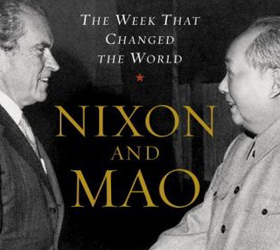
Margaret MacMillan’s new book Nixon and Mao: The Week That Changed the World (Random House, 404 pages, $27.95), describes the diplomatic maneuverings of Nixon’s famed visit in absorbing detail. It’s a formidable work of diplomatic history, and it is all the more impressive for its readability. It focuses mainly on the four principal leaders involved: Secretary of State Henry Kissinger, Premier Chou, Mao Tse-Tung, and the President himself. Some of the most exciting moments come when these four world-class egos are all together. The habitually harsh Kissinger, for example, “was completely entranced” by Chou En-lai, describing him as a “figure out of history” whose personal presence, through a combination of “controlled tension, steely discipline, and self-control,” matched that of Charles de Gaulle.
Like MacMillan’s earlier work Paris 1919: Six Months That Changed the World, the book is not just a narrative of historic events but also a meditation on what it means, and what it takes, to make peace. Nixon and Kissinger began to move toward reconciliation with Beijing in part out of a desire to deepen divisions between China and the Soviet Union. They also did it because they wanted to begin extricating the United States from the Vietnam War. As the secretary of state worked toward reestablishing relations with the Chinese, he did so in an atmosphere of domestic tension. “Nixon and Kissinger knew the damage Vietnam had done to the United States internationally as well as at home,” MacMillan writes. “In the United States, in Congress, on Wall Street, in the churches, in the universities, and on the streets, Americans demanded an end” to the war. Under that pressure, the Nixon administration hoped for China’s assistance in getting out of Southeast Asia.
In return, the United States had to offer Mao’s nation something. Nixon’s bargaining chip was Taiwan. Since the Chinese civil conflicts of the 1940s, Taiwan had remained a breakaway territory. Taiwan claimed independence as a democratic nation, but the Communist government in Beijing was determined to reclaim the island. The United States had long pledged military assistance to the Taiwanese. As the Nixon delegation prepared for the trip to China, it sent signals to Beijing indicating that, for the first time in decades, the American government might soften its support for Taiwanese independence—in exchange for China’s help regarding Vietnam. In preliminary conversations with Chou, Kissinger proposed casting U.S. policy in weakened language: “The United States acknowledges that all Chinese on either side of the Taiwan Straits maintain there is but one China. The United States does not challenge that position.”
After their week of meetings on Chinese soil, Nixon and his entourage seemed to have achieved what they had hoped for. In a memo to Chou, Nixon had succinctly stated his proposed reciprocal agreement: “Taiwan - Vietnam = tradeoff.” The President added: “Let us not embarrass each other.” The two nations didn’t embarrass each other, and they essentially executed Nixon’s tradeoff. The only party subject to embarrassment may have been Kissinger, who found himself the butt of jokes from both Nixon and Mao. For instance, MacMillan writes, “Kissinger, Nixon added, was the only man who could make secret trips to Paris and Beijing without anyone finding out beyond a couple of pretty girls. When Kissinger replied that he had used the girls as a cover, Mao was intrigued: ‘So your girls are often made use of?’”
The public response to Nixon’s trip was mixed. The Taiwanese were understandably upset at the apparent rapprochement between their greatest defender and their greatest antagonist, and conservative opinion leaders were also displeased. William F. Buckley, Jr., declared that Nixon’s meeting with Mao was as outrageous “as if Sir Hartley Shawcross had suddenly risen from the prosecutor’s stand at Nuremberg and descended to embrace Goering and Goebbels.” MacMillan is not caustic like Buckley, but she does question whether the President’s actions were as masterfully effective as he believed. In so openly courting Mao, she writes, “Americans may have unwittingly done more than merely reassure the Chinese leadership; they may have fed into the old Chinese belief that China was at the center of the world.” Indeed, in the long term China may have benefited more than the United States. The United States did manage to extract itself from Vietnam, but before long the Communist North violated its peace treaty with Washington and conquered Saigon. And America’s weakened support for Taiwan has burdened the island nation to this day.
Nixon once dreamed of becoming a President with, as MacMillan puts it, “the charm of a Kennedy and the leadership of a Churchill.” That’s hardly how the world remembers him today, but during that week in 1972 his best talents were on display, and with the collaboration of his fellow statesman, the thirty-seventh President managed to attain his own kind of greatness.