
George Washington’s Indispensable Friend
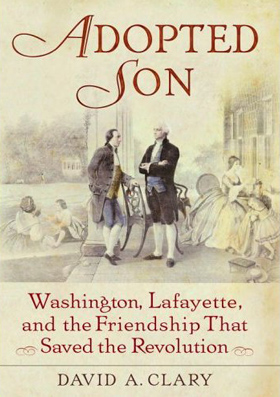
The historian David A. Clary’s new book, Adopted Son: Washington, Lafayette, and the Friendship That Saved the Revolution (Bantam, 512 pages, $27), opens with a startling image: George Washington and the Marquis de Lafayette, curled up together, asleep, on a cloak spread on the ground. The middle-aged commander-in-chief of the Continental Army and the 20-year-old French aristocrat-turned-revolutionary were exhausted in the aftermath of the Battle of Monmouth, New Jersey, in July 1778. The childless Washington and the fatherless Lafayette had known each other for less than a year, but they had already a formed a close, almost familial friendship. Clary argues that that bond was a key to the success of the American Revolution.
Marie Joseph Paul Yves Roch Gilbert du Motier, the future Marquis de Lafayette, was born into the French aristocracy in 1757, and he succeeded to many feudal titles, including marquis, when his father was killed by the English in the Seven Years’ War less than two years later. Like many young men of his class, he served in the King’s Musketeers as a teenager, and he rose to the rank of captain by the time he was 16. He was unusually eager for glory, and he saw his chance in the revolution that was brewing across the Atlantic against the hated British. In 1776, through Silas Deane, the American agent in Paris, he made arrangements to join the Continental Army. His departure made him something of a celebrity in France and may have ultimately played a role in helping to sway French opinion toward the American cause. (France would officially ally with America against the British in 1778.)
When Lafayette arrived on these shores, in 1777, Congress was reluctant to commission him at first. It was reluctant to promote any foreign officer to outrank Americans. But it acquiesced when he said he would serve without pay, as he didn’t, after all, need the money. Congress was eager to have solid connections in France, which he could provide. It resolved that his service be “accepted,” and that in consideration of his “zeal, illustrious family and connexions,” he be given the rank of major-general. It then told him to report to George Washington, whom he already held in awe. The commander-in-chief was immediately won over by what Clary calls Lafayette’s “puppy-dog charm” and “drop-jawed admiration.” And so began a friendship that would last until Washington’s death.
Lafayette proved to be an able soldier. He fought bravely and was wounded in the leg at the Battle of Brandywine in Pennsylvania in September 1777, and soon he was commanding American troops. He was steadfastly loyal to Washington, a quality that the general, who was undermined and betrayed by officers many times over the course of the war, truly appreciated. “I am now fixed to your fate,” the younger man wrote to the older in 1777, “and I shall follow it and sustain it as well by my sword as by all means in my power.” Lafayette even named his own son George-Washington Lafayette, and asked the elder Washington to be the child’s godfather. Their mutual trust paid off: Washington gave Lafayette command of the war’s crucial Virginia campaign, and it paved the way for the Americans’ final victory at Yorktown in 1781.
After the American victory was secure, Lafayette returned to France, and the parting, Clary writes, was difficult for both men. Lafayette wrote to Washington that their separation would bring him “unexpressible pain”; the usually reserved Washington “wept openly at his dinner table whenever he talked of his love for Lafayette.” In France, Lafayette soon became embroiled in the machinations of the French Revolution; his moderate views supporting limited monarchy forced him to flee his country and eventually landed him in a Prussian jail in 1792.
Washington, who had kept in close touch with him, was by then President. Against the advice of his aides, he wrote a personal letter to the king of Prussia pleading for his friend’s release, but with little effect. Lafayette was finally let go in 1797, but he and Washington would never see each other again; Washington died in December 1799. The provision in Washington’s will directing that his slaves be freed upon the death of his wife was, Clary says, almost certainly influenced by his friend Lafayette, who championed emancipation. The friendship did good even in death.
Clary’s book is not without flaws. Like many war histories it can get bogged down in technical details of battles. But its portrayal of Lafayette’s and Washington’s bond is fascinating, lyrically told and touching. “Picture the commander in chief asleep on his cloak after Monmouth, with the boy general curled up beside him,” Clary writes. “That image reflects the enduring truth in their story.”