
Trusted Writing on History, Travel, and American Culture Since 1949
SEARCH 75 YEARS OF ESSAYS!
December 2007
On December 27, 1927—80 years ago today—American musical theater changed forever with the opening, at New York’s Ziegfeld Theatre, of Show Boat. It was a hit from the very start. From its opening tryout in Washington, D.C., through its other out-of-town runs in Pittsburgh, Cleveland, and Philadelphia, it sold out. In New York it ran for 572 performances, a very long run in the 1920s and longer than any other show in Jerome Kern’s career.
It has been filmed three times (the first version, made in 1929, is lost) and has been revived numerous times in major productions, most recently in New York in 1994, when it filled the cavernous Gershwin Theatre for a year and half. No fewer than six of its songs have become standards, including “Ol’ Man River,” now so much a part of the warp and woof of American culture as to be widely regarded as a folk song.
December 25, 1776. On that cold and blustery Christmas Day, the fate of the new American republic hung in the balance. The previous summer, some 30,000 British troops had arrived in New York Harbor and proceeded to rout Gen. George Washington’s Continental Army at the battles of Long Island, Harlem Heights, White Plains, and Fort Lee. Several hundred miles to the North, Gen. Benedict Arnold had managed to hold off the king’s forces at Valcour Island, but he, too, was ultimately defeated. Facing a well-trained and well-armed foe, the Continental Army suffered chronic shortages of food, clothing, and blankets and was buckling under the strain of disorganization and faction.
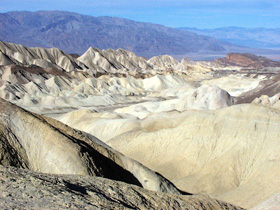
Soon after Halloween 1994, when Death Valley became a national park—the largest national park outside of Alaska—a rock hound friend persuaded me that I had to go see what he described as “strange and compelling,” “geologic heaven,” and, my favorite, “the earth without its clothes.”
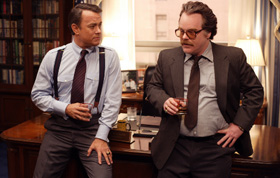
Just when you thought Hollywood had forgotten how to make outrageously funny political satire, along comes director Mike Nichols with Charlie Wilson’s War, which, at a svelte 97 minutes—including credits—is the tangiest refreshment of the holiday season. (And Nichols owed it to us, after doing near irreparable damage to the genre with his bloated and incomprehensible film version of Catch-22, in 1970.)
If you were going to write a history of medical care in America, who would you choose to exemplify its present state? It probably wouldn’t be Adam Goldstein. A diagnosed schizophrenic, Goldstein was convicted of second-degree murder in 2000 after pushing a young woman in front of a subway car.
In many towns across the South, the church steeples create the skyline. For more than 200 years, Southern houses of worship have been the place for commemorating the milestones of a life—birth, marriage, death. And many of those churches have interesting stories to tell. Hit the North Alabama Hallelujah Trail to visit 32 historic churches across Alabama’s mountain-lakes region, and experience the artistry, architecture, and soul of a culturally rich area where many of today’s worshipers warm the same pews as many generations before them.
A self-guided driving tour, the North Alabama Hallelujah Trail includes churches scattered across 16 counties. Each is more than a hundred years old, on its original site, and still holding services regularly.
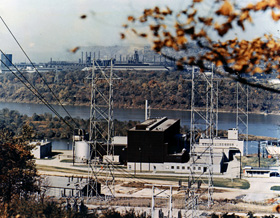
When residents of western Pennsylvania awoke on December 18, 1957, 50 years ago today, they became the first Americans to make their breakfast toast with energy generated by nuclear fission. During the night, the Duquesne Light Company had brought on line the first large-scale commercial atomic generating plant, which had been built in the township of Shippingport, 38 miles northwest of Pittsburgh.
Fifteen years ago today, on December 17, 1992, the North American Free Trade Agreement was signed by the United States, Canada, and Mexico. It created a huge free trade area of more than eight million square miles, 430 million people, and almost uncountable economic resources. It is the largest free trade area in the world in terms of gross domestic product, $15.3 trillion in 2006.
It began as an extension of a 1989 free-trade agreement between the United States and Canada, and it called for the immediate elimination of tariffs on about half the American goods exported to Mexico, and the phasing out of the rest over a period of up to 15 years. In addition, it strengthened intellectual property rights and made the export of American services easier.
Columbus Avenue, on Manhattan’s West Side, is, was, and always will be an adventure in real estate. Still, Penny Whistle Toys has managed to hold its spot for an impressive 25 years on the ground floor of the block-long building named the Endicott, where its large mechanical bear, a sidewalk feature, blows bubbles to charmed onlookers. Lately the bear suffered an accident to one arm, the result of adults playing with it, but it is in repair and will soon be back on the job. But what hopes are there for the shiny new Canine Ranch pet spa, and whither the Indian-themed furnishings store, Ponchicherri, that occupied a sprawling, now vacant corner space until a few months ago? Never mind. Whatever comes and goes, the avenue still has the power to enthrall.
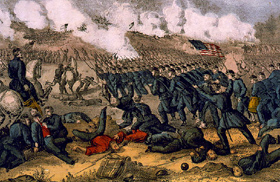
Some of the Rebels in Pickett’s Charge at Gettysburg on July 3, 1863, may have heard the voice of Sgt. Benjamin Hearst before they met the withering Union fire at the stone wall on Cemetery Ridge. Hearst, a veteran with the 14th Connecticut, yelled at the advancing mass, “Now we’ve got you! Sock it to the Blasted Rebels. Fredericksburg’s on the other leg!” And as the doomed men fell, the Federals behind the low stone wall shouted, “Fredericksburg! Fredericksburg!”