
Travel: The Earth Without Its Clothes
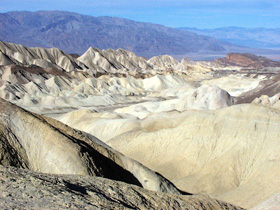
Soon after Halloween 1994, when Death Valley became a national park—the largest national park outside of Alaska—a rock hound friend persuaded me that I had to go see what he described as “strange and compelling,” “geologic heaven,” and, my favorite, “the earth without its clothes.”
I had resisted the area, previously a national monument, for a number of reasons. First, it is one of the hottest places on the planet, with daytime July temperatures averaging 116 degrees, and it is also one of the driest, with an annual rainfall of less than two inches. It is a place of extremes. Badwater Basin, at 282 feet below sea level, is the lowest point in the Western Hemisphere but is a mere 15 miles from where Telescope Peak hits the sky at 11,049 feet.
I resisted, second, because of all the warnings you hear: Carry plenty of extra water; watch out for flash floods; make sure your car is in good repair with plenty of gas, since there are only four stations in an expanse twice the size of Delaware. If you get lost—always a possibility—your cell phone won’t likely work, though you can always try one of the five pay phones in the 3.3 million acres. The adjectives—barren, brutal, desolate—didn’t help, and neither did some of the names: Devil’s Golf Course, Dante’s View. Or the wildlife, including scorpions, kangaroo rats, and rattlesnakes.
Not even the valley’s pioneer history inspires. In 1849 a party of gold seekers, encouraged by what they believed to be a map drawn by the explorer John Frémont, figured the desert valley would make a good shortcut to the California gold fields—a colossal mistake. The group was there three miserable months before they found a way out. Small wonder their parting shot was to give the valley its ominous name, even if only one of them, an elderly man, perished there. It wasn’t the heat that did him in; their ordeal took place in the winter months, when the temperatures range in the sixties and seventies.
Still, I agreed to go that winter a dozen years ago. The moment we paused at Zabriskie Point, all my preconceptions went flying into outer space. I got my first wild glimpse of the rift valley lying below, deep and steep and bathed in a miraculous golden light. It was the earth primeval, from the Precambrian era through the Paleozoic and the Cenozoic. Ice Age lakes left behind carved terraces; erosion was the artist, carving stone and splashing color in great waving arcs.
For three days, with temperatures in the high sixties, we took short and easy hikes into canyons, waking early to see the rising sun turn the Panamint Mountains an amazing bright copper color, and after dark repairing to the swimming pool at the venerable Furnace Creek Inn, heated by a hot spring to a constant 84 degrees. On that first trip, as we floated on our backs and watched the stars in the dark night sky, my rock-happy friend assured me that, having achieved national park status, which brings with it the highest level of protection, Death Valley was safe from encroachment. Nothing was going to change.
This past November I returned to Death Valley, in part to see if anything had changed. It was a perfect blue-sky autumn week, temperatures in the seventies and shirtsleeve comfortable. Once again, our first stop was Zabriskie Point in late afternoon. The walk to the top was easier than I remembered, the view over the desert valley as compelling, with the setting sun sending blazing shrieks of color everywhere, pale pink into violent violet.
The Furnace Creek Inn, that remarkable stone relic from the l920s, continues in its role as a four-star resort, luxurious enough to be listed as one of the Historic Inns of America. It is part of the Furnace Creek Ranch, an oasis that includes a grove of tall palm trees and a surprising splash of green—a golf course, possibly the only one in the world where coyotes hang around the edges waiting to snag unsuspecting migrating geese lured by the greenery.
I retraced my earlier visit, driving south to walk out on the blinding white salt beds of Badwater Basin, then back to the car to drive to the Devil’s Golf Course, followed by a swing through a nine-mile loop known as the Artist’s Drive, a Technicolor geological tour of rock formations in a mélange of rainbow colors that grow in intensity as the light changes. The roads were blissfully empty, and via CD Roy Rogers and the Sons of the Pioneers serenaded me with “Tumbling Tumbleweed” and “Happy Trails.” The trunk of my car held a case of bottled water, and my gas tank was full. All was right in this best of all desert worlds as I headed north toward Stovepipe Wells and the Mesquite Flat sand dunes, 150 feet high.
By late afternoon the dunes had been pocked by thousands of footprints left by the groups that come regularly to hike over them. But the winds often pick up during the night, so the photographers who appear at dawn find pristine dunes, all signs of interlopers erased. Beautiful, but potentially deadly. The Park Service newspaper reported the cautionary tale of a fit young newlywed, intent on hiking to the far side of the dunes in 120 degree heat, who died of heat and dehydration. I continued on to Mosaic Canyon, where the trail is lined by smooth marble decorated with inlaid rocks in patterns; the canyon narrows, rocks crowding in until you are scampering and sliding over them.
This should not be a drive-by park; you need to get out of your car and explore the fascinating canyons and hike the trails. The vastness of the place makes it hard to cover in a few days; I promised myself that this time I would see the curious “Racetrack,” where great boulders have mysteriously rolled, bowling-ball style, across an empty plain. Turns out it is in the far outback, a full day’s trip, preferably by four-wheel drive.
I settled for Dante’s View, an easy short hike ending at a 5,000-foot elevation, and the kind of exhilarating, otherworldly experience that catches in your throat as you look out over the 110-mile-long valley. Then, at a ranger’s suggestion, I drove the looping, dirt road into Twenty Mule Team Canyon, where I couldn’t shake the feeling that the rounded hills in softly wrinkled yellows and grays were really giant animals curled into the landscape, here a camel, there an elephant’s foot. Later I learned that the canyon has had an imaginative effect on others. Scenes from Star Wars were filmed there.
Most of the native desert plants are anemic gray-green, hardly noticeable against the parched terrain. “The earth without its clothes” remains an apt description. Death Valley was markedly unchanged from my first visit. The 95 percent that remains wilderness looks much as it must have looked to the ancestors of the Timbisha Shoshone who moved into the valley far in the past. Their tribal headquarters are near Furnace Creek Ranch.
Still, even with the highest protection of the government, including a ban on hunting and mining, change is inevitable. Nature continually uses wind and water to rearrange the landscape, and humans do their part. There is light pollution from Las Vegas (the swimming pool at Furnace Creek Inn was every bit as warm and inviting, but the stars weren’t quite as twinkling this time) and air pollution from Los Angeles. Even so, the vast empty park is my idea of a winter wonderland.
When to go: Winter, clearly. The Furnace Creek Inn is open from mid-October through mid-May. The people who show up in the summer tend to be Europeans on package tours or foreign automobile makers there to test out new prototypes in Death Valley’s extremes of geography and heat. For general information on the park, visit www.nps.gov/deva.
Where to Stay: The Furnace Creek Inn is the only posh hotel, with view rooms from $275 to $425. Visit www.furnacecreekresort.com. Less expensive accommodations are located nearby at Furnace Creek Ranch, which is open all year. Rooms there are from $119 to $191; it too has a swimming pool fed by a hot spring. The settlement of Stovepipe Wells Village to the north offers 83 “modern guest rooms,” a restaurant, and a pool. See www.stovepipewells.com. RVs are popular in the park, as is tent camping.
Where to Eat: There’s the dining room at the inn, and nearby Furnace Creek Ranch (architecture described as “Early California with Western ‘town’ theme”) has two restaurants, the Corkscrew Saloon, and a general store, as well as a gas station and the park headquarters—always a good first stop to find out what activities are planned and check out conditions in the areas you plan to explore.