
Fredericksburg: A Gettysburg for the Other Side
Some of the Rebels in Pickett’s Charge at Gettysburg on July 3, 1863, may have heard the voice of Sgt. Benjamin Hearst before they met the withering Union fire at the stone wall on Cemetery Ridge. Hearst, a veteran with the 14th Connecticut, yelled at the advancing mass, “Now we’ve got you! Sock it to the Blasted Rebels. Fredericksburg’s on the other leg!” And as the doomed men fell, the Federals behind the low stone wall shouted, “Fredericksburg! Fredericksburg!”
Why did an engagement fought seven months earlier, on December 13, 1862, become a battle cry? Because only now, with the tables so perfectly turned, was the Union avenging its own dead thousands, struck down in front of a different stone wall in what turned out to be the nadir of the war for the North.
A year before Gettysburg, each side thought the war would be a rout in its favor. The events of the summer and fall of 1862 disabused both of that notion. The Rebels invaded Maryland and had a string of victories in Virginia, and Northerners began to doubt Lincoln’s abilities as a commander. Then in September the Union turned back the invasion at Antietam, Maryland, and Lincoln issued his Preliminary Emancipation Proclamation. But in the midterm elections, Republicans took a beating, and to make matters worse the army seemed to squander the momentum it had gained with its victory at Antietam. Lincoln repeatedly tried to stir the commander of the Army of the Potomac, George McClellan, into action, but to no avail. His patience worn thin, Lincoln replaced McClellan with Ambrose Burnside on November 7.
Honest, likable, and modest, Burnside had turned down the job in July and again in September, claiming he was not competent to lead so great an army. He took it reluctantly now at the urging of associates who didn’t want it to go his rival, Joseph Hooker. Days after assuming command of the largest army ever on the American continent, Burnside responded to Secretary of War Edwin Stanton’s request to cable his plans immediately. He announced that the army, stalled since October in Warrenton, Virginia, would march on Richmond via Fredericksburg.
For its timing, the plan was unprecedented. Campaigns in cold weather, when storms often made roads and rivers impassable, were almost unheard of in the nineteenth century. But rather than retire to camp until spring, the Army of the Potomac would try to take the enemy capital. Burnside wanted to shorten his line of communications by marching to Fredericksburg and crossing the Rappahannock River there before Confederate Gen. Robert E. Lee’s army could oppose him. Lincoln approved the plan, saying, “It will succeed if you move very rapidly; otherwise not.”
Burnside did move rapidly. He marched his army 40 miles in two and a half days, arriving opposite Fredericksburg on November 17, well ahead of Lee. Unfortunately, the pontoons he had ordered to bridge the Rappahannock didn’t arrive so swiftly. Communication and transportation snafus had delayed the shipment, leaving him with four options. He could try to cross upstream, but heavy rains rendered the river impassable in that direction. He could try to cross downstream, under the protection of Union gunboats, but miles of bad road lay between, and Confederate strength in that direction was discouraging. He could withdraw and admit failure. Or he could sit tight. So he waited while the pontoons shipped—and while Lee gathered his army across the river.
The pontoons finally arrived on November 25, but lacking bridging material, the army didn’t begin construction until 3 a.m. on December 11. When Confederate snipers shot at the engineers from Fredericksburg windows, the Federals turned their 147 muzzles on the city for two hours. Even that didn’t stop the sharpshooters, and finally a boatload of Union soldiers dislodged them. The Union eventually built five bridges at three points along the city’s riverfront, and divisions began crossing on the evening of December 11.
Had Burnside stuck to his initial plan to attack December 12, you might have read an article on this site yesterday describing the pivotal Union victory at Fredericksburg. Although Burnside, thinking the element of surprise was completely lost, took his time moving the army across the river, Lee expected a battle farther south and held two of Gen. Thomas “Stonewall” Jackson’s divisions several miles downriver until noon on December 12. Instead of attacking, though, the Union army spent the night in town, where soldiers sacked and looted abandoned private homes. They smashed mirrors with gun butts, bayoneted feather beds and family portraits, guzzled alcohol, and dragged pianos into the street to provide accompaniment for their fellow troops, who danced in stolen bonnets, hoop skirts, and silk dresses.
While his men plundered, Burnside planned. He had slept little more than three hours each of the past several nights, but he had devised a strategy that might have worked, if not for undertows within the most political of Civil War armies. He intended Gen. William Franklin to sneak around Lee’s vulnerable right flank in the thick morning fog and attack at the same time as Gen. Edwin Sumner’s divisions assaulted the middle and left.
Jackson’s divisions were not all in place yet on the right, and Franklin might have forced them to retreat. Instead Franklin, loyal to McClellan and suspicious of his new boss’s judgment, waited three hours after receiving the orders to begin the assault on December 13, by which time the obscuring fog had lifted and Jackson’s troops had all arrived. Charging in at the Union’s left with two artillery pieces, 24-year-old Confederate Maj. John Pelham held off the assault for another hour until Confederate Gen. Jeb Stuart ordered, “Get back from destruction, you infernal, gallant fool.” Finally at 1 p.m., after mutual artillery bombardment, the Union infantry advanced, but even then rather than flanking the Confederates they confronted them head on. They managed to break through a weak point between two brigades but were driven back by the second line and didn’t renew the charge.
Meanwhile Sumner’s men were getting slaughtered. Burnside had ordered Sumner to send “a division or more” along the two roads leading southwest out of the city, to seize the hills of Marye’s Heights, held by the Rebels. Burnside had assumed that Franklin would attack the Confederates on the right by then, forcing Lee to reinforce Jackson with troops from the hills. But even if Lee had shifted his numbers, Burnside did not realize how much geography favored his enemy. From the crests of Marye’s Heights, Confederates had a perfect view of both roads and could shell incoming troops.
Once they left the safety of the city streets, the Federals had to cross 500 yards of muddy, open ground, dotted with gardens and a few scattered houses that impeded their advance but offered little cover. A canal obstructed their attempts to flank, funneling their advance against the strongest part of the Confederate line, a sunken road at the base of the hills, behind a four-foot-high stone wall—a perfect entrenchment for Confederate troops.
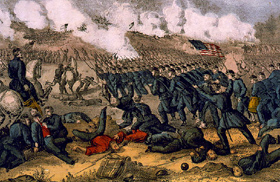
Sumner’s troops could not have anticipated the carnage they were about to face. As soon as they got within range of Confederate guns, they encountered what one soldier called a “perfect sheet of flame.” Entire regiments were mowed down immediately; 40 percent of one brigade went down before they had a chance to fire. Wave upon wave of Federal troops fell before the stone wall, so many that the units pushing forward behind them were slowed by their bodies. Some set up breastworks with the corpses of their fallen comrades. There was so much gunsmoke that they couldn’t see the Rebels, yet the Union forces kept coming.
Burnside, befogged by exhaustion, stubbornly refused to modify his plan and continued to throw men at the wall. Gen. James Longstreet, leader of the corps on Marye’s Heights, assured Lee, “If you put every man now on the other side of the Potomac in that field to approach me over the same line, and give me plenty of ammunition, I will kill them all before they reach me.” By all evidence, he was correct. By the time the battle petered out in late afternoon, 9,000 Union soldiers were dead or wounded in front of the stone wall, their bodies piled three deep. A Union survivor remarked afterward, “We might as well have tried to take hell.”
Of 106,000 Union soldiers who fought at Fredericksburg, 12,700 died or were wounded, compared with 5,300 out of 72,500 Rebels. Cold weather, short rations, and wintertime illness made otherwise survivable injuries fatal. Lee didn’t chase the Union troops straggling back across the river; not guessing the Union casualty figures, he expected renewed assaults the next day and didn’t want to give up his strong emplacements. Burnside did originally intend to redeem the situation with another attack, which he would lead personally, but his subordinates persuaded him not to. Instead the army set out December 15 to cross upstream. However, after three days of marching on icy, muddy roads, they returned to camp, dispirited and out of commission for the winter.
Throughout the North, angry citizens blamed the heavy casualties on Lincoln for forcing a winter battle, on Franklin for delaying his charge, and on Burnside for orchestrating the entire ordeal. Burnside had attacked because he thought the low morale of the country demanded it, but now the Union was worse off. He sent a letter, to General-in-Chief Henry Halleck taking full responsibility for the defeat, and it was published on the front page of The New York Times. The letter may have helped heal the traumatized Union, but it also sealed Burnside’s fate. Lincoln removed him from command on January 26, 1863, replacing him with Hooker after all.
Both sides quickly suppressed the memory of Fredericksburg. Southerners were disappointed because the win had gained them no ground. Lee opined after the war that “victories such as these were consuming us, and would eventually destroy us.” But Fredericksburg offered both North and South an important lesson about using old tactics against new weapons. In the days of smoothbore muskets, soldiers compensated for the guns’ inaccuracy by standing shoulder to shoulder and firing in unison, creating a wall of bullets. But the rifles used in the Civil War were more accurate and shot farther, making short work of dense formations like the Union brigades advancing on the stone wall.
Fredericksburg made these tactical anachronisms grimly obvious, but the moral of December 13, 1862 would take some time to sink in. Unfortunately for Pickett’s men, the lesson would not be learned before the tables were turned at Gettysburg.