
At the Movies: Charlie Wilson’s War
Just when you thought Hollywood had forgotten how to make outrageously funny political satire, along comes director Mike Nichols with Charlie Wilson’s War, which, at a svelte 97 minutes—including credits—is the tangiest refreshment of the holiday season. (And Nichols owed it to us, after doing near irreparable damage to the genre with his bloated and incomprehensible film version of Catch-22, in 1970.)
As you’ve probably heard by now, Charlie Wilson’s War is based on a true story told in the 2003 book of that title by the late George Crile, a 60 Minutes reporter. It’s about a Texas congressman who instigated the largest covert war in U.S. history, the Afghan resistance to the Soviet invasion. (Most of the weapons used—you’ve got to listen carefully in this movie, because the facts are delivered at machine-gun pace—were Russian-made, captured by the Israelis from the Syrians.)
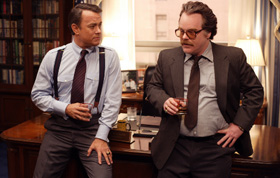
The script, by Aaron Sorkin (The West Wing), exaggerates a bit and gives Wilson more credit than he perhaps earned, which, of course, is inevitable when the lead role is give to a star of Tom Hanks’s stature. In cheesy epics like The Da Vinci Code, Hanks has become too used to simply walking through his roles, but here, walking is suited to the part, and Hanks does it with style. The real Wilson was a genial enigma, a boozing, sometime cocaine-imbibing sleazeball womanizer—one of his relationships was with Diane Sawyer, who is now married to Mike Nichols—who had lost his moral compass. The script suggests that in the Afghan war Wilson saw a chance to do what he regarded as the right thing while having a hell of a lot of fun. Hanks plays him with a small hard nugget of integrity beneath thick layers of candy-coated charm.
Despite a few distortions and truncations of actual events, Nichols and Sorkin have gotten it right, and more than that, they understand that in this story, the real-life characters wrote their own parts. Wilson, a liberal Democrat (“But not,” one of the characters reminds him, “where it counts”) is approached by a Texas socialite named Joanne Herring (played by Julia Roberts), surely the only billionaire in Texas in 1980 with a sympathy for or even a knowledge of the Afghan people. Herring, who later became a popular talk show host, had both money and connections, and Roberts plays her with a zest she hasn’t shown since her Oscar-winning Erin Brockovich seven years ago.
The third leg on this tripod is Philip Seymour Hoffman’s CIA agent, Gust Avrakotos, and it’s a good thing for Hanks and Roberts that Hoffman plays so well with his fellow actors; otherwise, after entering this film as if from a secret side door, he might have stolen it away. We’ve been so bombarded with cinematic FBI and CIA agents of rueful countenance that it’s a pleasure to watch a man at work who enjoys the lying, cheating, and double-talking that go with the job. (It’s hard to tell whether Hoffman gets most of the movie’s best lines or if he just makes them sound that way.)
Crile’s book was more than 500 pages long, and the filmmakers have boiled it down to everything you’d want to see in a movie. If Charlie Wilson’s War has a flaw as a film, it’s that it moves almost too quickly; in addition to the principals, the cast is filled with other terrific actors, including the veteran Ned Beatty as an old-style politician who jumps on Charlie’s bandwagon, Amy Adams (star of the current Enchanted) as Wilson’s starstruck assistant, Ken Stott as the Israeli arms linchpin, and Om Puri (an Indian actor) in a brief but witty performance as a stern-faced president of Pakistan. All of them grease the wheels so engagingly that you may spend more time laughing than thinking about what you’re seeing.
That’s Charlie Wilson’s War’s flaw as history. It’s a bit too effective at producing a “Damn, how did they get away with that?” reaction, and not quite effective enough at reminding us that these people are also in large part responsible for much of the mess we’re in today. But anwyay, it would be too glib to say that Wilson and his cohorts gave us the backdrop that produced Osama bin Laden—about whom, as yet, no one has made a satirical movie.