
January 2011


“Nobody, my darling, could call me a fussy man; But I do like a little bit of butter to my bread.”

Like A. A. Milne’s wistful king, Thomas Jefferson could be pardoned for feeling entitled to just a little consideration. The sage of Monticello, sometime inventor, author of the Declaration of Independence, former President of the United States, and purchaser of 828,000 square miles of Louisiana Territory, was experiencing the same kind of frustration that comes to king and commoner alike.

In 1800 Gilbert Stuart had painted Mr. Jefferson’s portrait. In 1805 he had done another. Mr. Stuart had been paid lor his first effort; but as of August 9, 1814, Thomas Jefferson had received neither portrait.

The former President reached lor pen and paper and addressed a letter to the artist in Boston.
Perhaps the most haunting tear of the American frontiersman was capture by the Indians, an experience of suffering which left a permanent mark on those who were lucky enough to survive it. As long as the Indian threat persisted, captivity accounts appeared constantly. One of the most remarkable examples of this uniquely American literary genre was written by a seventeen-year-old Scot named John Rutherfurd, who was captured near Fort Detroit during the Pontiac Rebellion of 1763. Published obscurely in the nineteenth century, his exciting account is today all but forgotten. It comes to AMERICAN HERITAGE from a New York book dealer, Miss Emily Driscoll, and has been edited by a noted authority on the history of the Great Lakes region, Dr. Milo M. Quaife, of Highland Park, Michigan.

A Man Withdrawn

We like to make thumbnail sketches of our famous men, and to Henry David Thoreau we have given one of the most compact of the lot. We see him as the complete lone wolf, the man who tried to reform the world by divorcing himself from it and reforming himself. Declaring that a free man could not without disgrace associate himself with a government that would make war on Mexico in the interest of the slavocracy, he went to jail rather than pay taxes; then he built a hut by Waiden Pond and lived there in complete isolation, creating his own world when the world other men had created seemed unsatisfactory.

This sketch has the merit of brevity, and it is drawn from life; after all, Thoreau himself provided the outlines. But it is incomplete, for Thoreau kept changing, and he refused to stop thinking after his sabbatical in the lonely cabin; and Leo Stoller tries to bring him into better focus in his perceptive essay, After Walden .


The sun set in a clear sky behind Charleston the afternoon of February 17, 1864. The besieged city lay in defiant silence, watching the Federal monitors at the entrance to the harbor. Out at Fort Sumter, where the war had begun, the faint boom of the sunset gun proclaimed that the little pile of rubble, now scarcely more than a symbol of resistance, was still held by its Confederate garrison. As the shadows lengthened, picket boats put out from the ironclads to begin the nightly vigils which the Federal Admiral John Dahlgren had so insistently prescribed.

Outside the bar, where the wooden ships comprising Dahlgren’s second line of blockade lay guarding the harbor’s entrance, the handsome sloop of war U.S.S. Housatonic prepared for a quiet night. A slight mist lay on the water as lookouts of the first watch took their stations. They were watchful but relaxed; it was not the sort of night a blockade-runner would choose for crossing the bar, and besides, the hard-driving Dahlgren was away on a trip to Port Royal.

I hear America singing,” wrote Walt Whitman in 1860, and on a quantitative basis, at least, the air was as full of quavering voices, scraping fiddles, and tinkling pianos as—in other ways, in different rhythms—it is today. The publishers of the confection at the left, for example, advertised 33,000 different pieces of sheet music in 1867—most of them especially aimed at the family group around the parlor upright. In the days before radio and television and before we developed a special musical form in jazz, this kind of singing was widespread. It was homely and unsophisticated, filled with maidens’ blushes and everyone’s tears, with crude humor and sentiment, and with the same appeals to the headlines which characterize Tin Pan Alley today. And, not to put too fine a point on it, most of this outpouring was as bad as the popular music of our own time—if not a little worse. The era produced Stephen Foster, Dan Emmett, a lew good hymns, and the music of the Civil War; but, in general, America had a tin ear.


In a recent bulletin of the Superintendent of the Census for 1890 appeal these significant words: “Up to and including 1880 the country had a frontier of settlement, but at present the unsettled area has been so broken iiito by isolated bodies of settlement that there can hardly be said to be a frontier line. In the discussion of its extent, its westward movement, etc., it can not, therefore, any longer have a place in the census reports.” This brief official statement marks the closing of a great historic movement. Up to our own day American history has been in a large degree the history of the colonization ol the Great West. The existence of an area of free land, its continuous recession, and the advance ol American settlement westward, explain American development. …

Since the dawn days of historical writing in the United States, historians have labored mightily, and usually in vain, to answer the famous question posed by Hector St. John de Crèvecœur in the eighteenth century: “What then is the American, this new man?” Was that composite figure actually a “new man” with unique traits that distinguished him from his Old World ancestors? Or was he merely a transplanted European? The most widely accepted—and bitterly disputed—answer was advanced by a young Wisconsin historian named Frederick Jackson Turner in 1893. The American was a new man, he held, who owed his distinctive characteristics and institutions to the unusual New World environment—characterized by the availability of free land and an ever-receding frontier —in which his civilization had grown to maturity. This environmental theory, accepted for a generation after its enunciation, has been vigorously attacked and vehemently defended during the past two decades. How has it fared in this battle of words? Is it still a valid key to the meaning of American history?

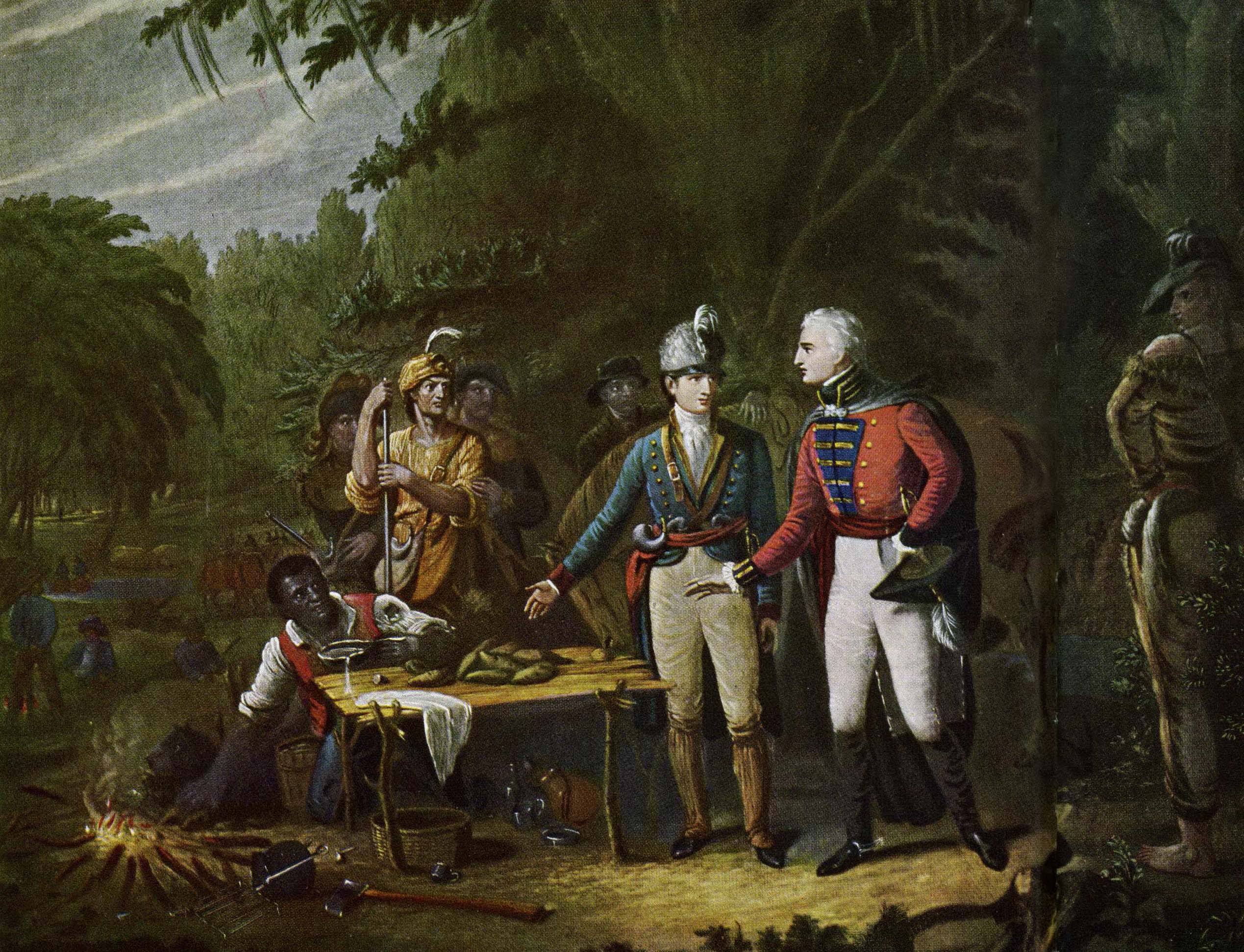
 In John Blake White’s famous painting, Marion offers a British officer a meal of baked potatoes. Legend says that White had sat on Marion’s knee as a child and remembered his features. The painting was reproduced on Confederate currency. Painting courtesy of Life (Harry Shaw Newman, The Old Print Shop)
In John Blake White’s famous painting, Marion offers a British officer a meal of baked potatoes. Legend says that White had sat on Marion’s knee as a child and remembered his features. The painting was reproduced on Confederate currency. Painting courtesy of Life (Harry Shaw Newman, The Old Print Shop) 

The great struggle between the President and the Supreme Court in 1937 stirred the national emotions to unusual depths because it brought Franklin D. Roosevelt’s crusade against depression into collision with one of our most hallowed traditions. And after a lapse of twenty years it remains high on the list of the most dramatic contests in our constitutional history.


Help us keep telling the story of America.

Now in its 75th year, American Heritage relies on contributions from readers like you to survive. You can support this magazine of trusted historical writing and the volunteers that sustain it by donating today.

Donate