
Trusted Writing on History, Travel, and American Culture Since 1949
SEARCH 75 YEARS OF ESSAYS!
December 2006
You’ve probably never heard of Elizabeth Carr. She turns 25 today. Her birthday is worth mentioning for just one important reason: On December 28, 1981, she became the very first baby born from in-vitro fertilization in the United States. She achieved life because of the hard work and technical achievement of two gifted researchers who tackled the scientific problem of IVF late in their lives—and forever changed the possibilities for human reproduction.
In the summer of 1978, two fertility doctors at Johns Hopkins University, Howard and Georgeanna Jones, were getting ready to retire. Before reaching the university’s mandatory retirement age of 65, Georgeanna had been director of its Laboratory of Reproductive Physiology. Howard, her husband and two years her senior, had been the director of the university’s international program on fertility control. Now they planned to spend a few years teaching at Eastern Virginia Medical School, in Norfolk, Virginia, and then, following their three children’s advice, spend their time fishing.
Gerald Ford was perhaps the most gifted natural athlete ever to occupy the White House. Captain of his high school football team and on the varsity of a major football power, the University of Michigan—where he was voted the most valuable player in 1934—he excelled as well in swimming, skiing, tennis, and golf, participating well into old age. It was probably lucky that he was so good at sports, for history has seldom thrown a curve ball like the one it threw at Gerald Ford.
On October 10, 1973, he held the relatively powerless position of minority leader of the House of Representatives, with very limited prospects of ever realizing the greatest ambition of his political career, to one day be speaker. But just 10 months later, on August 9, 1974, he was sworn in as the thirty-eighth President of the United States, the only man never elected to either the presidency or the vice-presidency to hold the office.
On this date in 1900, a 54-year-old Sunday school teacher walked into the most elegant bar in Wichita, Kansas, raised a heavy cane, and began to wreak havoc. By the time she was done, Carry Nation had broken the drinking parlor’s costly Venetian mirror, damaged its life-size painting of a nude Cleopatra, and smashed bottles, glasses, and decanters wholesale.
It was the start of a new phase in what would later be called the “culture wars” in America. Lampooned as a crank, a lunatic, and a menopausal virago by her enemies, Nation was in reality a woman of sincere beliefs who considered her vigilantism thoroughly justified. Her direct action raised questions about the responsibilities of citizenship and the role of government in legislating morality that remain on the front burner of American politics 106 years later.
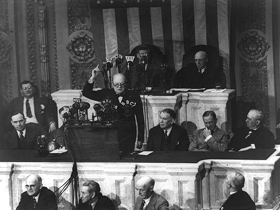
Throughout the World War II, Winston Churchill galvanized the free world with his oratory. After the Battle of France, for instance, he exhorted his beleaguered countrymen to stand so firm that “if the British Empire and its Commonwealth last for a thousand years, men will still say, ‘This was their finest hour.’” In December 1941, 65 years ago today, he spoke before one of his most challenging audiences yet: the United States Congress.

At the turn of the last century, the southern Indiana towns of French Lick and West Baden Springs were bustling resorts, thronged by visitors from all over the country coming to take the waters of the local mineral springs and play at the casinos. Today the two towns sit in one of the poorest counties in the state, but a massive grass-roots renovation project has been restoring two of their greatest hotels to all their former glory.
During the early twentieth century, the neoclassical French Lick Resort Hotel sparkled with stained glass, gilt detailing, and faux marble columns. It was rivaled only by West Baden Springs Hotel, a giant circular structure wrapped around an atrium topped by a huge dome. But the 1929 stock market crash followed by a statewide gambling crackdown halted the flood of wealthy tourists to the region. Eventually the West Baden hotel was sold to the Jesuits for a dollar, and French Lick changed hands repeatedly.
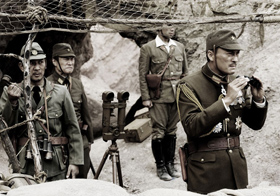
There is no film director of our time whom the majority of critics want to more passionately line up behind than Clint Eastwood. Future generations of film students may puzzle over why they’re supposed to venerate such puffed-up, overinflated works as Unforgiven and Flags of Our Fathers. I’m going to take a stab at the answer now and say it’s because most film critics are born lecturers, and it makes them feel smart to point out all the ways in which Eastwood consciously plays off the work of earlier filmmakers—i.e., how Unforgiven presents the dark side of John Ford’s Westerns, etc.
Ten years ago today, on December 18, 1996, the city of Oakland, California provoked national outrage when its Board of Education voted to classify “Ebonics,” or black English, as a distinct language, rather than a dialect of standard English.
From across the political spectrum and across the racial divide, commentators heaped scorn on city officials. Ellen Goodman, a liberal political columnist, complained that Oakland officials “have made ‘I be’ the linguistic equivalent of ‘je suis.’” Republican Congressman Peter King of New York argued that “Ebonics is the product of radical political correctness and ridiculous Afrocentrism. It is a racial stew of inner-city street slang and bad grammar. It is not a language.”
Three days before Thanksgiving, Brian Whisman slowly lifted the gates that were holding back the Muskingum River, and a rush of water began turning two 40-inch turbines deep below the Stockport Mill Country Inn, in southeastern Ohio. That day the 100-year old former gristmill became the only historic mill in the nation that is returning power to the local energy company—as well as offering paying guests a chance to experience history wrapped in luxury.