
At the Movies: The Good Shepherd
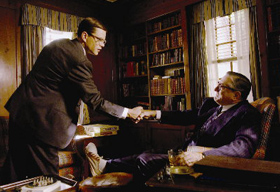
When it works, and it works for much of its two hours and 40 minutes, Robert De Niro’s The Good Shepherd feels like a film version of a John le Carré novel directed by Francis Ford Coppola. It’s about the birth of the Central Intelligence Agency and how it evolved out of the Office of Strategic Services, and it is in fact coproduced by Coppola and directed by one of his disciples (De Niro’s previous directorial effort, A Bronx Tale, was littered with homages to both Coppola and Martin Scorsese). Robert Richardson’s cinematography has the same layered, darkly burnished look as Gordon Willis’s famous shadings in the Godfather films, and the presence of so many carefully etched characters also suggests the Godfather influence.
This is especially true of the lead, Matt Damon’s Edward Wilson, a performance that, in its power and nuance, is reminiscent of Al Pacino’s Michael Corleone in The Godfather: Part II. Damon’s and Pacino’s characters, of course, are so different that it’s doubtful they could sit at the same dinner table and pass the salt to each other. Wilson, from a privileged WASP family, is recruited while at Yale to join the nascent intelligence organization shaped in the British mold. (“You’re going to have to learn the English system of intelligence,” an older officer played by William Hurt informs him.) Eric Roth’s screenplay captures perfectly the smug sense of entitlement and devotion to country that British intelligence imparted to sons of the American aristocracy; it’s the first time anyone has really probed the mentality of the men who gave us the Cold War.
Clearly Wilson is based in large part on James Angleton, who, along with “Wild Bill” Donovan (whose counterpart is played slyly by De Niro), helped form the CIA. Damon is remarkable, giving us a deep portrait of a shallow man, a monster of repression shaped at an early age by his father’s suicide and the patrician values of his social class. Wilson fights his own natural bent for poetry (like Angleton, he’s a devotee of Ezra Pound); his only emotional outlet is building model ships in bottles. His early relationship with Laura, a deaf girl (Tammy Blanchard), perhaps the only chance in his life to find a genuine soul mate, is scuttled for a fling with the sister of a Skull and Bones buddy. Dutifully he marries the girl after getting her pregnant, but since she’s played by Angelina Jolie, the plot hits a snag; Jolie is simply too vibrant to be convincingly pushed into the background, which is where she stays for six years when Edward accepts an assignment in Europe. It might have been more poignant if Jolie had played Laura, with her image lingering in the film as a reminder of the life Edward might have had.
The Good Shepherd is in both its strengths and weaknesses the child of, more than anyone else, Eric Roth. Roth has been trying to get the film made for years—Coppola himself was rumored to be the first candidate to direct it—and he probably wouldn’t have succeeded now if such actors as De Niro, Damon, Jolie, and Hurt, as well as Alec Baldwin, John Turturro, Billy Crudup, Michael Gambon, Timothy Hutton, and Joe Pesci hadn’t signed on, most of them for less than their market-value salaries. Roth, whose screenplays for Michael Mann’s The Insider and Steven Spielberg’s Munichwere more impressive than those films’ direction, is in some ways an old-fashioned, deep-dish writer who develops his characters slowly and carefully, eschewing flash-card psychology and sociology. (He thinks out his characters’ backgrounds beautifully; his Israeli secret agents in Munich open up to each other only around the dinner table.) Roth differs, though, from most of the successful screenwriters of this era in that his plots are devoid of melodrama and movie-ish romanticism.
The Good Shepherd may lose some viewers who are confused by its constant flashbacks, but those flashbacks are part of Roth’s strategy, a way of instantly cutting to an important moment in a character’s life while saving big chunks of what would otherwise be narrative time. Other viewers may be alienated by Roth’s immersions in time and place; it would have been easy, for instance, to write Jolie’s character as a modern woman with a raised consciousness who would appeal to a 2006 audience, but Roth has far too much integrity to go for the easy identification. Only once does he give in to the emotional quick fix: In a scene with an informant mobster played by Joe Pesci, a little door in Wilson’s head opens up and he begins shouting about how America really belongs to his kind, and that Catholics, Jews, and blacks are outsiders. (He seems more offended by Pesci’s being Italian and Catholic than a mobster.) It’s doubtful that such a guarded man as Wilson would have made this revealing outburst, but what he reveals to us is at least something true to his character.
De Niro seems to understand that the detailed, realistic material can’t be molded into conventionally satisfying forms, and he doesn’t try. He never really establishes a rhythm for the film, but, though he never truly builds momentum, he gets the story told by giving his actors space and letting them play out their characters. There’s an intensely riveting cat-and-mouse game between Wilson and his KGB counterpart, code name “Ulysses” (played by Oleg Stefan), which seems to promise that the film is going in a more traditional spy-movie direction. It almost comes as a bit of a letdown when the movie reverts to its somber tone and stolid pacing. But The Good Shepherdmaintains its own stubborn integrity and never violates its own code by trying to make its characters sympathetic. One feels that a real-life Edward Wilson could watch it and acknowledge that he allowed such a life to take away his family and his soul—and still nod approvingly. Yes, he might say, that is how it was. Right or wrong, that is how we were, and that is how it was.