
At the Movies: Letters From Iwo Jima
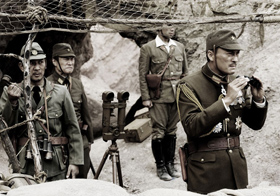
There is no film director of our time whom the majority of critics want to more passionately line up behind than Clint Eastwood. Future generations of film students may puzzle over why they’re supposed to venerate such puffed-up, overinflated works as Unforgiven and Flags of Our Fathers. I’m going to take a stab at the answer now and say it’s because most film critics are born lecturers, and it makes them feel smart to point out all the ways in which Eastwood consciously plays off the work of earlier filmmakers—i.e., how Unforgiven presents the dark side of John Ford’s Westerns, etc.
In any event, a few months ago scores of critics rushed to the front, like Marines hitting the beach, to raise the banner for Flags of Our Fathers, a film that is already fading in memory but from which critical opinion has receded only grudgingly, like Japanese soldiers giving ground on Iwo Jima. Now there’s a critical counterattack, as they rush to argue madly that Letters From Iwo Jima is the film Flags of Our Fathers wasn’t.
Letters From Iwo Jima is the better film, though that isn’t saying a great deal. Eastwood, and apparently many of his supporters, have talked themselves into believing that Letters From Iwo Jima is the first film to empathize with the Japanese Army in World War II; apparently they missed Frank Sinatra’s None but the Brave(1965); John Boorman’s Hell in the Pacific (1968) with Lee Marvin and Toshiro Mifune; and about a half dozen episodes of The Twilight Zone, particularly the one where an American switches identities with a Japanese soldier so that we can see their side of the story. I don’t know how the Japanese feel about Pearl Harbor, but Americans, at least those who run Hollywood, have made a concerted effort over the last half century or so to make up for the racist portrayal of the Japanese in wartime propaganda films.
That said, Letters From Iwo Jima holds together much better than Flags, if only because it’s all of a piece. Working from a script by the first-time screenwriter Iris Yamashita, a Japanese-American, with an assist by Paul Haggis (who contributed more to the enjoyability of Million Dollar Baby and Casino Royale than those films’ directors did), Eastwood delivers a more emotionally centered film than Flags of Our Fathers. Subtlety isn’t in Eastwood’s vocabulary; he paints with colors more primary than a Haitian artist. You could sum up this film by simply saying that it’s built around the responses of a handful of characters—presumably a cross section of the Japanese Army—to their likely extinction in defense of the first U.S. invasion of the Japanese homeland. That it’s a far more satisfying experience than that description would indicate is the result of the simple power of the script and the excellence of the actors, particularly Ken Watanabe, whose performance has transcended the cartoon-like characters he played in The Last Samurai and Batman Begins.
Watanabe’s General Kuribayashi is put in charge of the Japanese defenses of Iwo Jima and quickly perceives that the American assault can’t be stopped on the beaches. He orders construction of the miles of tunnels that turn the battle into a hell for both American and, ultimately, Japanese troops. Kuribayashi is intelligent, cunning, and worldly, having spent time in the United States and made friends with Americans. He has less in common with the Japanese officers in most Hollywood World War II movies, all of whom seem to have gone to school at UCLA, than with Pierre Fresnay’s Captain de Boeldieu in Jean Renoir’s Grand Illusion (1937). Like the officer in the Renoir film, Kuribayashi is a realist; he knows that the war and thus the supremacy of his class is coming to an end.
Since few of the Japanese defenders survive the battle, there really isn’t much of a place for Letters From Iwo Jima to go outside of putting the humanity of the men in bas relief, particularly the working-class characters who are skeptical about the sacredness of the Japanese soil they are defending—a little too much of a nod to liberal Americans who want to believe that, beneath the skin, they’re just like us. (I’d like to know how Japanese of that era feel about such skepticism.)
Still, Letters From Iwo Jima has a fine small-movie feel despite its 140-minute length, and it offers American audiences a nuanced view of wartime enemies at a time when we can use it.