
Mr. Churchill Goes to Washington
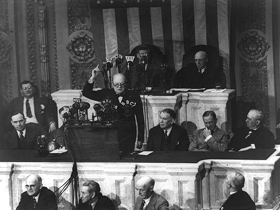
Throughout the World War II, Winston Churchill galvanized the free world with his oratory. After the Battle of France, for instance, he exhorted his beleaguered countrymen to stand so firm that “if the British Empire and its Commonwealth last for a thousand years, men will still say, ‘This was their finest hour.’” In December 1941, 65 years ago today, he spoke before one of his most challenging audiences yet: the United States Congress.
Less than three weeks earlier, the United States had been attacked by Japan at Pearl Harbor, and then Germany had declared war on the U.S. But Americans had still not fully embraced the fact that they were at war. Into this moment of uncertainty stepped Churchill, entering the U.S. Capitol the day after Christmas, 1941.
The prime minister had arrived in Washington several days earlier for an extended conference with Roosevelt. Plotting strategy together, the two leaders were joined by top members of their military staffs, including Lord Beaverbrook, Churchill’s supply minister; Sir Dudley Pound, his admiral of the fleet; and, on the American side, George Marshall, Harold Stark, and Harry Hopkins, among others. The leaders of the two nations would be close collaborators during the years ahead, and the talks covered a range of topics, including the possibility of making a stand against the Japanese at Singapore and the necessity of increasing aid to the Soviet Union. During the meetings the two men added to their number a third head of state, Canada’s MacKenzie King.
On December 23, in the midst of his intense schedule of meetings and strategy sessions, the prime minister received an invitation from Senate Majority Leader Alben Barkley to speak before a joint session of Congress. Churchill agreed. Many members of Congress had already left Washington for the holidays. This meant he wouldn’t speak to all of them, but it also meant that rather than addressing a massive audience in the cavernous House of Representatives, as usual for a guest of his stature, he could use the more intimate and acoustically superior quarters of the Senate.
As he entered that chamber on the afternoon of December 26, he knew the high stakes of the occasion. Anglo-American relations were more important than ever before, and it was his job to rally the spirits of America’s leaders. Furthermore, his speech would be carried by the three major broadcasting companies and beamed across the United States and into Great Britain. Many millions would hear his words.
He rose easily to the immense demands of the moment. His speech, just over half an hour long, struck a tone that was simultaneously comforting, confident, cheerful, and defiant. Raising his hand in the air, he reassured his listeners that they would triumph over foreign aggression, declaring that the Allies were “masters of our fate.” He repeatedly emphasized the shared identity and purpose of the United States and Great Britain, always speaking about them jointly, as “we,” and he dryly referred to his mother’s American roots: “By the way, I cannot help reflecting that if my father had been American and my mother British, instead of the other way around, I might have got here on my own.” In a climactic moment, speaking in steady and rising tones, he delivered a powerful warning against the military foes of the Allies. “Is it possible,” he demanded, “they do not realize that we will never cease to persevere against them until they have been taught a lesson which they and the world will never forget?” As he delivered this rhetorical question, his listeners answered, with thunderous applause.
Later he would call his speech’s warm reception “the finest compliment I have ever received.” The New York Times reported that the broadcast was “heard excellently” by an international audience and reached “millions of homes throughout the British Isles.” In the following days Americans sent hundreds of telegrams to the prime minister, praising his speech and proclaiming their admiration for his resolute leadership. Across the Atlantic, the Times of London and the Daily Telegraph echoed his words and sentiments on their editorial pages.
But before Churchill could receive any of those telegrams or read any of those editorials, he still had business to conclude in Washington. After he pronounced the final words of his speech, he intended to get right back to mapping a war strategy. But pressed for time though he was, he couldn’t resist giving his audience one final piece of encouragement as he walked out of the Senate chamber. At the door, standing beside the sergeant at arms, Churchill turned back to face the chamber and, as the Times described it, “raised his right hand with the first and second fingers extended in the V-for-Victory sign.” On the other side of the chamber, Chief Justice Harlan Fiske Stone returned the salute. A great partnership between nations was underway.