
A Hard Christmas at the Bulge, 1944
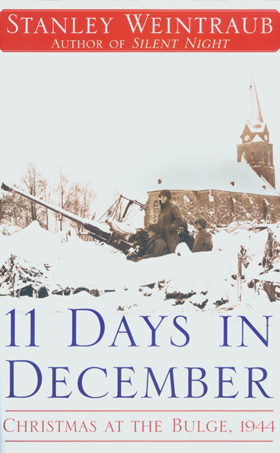
In the fall of 1944 the Allies had every reason to hope that the war in Europe would be over by Christmas, but on December 25, 1944, American troops found themselves stuck behind a new German line. On December 16, 30 German divisions, 10 of them armored divisions, had attacked the American Army along the Belgian-German border, achieving absolute tactical and strategic surprise. The result was the largest battle Americans have ever fought in. Some 640,000 of them took part in the Battle of the Bulge. Stanley Weintraub, Evan Pugh Professor Emeritus at Penn State, has just published Eleven Days in December: Christmas at the Bulge, 1944 (Free Press, 224 pages, $25), his tenth book. Christmas at the Bulge, he shows, was about as grim as it gets. There were POWs who were more or less starving on Christmas Day, and Gen. George S. Patton was praying for divine intervention to allow him to get in some killing on the day of the savior’s birth.
My father, who spent that Christmas in the Ardennes forest, remarked that one eerie feature of the battle was that Allied bombers had passed over the forest for some years dropping shredded aluminum foil to baffle German radars, and that as a result the campaign was fought in a forest full of Christmas trees. It was quite a beautiful battle in that one respect. Weintraub doesn’t mention that particular detail, but he does tell some striking stories, like that of a tiny celluloid doll sent to a Pvt. William Horton. It arrived damaged, with one of its eyes punched out, was promptly dubbed “Purple Heart Mary,” and with mordant humor was hung on a tree as a solitary ornament. There were more than 80,000 American casualties in the Bulge, so a fair number of people could have made that joke.
The actual “bulge” was the dent Field Marshal Gerd von Rundstedt made in the American lines when he launched his offensive. Enjoying numerical superiority of six to one in some places, his forces penetrated 60 miles at their farthest reach, but the shoulders of the Bulge held firm, and American units kept key road junctions. Most crucially, they held St. Vith and other towns in what became known as “the fortified goose egg,” as well as the city of Bastogne, long enough for Gen. Dwight D. Eisenhower to bring up reinforcements, preventing any German breakout. The tenacity of the American troops kept the offensive from achieving any of its goals. The German plan had assumed that St. Vith would fall on December 17, but a scattering of American units held the town until December 21 and the surrounding ground for two days more; they were then pulled out, their work done. For a crucial week they had created a salient that threatened the flank of the 5th Panzer Army and more or less immobilized the 6th SS Panzer Army. Bastogne, surrounded by the Germans on December 20, never fell; Patton’s 4th Armored Division broke the siege the day after Christmas.
The original, madly ambitious German plan had been to drive through Belgium to the port of Antwerp, using captured gasoline to refuel their vehicles. If that plan had succeeded, which no one but Hitler thought possible, it would have split the American and British forces and stranded four Allied Armies behind German lines and without supply. As it was, the Germans barely got to the banks of the Meuse River, and they threw away their last reserves doing so; German casualties were probably around 100,000. The biggest shock was that the almost-beaten Germans had launched a major offensive at all, and the first reaction included some panic both on and behind the Allied lines. Two regiments of one American division were surrounded in the first attacks; nearing the end of their ammunition, food, and medical supplies, and taking casualties from artillery to which they could not reply, they surrendered.
There was enough blame to go around, and it has gone around ever since. Field Marshal Bernard Montgomery, the British general, was delighted to see the Americans embarrassed, and he gloried in having American forces put under his command at the beginning of the subsequent emergency. Weintraub spends a fair amount of space in his short book on the defects of the Allied commanders. Eisenhower is sometimes whistling in the dark, at other times immobilized by his personal guards’ groundless anxieties about German commandos (who actually were real enough; they wore American uniforms and carried American papers). Montgomery is smug and preening. Gen. Omar Bradley, humiliated, refuses to face his own irrelevance to what is happening. Patton is self-loving and bombastic. And so forth. None of these judgments is wholly wrong, but the collective effect seems ungenerous. Weintraub’s relentlessly debunking tone reminded me of Goethe’s remark that “No man is a hero to his valet”—and it also brought to mind Hegel’s rejoinder that this is “not because the hero is not a hero but because the valet is a valet.”
Weintraub does like one American general, Anthony McAuliffe, who commanded the men who became known as “the battered bastards of Bastogne.” McAuliffe’s laconic reply to a demand for surrender (“Nuts!”) went down in history, and Weintraub is happy to preserve its luster. He also likes ordinary soldiers and many officers below the rank of general; he effectively evokes their suffering, and sometimes their achievements. The reader who doesn’t already have a good grasp of the chronology of the battle may find the book a bit hard to follow, since Weintraub moves back and forward in time over his 11 days. This is not a history of the whole of the Bulge but an attempt to give a sense of its most dramatic period. And anyway it isn’t easy to say when the battle ended; Hitler ordered the withdrawal of his divisions from the Ardennes on January 7, but another date for the end of the battle is January 15, when the American pincers of the counterattack met up. My father, whose regiment fought more or less continuously from the December 16 through the next 11 weeks, was never sure why the battle was later thought to have ended at any particular moment.
Weintraub gives the most space to the siege and relief of Bastogne, and he gets across the miseries of the brutal winter weather of blizzards and freezing rain, which intensified the suffering of the soldiers, initially grounded Allied air power, and produced Patton’s meteorological prayers. He also conveys the wretchedness of American prisoners, describes in some detail one of the many massacres committed by the SS, and offers a vivid view of the savagery and effectiveness of Allied air power when the weather finally broke.
For my money what the book lacks is a sense of what was achieved, rather than what was endured. A few years ago I had the good fortune to tour the Ardennes in the company of men who had fought there 60 years earlier. One of them had come ashore on Omaha Beach carrying a Browning automatic rifle. Wounded in the Normandy fighting, he’d been evacuated to England, patched up, and then sent back to the 30th Infantry Division, arriving in time for the Bulge. At that point he no longer carried the Browning, for he had become a telephone linesman. But when the panzers tried to break through the 30th’s very thin line, he was sent forward with an M1 rifle, as was every cook, laundryman, and bottle washer a desperate high command could find. It wasn’t too bad, he told me. The snow was deep, the German armor kept to the road, and when you knocked out one tank the others had to stop, which helped a lot. Then, looking out over a field, he seemed confused, and mildly querulous. There had been more trees in ’44, and fewer houses, and everything had looked different. He glanced down the grassy slope again, his memory kicked in, and his voice became colder and harder. He remembered that an American battalion had been deployed over there, with his own drawn up behind it. The panzers had broken through that first battalion, but here—he pointed a very few feet in front of us—“that’s where we stopped the First SS Panzer Division.” This is not a claim that many people can make, or ever could. It is no longer the fashion for academic historians to communicate a sense of the heroic in war, and this is in certain ways a change for the better. But not in all ways.
Looking at the photographs of American citizen soldiers in the Bulge, with their drab, stained, ungainly uniforms, and recalling the tenacity with which they held vital ground, one remembers with some satisfaction the predictions by their enemies (and by some of their allies as well) that Americans were too soft for the job, and that the winter fighting in the Ardennes would prove it.
Instead, it proved something very different.