Trusted Writing on History, Travel, and American Culture Since 1949
SEARCH 75 YEARS OF ESSAYS!
October 2006
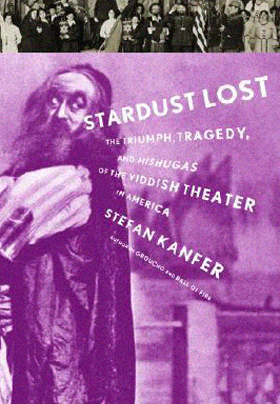
Anyone who’s seen Fiddler on the Roof, in either its stage or film incarnation, knows what a yenta is. A yenta is, in Yiddish, a well-meaning busybody, a gossip, a meddler. The term probably originated with Sholem Aleichem’s now-famous collection of short stories about Tevye, the lovable but unschooled milkman who has five rebellious daughters, a boisterous and opinionated wife, and a world of troubles, both financial and political. Among the play’s colorful cast of characters is Yente the matchmaker, a diminutive marriage broker who pokes her nose in everyone’s business. Hence the term yenta.
“This has been a massive, very expensive effort, because we’ve wanted to bring George Washington back to his rightful place as first in the hearts of his countrymen.” That’s how James Rees, the executive director of Mount Vernon, Washington’s estate on the Potomac River in Virginia, explains the building of the new visitor center and museum there. It opens today, October 27, after 11 years of planning and construction, $60 million of fundraising for initial costs, and another $50 million to endow future operations. The results are truly splendid.
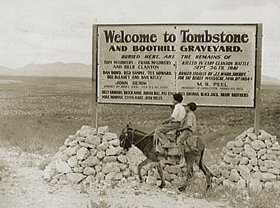
I once asked Johnny Cash what he thought of his reputation as a living legend. “There’s no such things as a living legend,” he replied. “You don’t know if you’re a legend until you’re a legend after you’re fact.” By that definition, the gunfight at the O.K. Corral is one of our most enduring legends.
The fact of it was perhaps 30 seconds long—though in Gunfight at the O.K. Corral (1957) Burt Lancaster and Kirk Douglas padded it out to nearly eight minutes, beating Henry Fonda and Victor Mature’s record in My Darling Clementine (1946) by nearly three minutes.
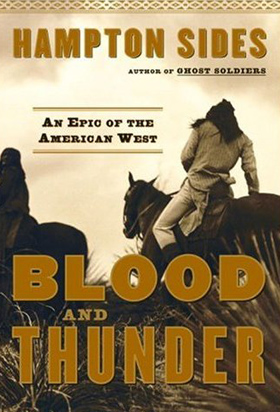
Hampton Sides’s Blood and Thunder: An Epic of the American West (Doubleday, $26.95) is a comprehensive, beautifully written account of the nation’s mid-nineteenth-century expansion to the Pacific under the banner of “Manifest Destiny.”
A hundred and five years ago today, Annie Taylor became the first person to go over Niagara Falls in a barrel. She was 63 years old, a widow, and a failed dancing school teacher—an unlikely candidate for such an exploit. But she survived, and her name goes down in history as not only the first survivor but the only woman ever to try barreling over the falls alone.
At 1:30 that afternoon, she stepped out of a cottage owned by Fred Truesdale, a local river man she had hired to help launch her barrel, and faced a gathered crowd. Demurely dressed all in black, including a big hat with ostrich feathers, she walked to a skiff and rode with the barrel out to a small island a mile and a half above the cataract. There she got out of the boat, hid herself in a clump of reeds, and stripped down to the Victorian version of underwear—a short skirt, a shirtwaist, stockings, and slippers. She was ready for the barrel.
Twenty-three years ago today, more than 300 U.S. Marines were sleeping inside a makeshift barracks beside the Beirut airport as a balmy dawn was breaking over Lebanon, when a smiling man with a bushy mustache drove a Mercedes truck loaded with explosives into the building. The ensuing blast, estimated to be the largest non-nuclear explosion ever, lifted the four-story building off its foundations and caused it to collapse, killing 241 Americans.
Why were the Marines there? Why were they left vulnerable to such an attack? What lessons did and should we learn from the incident? These questions remain as relevant today as they were two decades ago.
When President Ronald Reagan assumed office in 1981, he saw the conflict in the Middle East in terms of America’s ongoing struggle with the Soviet Union. Administration officials pointed to the Soviets as the primary source of world terrorism. Intelligence analysts knew that this was nonsense. In the Middle East, Cold War loyalties were a thin veneer covering far more deeply rooted conflicts.
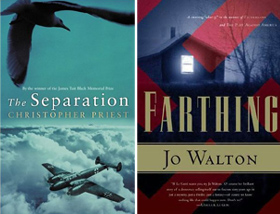
Alternate histories always have a fork in the road of time, a moment where history branches onto the substitute path that the novelist explores. And the forking almost always has downstream effects. The new path, the route between the point of departure from what actually happened and the effects of that departure, is marked out by successive changes, and for the tale to be satisfying, each change must be plausibly linked to its predecessors.
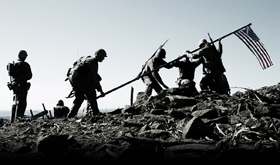
Clint Eastwood seems to have generated a phalanx of critics who are willing to take his films on precisely the terms on which he presents them. Flags of Our Fathers, co-produced by Eastwood, Steven Spielberg, and Robert Lorenz, and co-written by William Broyles, Jr., and Paul Haggis from a book by James Bradley and Ron Powers, is being touted by many in the mainstream press as a powerful war drama that also undercuts romantic notions of war—in other words, a film that will appeal to both the Greatest Generation and the counterculture that rebelled against it. But once initial critical reaction subsides, I doubt that either generation will see its sensibilities reflected in the movie.
“If ponies rode men and grass ate cows,/ And cats should be chased to holes by the mouse,/ If the mamas sold their babies to the gypsies for half a crown;/ Summer were spring and the t'other way around,/ Then all the world would be upside down.” Two hundred twenty-five years ago today, 8,000 sullen British soldiers marched out of Yorktown, Virginia.
According to legend, as the column approached a mile-long gauntlet of smiling American and French troops, the English fife and drum corps played a melancholy march called “The World Turned Upside Down.” There could be no more fitting music for this sunny afternoon. On October 19, 1781, the British army under Gen. Charles Cornwallis surrendered to the Americans, ending the siege of Yorktown—and the Revolutionary War.