
Alternate History: After the Nazis Won World War II
Alternate histories always have a fork in the road of time, a moment where history branches onto the substitute path that the novelist explores. And the forking almost always has downstream effects. The new path, the route between the point of departure from what actually happened and the effects of that departure, is marked out by successive changes, and for the tale to be satisfying, each change must be plausibly linked to its predecessors.
The reader also has to wind up far enough from the point of departure to make things interesting. Most books about a Nazi conquest of Britain, and there are a lot of them, assume a successful Sea Lion, which was the code name for Hitler’s projected invasion, as their point of departure. These books can be disturbing as they trace the downstream effects, but the more you know about Sea Lion, the less persuasive they tend to be, because Sea Lion was almost certainly doomed. Even in the unlikely event that the Luftwaffe won command of the skies over the Channel, German aircraft would probably not have done much damage to the Royal Navy’s capital ships, because Germany did not yet possess an operational air-launched torpedo. Most of Germany’s gravity bombs were 50-kilogram general-purpose munitions, which could not have penetrated the deck armor of a heavy cruiser, let alone a battleship. The German navy, crippled in the Norwegian campaign, could not have protected the slow, unstable and ungainly boats—the wretched prahms—that were intended to carry the invaders. There were fewer than 30 operational German submarines, Germany had lost a large proportion of her paratroopers and air transports in the Low Countries, and logistics for the invasion would have been a nightmare.
What if the alternate historian knows these things? In 2004 Martin Marix Evans published Invasion!: Operation Sealion, 1940 (Longman, $25.95), a book that is half an excellent history of the German and British planning and half an exploration of what would probably have happened had Sea Lion not been called off. The resulting campaign looks like ones that occur in the war games professional militaries have used to assess the likely outcome of Sea Lion. Evans’s Germans invade in September, he gives them every reasonable break, and then he describes the absolutely plausible fighting that results in the destruction of the invaders. And then, somewhat maddeningly, he stops.
On the one hand, this is commendable restraint. We know what would probably have happened in one small part of the world over a couple of weeks in 1940, and at that point the conscientious historian hangs up his spikes, because the ability to project further downstream is the province of the novelist, not of the historian. Still, what happens downstream is what we really want to know, so Evans’s book, while fascinating and immensely competent, is also frustrating. To the best of my knowledge, no one has written a novel imagining a world history in which Sea Lion was tried and failed, although many have written of its implausible success, because that success is so grimly fascinating.
This does not mean that books projecting a successful 1940 Sea Lion are hopelessly implausible; the probable doesn’t always happen. Professional militaries also war-game the 1940 Battle of France, and the French and British almost always win that. But the grossly implausible point of departure has obvious problems for the reader who takes to heart Damon Runyon’s observation that “the race is not always to the swift, nor the battle to the strong, but that’s the way to bet.” We have so many alternate histories with successful Sea Lions because in 1940 Germany looked both strong and swift, and the first generations of World War II history assumed that a plausible alternate path was only narrowly avoided in the summer of 1940. Historians now know better, but until recently alternate history novelists did not.
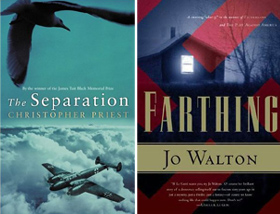
Two alternate histories that share a point of departure, the flight of Hitler’s deputy führer Rudolf Hess to Scotland, on May 10, 1941, have recently been published in the United States. They’re both by writers with greater literary gifts than are usual in this genre, and both are set downstream from that point of departure. Christopher Priest’s The Separation (Old Earth Books, $25) is set in an alternate present, Jo Walton’s Farthing (Tor Books, $25.95) in an alternate 1949. The Separation was first published in 2002, won the Arthur C. Clarke Award and the British Science Fiction Award, and was a finalist for the Sidewise Award for the best alternate history. Late in 2005 it was published in this country by Old Earth Books. Farthing, published this August by Tor, has not yet won any awards, but it deserves some. And both novelists escape the plausibility problem that ensnares most authors who want to unmake the history that flows from Britain’s victory in World War II. If having Hitler defeat Britain by invasion is implausible, why not simply let Britain drop out of the war?
Rudolph Hess sought precisely that end when he flew to Scotland in a Messerschmidt on May 10, 1941, bailed out at 6,000 feet, and demanded to be taken to the duke of Hamilton, whom he had met at the 1936 Berlin Olympics. Hess sought peace between Germany and Britain so that Germany could invade the Soviet Union without a two-front war. In real history Churchill had Hess imprisoned and sought to warn Stalin of the impending German attack; he was ignored, and the attack followed. In The Separation and Farthing, different political forces, for very different reasons, take Hess up on his offer. Britain drops out of the Second World War, and our world is unmade.
The chances of Churchill’s accepting Hess’s offer were minuscule, which is in itself remarkable, because in May of 1941 things looked very bad for Britain. The Soviet Union was allied with Hitler, while the neutral United States was focused more on Japan, with isolationist sentiment still strong. In April Britain had been hurled out of Greece, which Germany had easily conquered, along with Yugoslavia and Italian colonial North Africa. Later in May Germany would take Crete, smashing up the Royal Navy in the process. The Royal Air Force’s ineffectual bombing campaign against Germany was expensive in aircrew and aircraft, and the Battle of the Atlantic would get worse before it got better. Britain was alone, and there was no discernible path to victory.
In both The Separation, an admirably intricate novel, and in Farthing, a clever subversion of the English country house murder mystery, we learn the alternate history that follows the shared point of departure in the most satisfying way, which is fitfully, in bits and pieces. In a conventional novel set in the present you are rarely lectured on the history that has produced that present, so revealing the origins and development of alternate paths only slowly and erratically aids the suspension of disbelief. In The Separation, pacifists and other decent people prevail on Churchill to step down and accept Hess’s offer; in Farthing, right-wing aristocrats replace Churchill and make a separate peace with Germany.
In The Separation, the alternate history that follows is apparently meant to be preferable to the history that actually happened, although few Americans will think so. Hess overthrows Hitler, and the Germany he leads goes on to conquer the Soviet Union but eventually implodes, rather the way the Soviet Union really did. The Americans preemptively invade Japan and then China and then Siberia, and then they too implode, becoming an authoritarian, impoverished, and isolationist society. By the millennium the United Kingdom is the most powerful state on earth, and there is a prosperous and democratic European Union. Churchill agrees to the Rudolf Hess deal to contain the postwar expansion of Communism and prevent the United States from someday intervening in European affairs. With German agreement, England’s military sends many Jews to Madagascar, where they set up the Republic of Masada and start oppressing the native population. They wind up facing terror and national resistance 50 years later, while they (apparently deceitfully) promise the natives some degree of eventual self-rule.
The Separation has numerous admirers—it was very favorably reviewed when it came out in 2002—and it is an elegantly constructed and gracefully written work. But by my lights the downstream effects do not plausibly flow from the point of departure. What is morbidly fascinating about The Separation is its vision of a better world and its confidently low estimate of the cost of achieving that world. The alternate European Union is the highest state of human felicity, the Americans are vulgar, paranoid, wicked, and inept, and war is always evil and never necessary. There is no relationship between the defeat of Nazism and any Allied war effort. In The Separation, anyone who used or threatened force against Communists or Nazis seems at best misguided and at worst morally identical to Communists or Nazis. This alternate Europe has purchased its happiness at the cost of many, many millions murdered or enslaved outside its borders (at a minimum, scores of millions of Slavs), but that is apparently a moral bargain compared to the monstrousness of fighting wars oneself, rather than letting evil clowns like the Americans or Nazis do it for you. At some level, The Separation seems to imply that while George Bush may think he’s Churchill, Churchill in fact verged on George Bush, and a good and just society needs neither.
The Separation is much better as a novel than as alternate history, but as alternate history it is nonetheless instructive, for it is evidence of a flight from what were once understood to be the lessons of World War II. Those lessons, about the occasional terrible necessity of force, are in some quarters apparently now unacceptable, and the solution turns out to be changing the history that generated them, sometimes in fantasy, sometimes in more straightforward ways (in some more orthodox histories, the harsh necessities of Allied strategic bombing have recently been reduced to strategically irrelevant mass murder).
In Farthing, it is pro-German aristocrats, people loosely modeled on our history’s appeasers, specifically the ones known as the Cliveden set, who bring down Churchill and accept Hess’s offer of peace. The novel opens in a 1949 in which Germany is still at war with the Soviet Union—the front seesaws well east of the prewar border—and at peace with Britain, which retains an empire swollen with some war booty extracted as the price of peace with the Reich. An aristocrat’s unconventional daughter, married to a Jewish Royal Air Force veteran, narrates alternating chapters; the others are told from the point of view of a Scotland Yard inspector. The young woman begins the novel at a weekend in the great country house in which she grew up, where a politician has been murdered. The inspector shows up, and the secrets start to come out. This aristocratic world, with a marvelous invented slang, is initially alluring, indeed seductive. It looks like a venue for the upper-class idyll that World War II is generally thought to have destroyed. But after a while, things get very ugly indeed.
The first small secrets are the ones that are normally revealed in country-house murder mysteries—adulteries and other sexual irregularities. The larger mystery eventually disclosed is the nature of the world that a separate peace with a Nazi-dominated Europe might well have produced. Farthing’s new antiwar ruling class dislikes Jews and detests trade unions, and British legislation and custom in this alternate 1949 express those distastes. This class has preserved the façade of parliamentary democracy, but democracy and this sort of elite rule may not be a stable pairing. Jewish Royal Air Force veterans and their aristocratic and idealistic wives may grossly overestimate the durability of the ideals of fair play and the rule of law. Farthingis at first charming and finally harrowing.
It is also a powerful challenge to the alternate path imagined in The Separation. Farthing suggests that the likeliest alternative to World War II was not a world of Guardian columnists spared a guilty conscience over Dresden, and that the people who didn’t want to fight Hitler to the death were at least as likely to be very nasty customers as they were to be people who were more farsighted and historically sophisticated than Winston Churchill.
Until very recently, the sort of people who thought that Britain should have bowed out of World War II were likely to be anti-American ultraconservatives nostalgic for empire. These people suspected that Churchill had made at least a half-conscious choice to forfeit the empire for the total destruction of the Third Reich, and had thereby ushered in not only loathsome American hegemony abroad but equally loathsome social democracy at home. The most recent historian to have articulated a version of this was John Charmley, in his Chamberlain and the Lost Peace, Churchill: The End of Glory, and Churchill’s Grand Alliance. These books make, to most American tastes, a repellant trilogy. Now, rather oddly, this seems to have mutated, at least in alternate-historical fantasy, into an ultraliberal fantasy. While empire goes unmourned, social democracy is purchased at a cheaper price. War, which in real history created a social-democratic European Union, is the sort of thing wicked Americans do, and never to a good end.
Some alternate histories, then, seem less about what might have been than about what supposedly ought not to have been, and the alternate paths they describe are less historically plausible than politically necessary for political battles to be waged without hindrance. Other alternate histories, meanwhile, retain a sharp sense of what might have been and was very luckily avoided. Alternate history is a fairly new and all too often ham-fisted literary form, but both The Separation and Farthing made me think of some very old British literature—Act V, Scene 7 of Shakespeare’s King John:
This England never did, nor never shall,
Lie at the proud foot of a conqueror,
But when it first did help to wound itself.
Now these her princes are come home again,
Come the three corners of the world in arms,
And we shall shock them. Nought shall make us rue,
If England to itself do rest but true.
That was how the history Priest and Walton alter was understood when I was a boy—that with the appeasers discredited, England in 1940 and 1941 was again to herself but true, at which point the three corners of the world did come in arms against her. And she did shock them. At a guess, Walton still sees it that way. She has written a very clever little novel to get her point across.