
At the Movies: Flags of Our Fathers
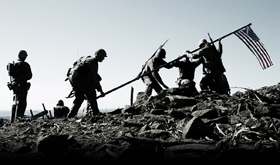
Clint Eastwood seems to have generated a phalanx of critics who are willing to take his films on precisely the terms on which he presents them. Flags of Our Fathers, co-produced by Eastwood, Steven Spielberg, and Robert Lorenz, and co-written by William Broyles, Jr., and Paul Haggis from a book by James Bradley and Ron Powers, is being touted by many in the mainstream press as a powerful war drama that also undercuts romantic notions of war—in other words, a film that will appeal to both the Greatest Generation and the counterculture that rebelled against it. But once initial critical reaction subsides, I doubt that either generation will see its sensibilities reflected in the movie.
For one thing, there’s bound to be some dissatisfaction among viewers, once they’ve seen it, with the way it has been promoted in TV commercials and movie trailers. Though an enormous amount of money and ingenuity have gone into the initial scenes of the assault on Iwo Jima, the bloodiest American engagement of World War II, Flags of Our Fathers deals with the battle at no great length and quickly moves on to the real subject, namely that the famous photograph of the raising of the American flag was used to promote the U.S. war effort in conjunction with a tour featuring the three men in the picture who survived.
Let me pause for a moment. Partly because of Spielberg’s participation, the comparisons between the Iwo Jima landing in Flags of Our Fathers and the D-day assault in Saving Private Ryan are inevitable. Since I wasn’t at either actual event, I’ll just say that Spielberg’s landing strikes me as more realistic; the scenes in Eastwood’s movie are more stylized, with computer graphic images grafted onto the film and the entire sequence shot in a tone that is practically monochromatic.
The viewer will make up his own mind as to which is more effective, but I want to point out that this is the second big-budget war film in recent years to spend tens of millions on an assault scene that has little to do with the main points of its plot. Saving Private Ryan was supposed to be about a squad of soldiers out to rescue Private Ryan, the last sibling in his family to survive World War II. There was little point in recreating the spectacle of Omaha Beach except the obvious one, to give paying customers a large dollop of action. In terms of the plot, the film could just as easily have begun any time after D-day (particularly since Spielberg placed D-day in the context of a flashback by a character who hadn’t fought there).
While watching the actors hit the beach in Flags of Our Fathers, I had a thought similar to the one I had when I saw Saving Private Ryan, which is: Why don’t the filmmakers simply take some of the great battle footage of the actual landings and start the films from there? And once again the answer is obvious. The filmmakers seem afraid to kick off a major World War II drama without the kind of action sequences that are supposed to lure customers. Considering what the rest of Flags of Our Fathers is actually about, the first 15 or 20 minutes seem, in retrospect, gratuitous, except to tell us that war is hell—which we all knew before watching the movie.
So little attention is paid to the specifics of the campaign that we’re never actually shown how and when Mount Suribachi, where the flag was planted, was taken. We are shown how the six servicemen in the most famous photo of the war were selected, and how the picture was staged. We’re told that “the right photograph can win a war,” which certainly isn’t mere rhetoric considering the impact the photo had. Then Flags of Our Fathers turns into an altogether different movie, a story of how the three who survived Iwo Jima—Ryan Philippe as a young medic, Jesse Bradford as the fast-talking ethnic that every platoon or bomber crew is supposed to have had, and Adam Beach as the most famous of the group, a Pima Indian named Ira Hayes—are treated as heroes and sent on a lengthy and elaborate war bond tour around the country.
Eastwood and his writers paint the tour, which takes up most of the film, in a thick coat of irony. Perhaps fearing that the obvious propaganda value of the famous photo and the men who inspired it would be taken as tacit approval of the kind of photo opportunities that helped sell the war in Iraq, Eastwood chooses instead to reveal the exaggeration and exploitation of the myth at every turn. (A ludicrous simulation of the flag raising at a celebration at Chicago’s Soldier Field is greeted by guffaws from the soldiers and will, if the screening I attended is any indication, be taken the same way by audiences.) You might expect the GIs to enjoy their adulation, but we mostly see bewilderment and angst that the war bond effort distorts and caricatures the heroism of their comrades (Beach’s Hayes is given to breaking into tears).
That the story is told in the framework of a Citizen Kane-style investigation by the son of one of the three merely adds another layer of anesthetizing irony. Why, one wonders, couldn’t the whole thing be told in a simple straightforward manner? Why, for that matter, not simply focus everything around one character, such as Ira Hayes (as was done in Delbert Mann’s underrated 1961 film, The Outsider, with an unexpectedly fine performance by Tony Curtis)?
Flags of Our Fathers, like several of Spielberg’s own films, including his recent Munich, doesn’t straddle a fence between patriotism and skepticism but jumps back and forth between the two. The film seems uncentered, and it doesn’t help that parts of it often feel derived from other films; for instance, the bond rallies echo a smarter and more successful treatment of the same theme in the circus-like press events for the astronauts in Philip Kaufman’s The Right Stuff (1983). It also doesn’t help that two of the strongest presences in the movie, Barry Pepper and Harve Presnell, were also in Saving Private Ryan. Or that Beach played practically the same role, that of a conflicted American Indian, in John Woo’s South Pacific war film, Windtalkers, only four years ago.
Flags of Our Fathers, though, has a larger problem that, as far as I’ve been able to determine, has as yet gone undiscussed by Eastwood’s acolytes. Why, exactly, do we need an ironic treatment of the story of the Iwo Jima photograph and the uses to which it was put by the U.S. government? I’m not aware that it was ever a secret that “Raising the Flag Over Iwo Jima” wasn’t an actual battle shot, and I doubt that any Americans would have felt betrayed had they known that from the outset. I thought just about everyone was prepared to accept the photo as symbolic of the heroism exhibited by the U.S. troops on that day, and that in fact the men who fought on Iwo Jima regarded it as fortunate that the picture immortalized their sacrifice for all time. As for the bond drive, it isn’t clear to me how the excesses of the government’s campaign falsified the courage of the troops. Since Eastwood and Spielberg accept the obvious, that U.S. action in the Pacific was legitimate, why should the hype used to raise money to fight a war that must be fought be viewed as ironic or hypocritical? Exactly what myth does Eastwood feel he is debunking? Rather than feel stirred, the viewer is likely to leave the theater wondering just that.