
125 Years of the O.K. Corral
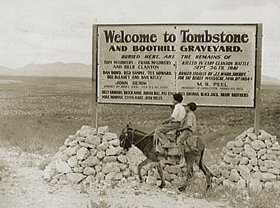
I once asked Johnny Cash what he thought of his reputation as a living legend. “There’s no such things as a living legend,” he replied. “You don’t know if you’re a legend until you’re a legend after you’re fact.” By that definition, the gunfight at the O.K. Corral is one of our most enduring legends.
The fact of it was perhaps 30 seconds long—though in Gunfight at the O.K. Corral (1957) Burt Lancaster and Kirk Douglas padded it out to nearly eight minutes, beating Henry Fonda and Victor Mature’s record in My Darling Clementine (1946) by nearly three minutes.
Today, October 26, marks the 125th anniversary of the street fight, as it was called at the time, and as thousands of tourists jam the streets of Tombstone to attend forums and watch reenactments, it’s fairly obvious that the Gunfight at the O.K. Corral is firmly entrenched in American mythology.
In fact, it seems that to some of our neighbors the gunfight is an enduring symbol of American character flaws. A few years ago when negotiations between General Motors and the United Auto Workers were getting tense, the Toronto Star cautioned them, “Both could learn a lesson or two from the gunfight at the O.K. Corral.” And in 1998 a newspaper in Singapore, accusing the Clinton administration of saber-rattling, warned that “a trigger happy American blazing away to glory like Wyatt Earp at the O.K. Corral, inspires no confidence in its role as a global policeman.”
Tell that to the Marine officer who landed in Somalia in 2003 and declared, “This may be the O.K. Corral, but we’re Wyatt Earp.”
Actually, it was Virgil, Wyatt’s older brother, who was town marshal in 1881. The gunfight wasn’t fought in the O.K. Corral, but in a lot in back of the O.K. Corral next to Fly’s Photography Studio, and it spilled onto Fremont Street, now Highway 80. And it wasn’t so much a gunfight as an arrest gone wrong. Outside of that, Hollywood has gotten most of it right.
The movies generally portray the gunfight as a result of personal antagonisms between the Earp brothers and the “Cow-boys,” at the time a standard euphemism for cattle rustlers. Trouble had been brewing between the Earps and Cow-boys for two years—the rustlers had been stealing cattle in Mexico and murdering with impunity—but the immediate cause of the fight was a deal Wyatt made with one of them, Ike Clanton. Some of Ike’s friends had killed a stage driver during an attempted holdup; Wyatt, who wanted to seek the lucrative office of county sheriff, thought their capture would win him votes. Ike wanted the reward but panicked when word got out that he had made a deal with Wyatt Earp. He probably instigated the fight by goading his younger brother, Billy, and Tom and Frank McLaury—fences for stolen cattle if not actually rustlers themselves—into confronting the Earps.
That the fight became legendary astonished Earp, a buffalo hunter, gambler, shotgun guard, saloon keeper, boxing referee, faro dealer, and peace officer, who was born on March 19, 1848, in Monmouth, Illinois, and died in Los Angeles in 1929. The Tombstone gunfight was his first and only classic face-to-face shootout. In cow towns like Dodge City, he was renowned for his ability to keep the peace without firing a gun; the men he killed in the lot in Tombstone may have been the first he ever shot.
Since his death, Wyatt Earp’s image has gone through several phases. First, in the 1930s, he was evoked as an antidote to big city gangsters like Al Capone and Dutch Schultz. In the second, from about the end of World War II through the Eisenhower era, he stood for America's Cold War resolve, holding the thin blue line in defense of democratic ideals. By the late 1960s his name was linked with predatory white America. In a 1971 film, ‘Doc’, a Vietnam War allegory with a script by Pete Hamill, Wyatt was a sadistic bully who made Lyndon Johnson-type speeches over murdered enemies.
The real Wyatt Earp might be best described simply as an adventurer. He and Josephine Sarah Marcus, a Jewish actress from New York whom he met in Tombstone, roamed boomtowns and mining camps from Arizona to Alaska, making and losing fortunes. They finally settled into genteel poverty in Los Angeles. They were together for nearly 47 years. Earp was a minor celebrity in his later years, lionized by the likes of Jack London, Charlie Chaplin, John Ford, William S. Hart, and Tom Mix, on whose films he did some advisory work. But he couldn't escape the memory of the gunfight in Tombstone. He still hasn’t, and if the crowds roaming the streets there this week are any indication, he never will.
Why did history and Hollywood choose to make the gunfight at the O. K. Corral immortal? A partial answer is that Americans have always looked to the West—to the Alamo, to Custer’s Last Stand, to the O. K. Corral—for defining moments in our national character. Jeff Morey, the author of the forthcoming Blaze Away: The O.K. Corral Gunfight in Legend and Fact, says, “The shootout continues to fascinate because it has all the elements of classical mythology while being anchored in hard reality.” The Earp biographer and Arizona Territory historian Tim Fattig writes, “The Tombstone story, and, particularly, the episode we thing of as ‘the gunfight near the O.K. Corral,’ is nothing less than America’s contribution to world myth. As history goes, it is not very elevated, but as legend, it is potent.”
Another reason for the story’s lasting power is that in time, historians came to see the Earps and the Cow-boys as representatives of opposing cultural and political forces. The Earps were Republicans who worked for Eastern capitalists like Wells Fargo—in the words of one sociologist, “incorporation gunfighters”—while the Cow-boys were “resistance gunfighters” with “Southern Democratic values,” if such values can be stretched to include cattle and stagecoach theft.
There were also issues of jurisdiction that echo to this day. Who had the authority, Town Marshal Virgil Earp (also a deputy United States marshal) or the county sheriff, John Behan, a political rival to the Earps and an ally of the Cow-boys? (To add spice to the debate, Josephine Marcus had left Behan for Wyatt before the gunfight.) The Earps, as the only Federal law in their part of the Arizona Territory, were regarded by many locals with the same contempt that right-wing Westerners still hold for Washington.
And of course there’s the ongoing debate regarding the U.S.-Mexican border. In the Earps’ day, the problem was mostly caused by Americans—the Cow-boys—crossing to the Mexican aside, mostly to steal cattle or to prey on traders and smugglers, and the complaints were from the Mexican government. After all, Arizona and the entire U.S. Southwest had been part of Mexico as late as 1848. The area was taken by the United States in what not only Mexico but many Americans, including Abraham Lincoln, regarded as an unjust war, an ugly fact that has somehow escaped the current controversy over illegal aliens.
Why Wyatt Earp has been singled out is a more complex question. The answer may have less to do with the gunfight than with what followed it. In retaliation for the Tombstone fight, Virgil and Morgan were ambushed, and Morgan was killed. Wyatt then formed a posse and hunted down the assassins, bringing back no prisoners. He never apologized for his actions, and he died without finishing his autobiography. Ever since, people have been trying to claim him for their own and put words in his mouth.
In 1931 a former press secretary to Theodore Roosevelt named Stuart Lake published the hugely successful Wyatt Earp, Frontier Marshal. About half of it was fiction and the other half exaggerated truth, which would prove to be more truth than in most subsequent books on Earp. Most Earp scholars now dismiss The Earp Brothers of Tombstone, by the Pulitzer Prize winner Frank Waters, supposedly the memoirs of Virgil’s wife Allie, as fraudulent. Waters’s papers at the University of New Mexico in Albuquerque reveal practically nothing to substantiate most of the statements allegedly by Allie Earp in the book. Waters’s book has been the leading source for anti-Earp historians since its publication in 1960, and its recent debunking has generated the need for a whole new look at the Earp-Tombstone story.
Another much publicized hoax was I Married Wyatt Earp, supposedly the memoirs of Josephine Marcus, edited by Glenn G. Boyer and published for more than 20 years by the University of Arizona Press before being exposed as a fake. (Her real unfinished memoirs remain unpublished, though available in collections at the Arizona Historical Society and other libraries.) Unfortunately, books derived from Boyer’s bogus work pollute much of the literature being sold to tourists in Tombstone this week.
It’s probably a safe bet that the O.K. Corral will go on being a legend, and in another couple of decades Hollywood will again visit the Tombstone of the early 1880s. No matter how the movies choose to interpret the gunfight and its aftermath in future films, it’s a healthy sign that the street fight in Tombstone is still being used to make one point clear, namely the limits of force and the irreversible consequences of violence even when it’s justified. As Steven Lubet, the author of Murder In Tombstone(Yale University Press, 2004), puts it, “The line from Wyatt Earp to Amadou Diallo [an unarmed African man shot 19 times by four New York City policemen in 1999 in a case of mistaken identity] may be a metaphor, but it is a powerful metaphor that has had an impact on perceptions of law enforcement for more than a century. To critics, an overzealous police officer may be a cowboy, but to many citizens, an effective cop is today’s counterpart of the frontier marshal, using badge and gun to impose peace on troubled streets—with as much force as necessary.”