
Kit Carson: Both Hero and Villain?
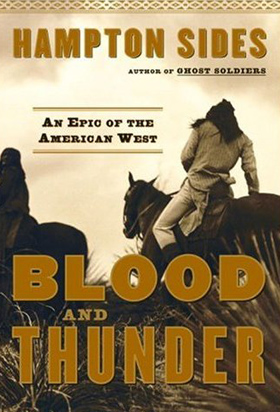
Hampton Sides’s Blood and Thunder: An Epic of the American West (Doubleday, $26.95) is a comprehensive, beautifully written account of the nation’s mid-nineteenth-century expansion to the Pacific under the banner of “Manifest Destiny.”
Between the 1840s and 1860s, the United States warred against two foes, Mexico and the Indian tribes of the Southwest; the latter, especially the Navajos, were by far the more tenacious. Sides hangs his narrative on a central character in those battles, the trapper, scout, and soldier Kit Carson, whom the author found popping up again and again at critical episodes in the winning of the West. “Out here in the West,” Sides said recently, “Carson is like a jack-in-the-box.”
In Sides’s view, the chief agent of Manifest Destiny (the term was coined in 1845 by a New York City newspaper editor) was the nation’s eleventh President, James K. Polk. A dour, charmless, and immensely energetic character, Polk, elected in 1844, engineered the Mexican War of 1846 to ’48, America’s first foreign military intervention. During his single term the United States seized from Mexico an area half as large as the existing U.S.A, some 1.2 million square miles. “It was a bald land grab of gargantuan proportions. . . . Perhaps to dignify the nakedness of Polk’s land lust, the American citizenry had got itself whipped into an idealistic frenzy, believing with an almost religious assurance that its republican form of government and its constitutional freedoms should extend to the benighted reaches of the continent then held by Mexico, which, with its feudal customs and Popish superstitions, stood squarely in the way of Progress.”
Sides follows General Steven Watts Kearny’s 2,000-mile march, with his Army of the West, from Fort Leavenworth in the Kansas Territory all the way to Los Angeles. Encountering surprisingly little Mexican resistance, Kearny, a fastidious Easterner often called the father of the American cavalry, claimed the New Mexico territory (present-day New Mexico and Arizona, as well as parts of Colorado, Utah, and Nevada) and the grand prize, California. Standing before the Pacific, one of Kearny’s Midwesterners exclaimed, “Lord! There is a great prairie without a tree.”
Just as fervent an advocate of westward expansion as Polk was the Missouri senator Thomas Hart Benton, “one of the lions of the Senate at a time when the Senate was full of lions—roaring egos like Henry Clay, Daniel Webster and John C. Calhoun.” Benton’s most concrete contribution to American empire was to procure for his ambitious son-in-law, the topographer John Charles Frémont, the assignment of mapping the still-sketchy Oregon Trail. “Hoping to encourage a full-scale wave of emigration, Senator Benton and others realized that what settlers most sorely needed was a foolproof map and guidebook.” After two expeditions, in 1842 and 1843 to ’44, Frémont provided just that. Published in 1844, Frémont’s account of his treks, from Kansas clear out to Oregon, “set in motion one of the great mass migrations of history,” as thousands of settlers headed west.
Frémont was lionized in the press as the “Pathfinder,” a name taken from James Fenimore Cooper’s Leatherstocking Tales, but the sobriquet really belonged to the scout Frémont had fortuitously hired for his expeditions, Christopher “Kit” Carson. A Missourian born in 1809, Carson had headed west as a teenager to become one of the most redoubtable of the fur trappers and explorers already being mythologized as “mountain men.” “The special thing that Carson had,” Sides writes, “couldn’t be boiled down to any one skill; it was a panoply of talents. He was a fine hunter, an adroit horseman, an excellent shot. . . . As a tracker, he was unequalled.” But Carson’s skills were only part of the package. He was cheerful, had a wry sense of humor, and was unfailingly honest. “Carson and Truth,” said Frémont, “are one.” Thomas Hart Benton praised Carson as “a man whose word will stand wherever he is known.”
He was also, Sides tells us, “a natural born killer.” Carson’s cold-blooded brutality was never unprovoked—he acted either in reprisal or under orders—but he “could be brutal even for the West of his day.” Sides points out another vital contradiction in Carson’s character. Though he was on sympathetic, intimate terms with the Indians of the West—he married two of them—he was also a ruthless Indian killer. Blood and Thunderdescribes in detail the massacre of an entire Indian village that Carson carried out under Frémont’s command. This and other murders—the term isn’t exaggerated—that Carson committed under orders lead Sides to speculate that “Carson seemed incapable of resisting an order” he might personally disagree with. “When given a command, he was the good soldier; in such situations, his trigger-finger did not communicate with his conscience.”
After General Kearny and his Army of the West had more or less effortlessly penetrated the New Mexico territory, Kearny began to realize that “the real war in New Mexico was not between the Americans and the Mexicans, but rather between the nomadic Indian tribes and everyone else. He had stumbled into an age-old conflict that showed no signs of abating with the American presence.”
Of the Southwestern tribes, none was more intractable than the Navajos, who for several hundred years had lived largely by raiding New Mexican settlers for sheep, goats, and horses. Halfway through Blood and Thunder, the U.S.-Navajo struggle emerges as the book’s central theme. After the Americans conquered New Mexico, they signed a series of treaties with the Navajos to ensure that the tribe cease its raids. “New Mexico has been attached to our government,” an American officer explained at a U.S.—Navajo parley. “Now, when you steal property from New Mexicans, you are stealing from us. When you kill them, you are killing our own people. . . . This cannot be suffered any longer.” The Navajos signed the treaties and went right back to their old ways; as far as they were concerned, “the bilagaana [white man] would leave and go back to wherever they came from, and the raids against the New Mexicans would resume as usual.”
Matters changed when Brig. Gen. James Henry Carleton became military commander of the New Mexico territory, in 1862. “These Navajo Indians,” Carleton declared, “have long since passed that point when talking with them would be of any avail. They must be whipped and fear us before they will cease killing and robbing the people.” On an exploratory trek in the early 1850s, Carleton had stumbled across a fertile valley on the Pecos River just west of the Texas border. Gradually, an idée fixe took shape in his mind: This spot, known locally as the Bosque Redondo, or Round Forest, would be the perfect place to turn the Navajo into a sedentary, peace-loving, farming people—Christian, of course. “The only peace that can ever be made with the Navajos,” Carleton wrote, “must rest on the basis that they move onto the lands at Bosque Redondo . . . become an agricultural people and cease to be nomads. Entire subjugation or destruction . . .
are the alternatives.”
But first the Navajo would have to be flushed from their rugged red-rock homeland in what is now Arizona. An all-out war would have to be waged against them, “a kind of persistent guerilla activity combined with a ruthless scorched-earth policy—to chase and starve them into submission.” Carleton had the perfect commander in mind: Carson, who had proven his command ability as a Union colonel in the Civil War’s western theater. Carried out in 1863-64, Carson’s pitiless, no-holds-barred campaign against the Navajos accomplished what no other effort had been able to do—bring the proud people to their knees. A Navajo friend of Sides’s told him, “We think of Kit Carson the way Jews think of Hitler.”
Carson’s mission accomplished, some 9,000 Navajos were marched 400 miles to the Bosque Redondo, a forced relocation second only in American history to the Cherokees’ Trail of Tears. The Bosque Redondo agricultural-cultural experiment proved an utter disaster. Crops failed, the Navajo refused to adapt to a sedentary life, and they plunged into abject poverty. Three thousand Navajos, a third of the captives held there, died at Bosque Redondo. In 1868 they were permitted to return to their ancestral home. Today it is the largest Indian reservation in America.
The same year the Navajos returned to their land, Kit Carson died in bed. He had long figured in the national imagination. Since the late 1840s he had been the hero of dozens of fictionalized potboilers known as “blood and thunders.” Celebrating Carson as nature’s nobleman, a figure of infinite pluck and chivalry, the blood and thunders created an image that Carson spent the rest of his life trying to live down. As Sides recently explained, Blood and Thunder made a perfect title for this book, which masterfully “examines the tension between the glorious myth and the brutal reality of Carson’s West.”