
The Greatest Inventor Dies
“I suggest that all individuals should extinguish their lights for one minute on Wednesday evening, October 21, at 7 o’clock Pacific Time, 8 o’clock Mountain Time, 9 o’clock Central Time and 10 o’clock Eastern Time,” President Herbert Hoover announced on October 20, 1931. Households across the country complied, and in those 60 seconds America recalled a different world—a world before miracles were routinely summoned with the flip of a switch, before sound could travel not only oceans but decades, before acetate could immortalize movement, before ingenuity conquered night: a world before Thomas Edison. America sat in darkness that fall evening to mourn the nation’s most prolific inventor, who died on October 18, 1931, 75 years ago today.
Edison departed a country much changed from the one he had been born into 84 years earlier. The sickly Ohio youth had only four years of formal schooling, but a lifelong yen to read whatever he could get his hands on, combined with a compulsion to experiment, taught him the basics in a wide range of subjects. An only child, he was rebellious and self-centered, and from an early age he hated being told what to do or think. At 12 he began work as a salesboy on the Grand Trunk Railway, but he continued his self-education. He set up a chemistry lab in the baggage car, which, predictably enough, caught fire. Around this time he lost most of his hearing, although whether because his boss boxed his ears or as a result of another injury or illness is lost to the vast Edison legend.
In 1862 he took a job as a telegraph operator in Port Huron, Michigan. At the time telegraphy was the only major industry to have harnessed electricity. Edison would change that, of course. By 1868 his tinkerings with telegraph equipment had evolved into his first official invention, an electronic vote recorder. He received a patent on October 28, 1868—his first of 1,093.
That year he quit the telegraphy business to concentrate full-time on invention. Over the next several decades, his labs in Menlo Park, New Jersey, New York City, and Newark turned out one seminal innovation after another. He developed the phonograph and an improved telephone transmitter in 1877; two years later he perfected the first long-lasting light bulb. To create a wider market for his inventions, he opened the first commercial electric station in 1882. He went on to produce the Kinetoscope—forerunner to the movie camera—in the 1890s. A phenomenon he had discovered back in 1880, the “Edison effect,” paved the way for the radio vacuum tube decades later. Each of these discoveries would spawn an entire industry.
What made Edison so successful? For one thing, he worked hard. He would hole up in his lab for weeks at a time, sleeping on unused tables and eating meals delivered by his wife. He also investigated only what he deemed “practical.” “Anything that won’t sell, I don’t want to invent,” he explained. Countless inventors have died in obscurity because the world wasn’t ready for their ideas, but whenever Edison was ahead of his time, he waited for the world to catch up. He also pushed his products relentlessly in press interviews, capitalizing on a growing public fascination with the “wizard of Menlo Park.”
His self-promotion unfortunately tended to obscure the achievements of his collaborators. “Edison is in reality a collective noun and means the work of many men,” said Francis Jehl, one of his assistants. For nearly all of his inventing career, Edison worked with talented partners, including Charles Batchelor, Francis Upton, Jim Adams, William Kennedy Laurie Dickson, and Nikola Tesla. (He prized a keen mind above formal scientific education in his coworkers. “Trouble with these damn graduate chemists,” he once complained. “They think they know everything. I can’t tell them anything.”) If he hogged too much credit, it was nevertheless his personal dynamism that pushed his team to its discoveries.
By the late 1920s, though, the dynamo was slowing down. Edison had long suffered from diabetes and stomachaches, and now he focused his experiments on his own health. The results proved disastrous. To find out what might relieve his pain, he tinkered with his meals, trying different foods in varying amounts. When he concluded that milk made him feel better, he removed everything else from his diet. From 1928 through 1931 he ingested a pint of milk every three hours and nothing else. He didn’t even drink water. In May 1931, ashen and weak from malnutrition, he cut himself down to seven glasses of milk a day. Low on fluids, his kidneys could not eliminate waste effectively, and he developed uremia and nephritis.
His doctor begged him to eat normally, but Edison, ever the iconoclast, refused. He also declined to bathe, exercise, use an oxygen tank, or be x-rayed, and he continued to smoke cigars and chew tobacco. He had recovered, Lazarus-like, from many serious illnesses over the course of his life, and he assumed he would bounce back this time too. By September, though, he was confined to bed. Reporters crowded the garage on his West Orange, New Jersey, estate, where 20 telephones and 8 telegraph lines were set up to deliver updates on the inventor’s health to a vigilant world. “Hundreds of inquiries came in daily,” The New York Times reported. “They came from others of the world’s great—from President Hoover, Pope Pius XI, Henry Ford, and Harvey Firestone. And they came from the anonymous public whom Edison had served.”
In late September, his eyesight and hearing failed altogether, and he sank into a coma. On October 17 he woke briefly and told his wife, “It’s very beautiful over there.” Those were his last words. He died at 3:24 the next morning, surrounded by family.
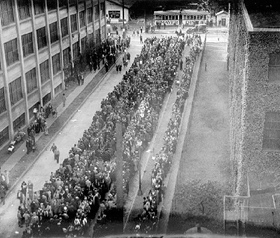
The entire Western world seemed to mourn his passing. The pope and the President expressed their condolences, and newspapers across the United States and Europe eulogized him. The New York Times devoted three and a half pages to his life; a cartoon in the New York World-Telegram showed the angel of death snuffing a single light bulb above his bed. His body lay in state for two days in the library of his lab, where 50,000 people filed past the flag-draped bronze coffin.
(In a less conventional memorial, Henry Ford asked Edison’s son Charles to capture the inventor’s last breath. “During Mr. Edison’s last illness there was a rack of eight empty test tubes close to his bedside,” Charles later wrote. “Immediately after his passing I asked Dr. Hubert S. Howe, his attending physician, to seal them with paraffin. . . . Later I gave one of them to Mr. Ford.” Ford, one of Edison’s best friends, kept the tube until he himself died. It is now on display at the Henry Ford Museum, in Dearborn, Michigan.)
America had plenty of reason to remember Edison. Few people had been untouched by his innovations. In addition to brightening everyday life in countless small ways for ordinary Americans—who could now entertain themselves with radio, records, and movies and light their homes after dusk—he had redrawn the national landscape. Electric power allowed for improved elevators, so buildings could rise to new heights. Cities built electric railways, factories converted from coal and steam, and electric appliances made business, industrial, and household tasks easier.
“He was a milestone, but not a terminus,” Waldemar Kaempffert wrote in The New York Times Magazine on October 25, 1931. “What has been this far accomplished is but a harbinger of what is to come.” The rest of the twentieth century proved Kaempffert right in more ways than he could have imagined. Cinemas, television, and the Internet bring moving pictures to nearly every corner of the globe. Telephones have unchained themselves from our walls, and many Americans are never without one. Virtually every home in America has electricity today. Every electric appliance you might plug in at home—a refrigerator, a vacuum cleaner, a computer—is an outgrowth of his work; every medical advance dependant on an electronic machine is too.
But, in a sense, Edison was a terminus: The era of the generalist died with him. He had begun his career in the infancy of modern science, when the rules were still fungible. Scorning theory, he worked by exhausting every possible solution to a problem. “If he had a needle to find in a haystack, he would not stop to reason where it was most likely to be, but would proceed at once, with the feverish diligence of a bee, to examine straw after straw,” Tesla said. “Just a little theory and calculation would have saved him 90 percent of the labor.” By the time of Edison’s death, scientific procedure and university education ruled the nation’s labs. Technical invention would be the work of specialists from then on.
But even if we never again have such a prolific inventor, Edison’s legacy will continue to touch every aspect of modern life. “Let us think what an earthly immortality is his. Every incandescent light is his remembrancer,” The New York Times wrote. “Wherever there is a phonograph or radio, wherever there is a moving picture, mute or speaking, Edison lives.”