Trusted Writing on History, Travel, and American Culture Since 1949
SEARCH 75 YEARS OF ESSAYS!
January 2007
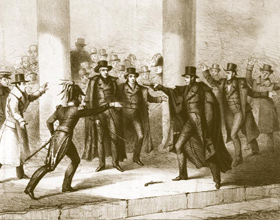
On this date in 1835 a deranged gunman attempted the first presidential assassination in American history. He ended up being beaten to the ground by his target, Andrew Jackson.
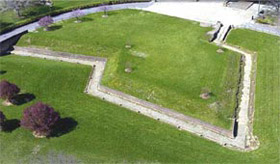
The last traces of the largest symbol of Great Britain’s imperial ambitions in America were buried without ceremony this month at Pittsburgh’s Point State Park. The action comes a year before the city celebrates the 250th anniversary of its founding at the very site of the burial.
Fort Pitt, named for the prime minister who led England to its victory in the Seven Years’ War (1755-1763), was the biggest and most expensive fortress on the frontier. Constructed after British troops drove the French from the western frontier in 1758, it stood at the forks of the two rivers that formed the Ohio, a show of force to French and Indians alike that England ruled the continent.
On this date in 1945, January 27, Soviet troops of the First Ukrainian Front arrived at the town of Oswiecim in south central Poland. In a camp there they found several thousand sick and starving prisoners. Inured to brutality and privation after many months of campaigning, the soldiers were not initially very impressed by the discovery. Newspapers barely mentioned the liberation.
Only later would the world understand that these troops had arrived at a place where rational, educated, and civilized men and women had coolly implemented the worst mass murder in human history. They had arrived at the place that the Germans had renamed Auschwitz.
After their invasion in 1939, the Nazis had strung barbed wire around 22 Polish army barracks in the town to form a prison camp. They locked up local dissidents and Russian prisoners of war and incorporated Auschwitz into the network of concentration camps that provided slave labor for the Reich. Workers toiled in local gravel and coal mines. Thousands of prisoners were shipped through Auschwitz to camps like Dachau and Buchenwald in Germany.
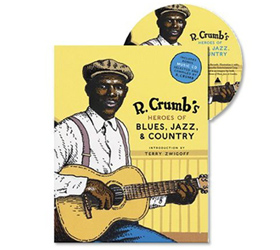
A most unusual document has been released that no lover of American music should be without: R. Crumb’s Heroes of Blues, Jazz, & Country (Harry N. Abrams, 240 pages plus audio CD, $19.95). In it the great cartoonist Robert Crumb chronicles what many would argue is the finest era of popular music, the period roughly from 1926 to 1935, with a series of beautiful pen-and-ink drawings and watercolors.
In 1880 Ralph Waldo Emerson delivered the hundredth lecture of his career, at the Concord Lyceum in Concord, Massachusetts. Reflecting on the intellectual restlessness of his peers, the 77-year-old patriarch of American letters remarked, “I suppose all of them were surprised at this rumor of a school or sect, and certainly at the name Transcendentalism. . . . Meetings were held for conversations with very little form . . . of people engaged in studies, fond of books, and watchful of all the intellectual light from whatever quarter it flowed.”
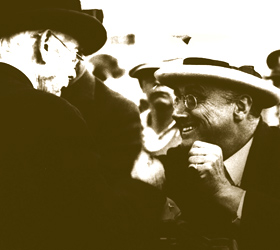
When New York’s governor, Franklin Roosevelt, announced his presidential candidacy on January 23, 1932—75 years ago today—the reaction was very mixed. Time magazine noted that “of the squire of Hyde Park who wants to be President there are abroad in the land two strong and conflicting views. One view is that the U.S. is blessed among nations to have available for the White House a man whose life and works have been so admirable. The other view is that the sum total of his 50 years are not sufficiently significant, in thought, word or deed, to warrant his elevation to the highest position in the land.”
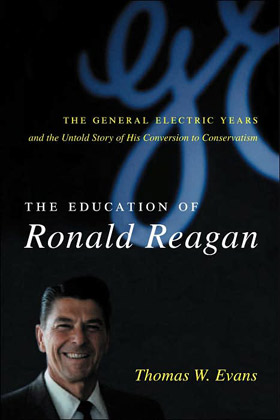
In 1965 the political satirist Tom Lehrer recorded a live concert album featuring musical numbers lampooning the leading public figures of the day. One of the record’s best songs, “George Murphy,” took Californians to task for electing a prominent song-and-dance man to the U.S. Senate. The song opened, “Hollywood’s often tried to mix/ Show-business, with politics/ From Helen Gahagan/ To, Ronald Reagan?” At which point the audience breaks into laughter. Of course, Ronald Reagan had the last laugh. The very next year he crushed Gov. Edmund “Pat” Brown in California’s gubernatorial election.
Today is Alexander Hamilton’s 250th birthday. Unless, of course, it’s his 252nd. He claimed to have been born in 1757, but there is considerable nearly contemporary evidence that he was actually born in 1755. But there is no argument that he was not yet 50 when he died at the hands of Aaron Burr in 1804. And there is no argument that despite his brief life he had more influence on the future of the United States than all but a very, very few of the Founding Fathers.
Hamilton was not like the other Founding Fathers. He was the only one not born in what is now the United States, having come into the world on the British West Indian island of Nevis. And unlike even Benjamin Franklin, whose family was middle-class, he was born into poverty. His mother had left her husband, who was apparently a brute, and was living with Hamilton’s father. He abandoned her after fathering two children.