
Pittsburgh Buries Its History
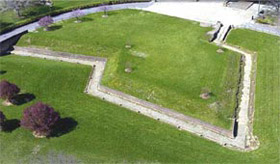
The last traces of the largest symbol of Great Britain’s imperial ambitions in America were buried without ceremony this month at Pittsburgh’s Point State Park. The action comes a year before the city celebrates the 250th anniversary of its founding at the very site of the burial.
Fort Pitt, named for the prime minister who led England to its victory in the Seven Years’ War (1755-1763), was the biggest and most expensive fortress on the frontier. Constructed after British troops drove the French from the western frontier in 1758, it stood at the forks of the two rivers that formed the Ohio, a show of force to French and Indians alike that England ruled the continent.
As part of Pittsburgh’s efforts to replace more than a century of industrial dirt and decay with a riverfront park, one of the fort’s five bastions and part of its moat were recreated in the 1960s using some of the original bricks and cornerstones salvaged from the ruins. Called “the Music Bastion,” because it had been used by buglers, the structure was the first evidence to park visitors of the area’s historical significance.
“Its size . . . gives a sense of the sheer physical authority the wilderness outpost must have conveyed,” Barringer Fifield wrote in his 1996 book, Seeing Pittsburgh. The bastion and moat filled most of Point State Park’s acreage nearest the city. The bulk of the park’s 18 acres lies beyond Pittsburgh’s primary highway interchange and is accessible primarily by a pedestrian underpass. The remnants of the fort were seen as an obstacle to using the city side of the park for recreational activities.
To address that concern, the $35-million renovation of the park that started in December is covering and filling the bastion and moat to create a wide lawn for stage events. The region’s Riverlife Task Force devised the park’s upgrading plan as part of its effort to beautify the area’s riverbanks. Despite pleas and legal threats from local preservationists, the Commonwealth of Pennsylvania continues to press ahead with the burial. The state’s department of Conservation and Natural Resources promises that the contractors are covering the bastion and moat in a way that will preserve them so they can be excavated in the future.
The burial “seems like such a great shame to me,” says Fred Anderson, author of Crucible of War, the popular 1997 history of the conflict (known in America as the French and Indian War). “I liked that reminder of Fort Pitt. I don’t think there’s any place else like it in America.”
Anderson, a professor of history at the University of Colorado, calls Fort Pitt “an absolutely crucial projection of imperial power. There was nothing like it in terms of size and military strength under British rule west of the Appalachians. Burying what’s left of it is a sad surprise.” He considers the burial “a mistake to do right now, just as the city was nearing its 250th anniversary. I’m staggered and puzzled by it. There will be nothing visible to give people a clue about the historical importance of Pittsburgh.”
Andrew Masich, president and CEO of the Senator John Heinz Pittsburgh Regional History Center, disagrees. “The installation was at cross-purposes with a public park. I think it did more to discourage people from using it,” he says. “You have to consider that it was Fort Pitt’s job to keep people out, and that’s what the structures were doing in the park.” He adds that the recreated portions of Fort Pitt were only “approximations. You were not seeing an archeological site here, but a reproduction.”
The state’s plan to protect the buried bastion is both sensible and practical, Masich argues. “The people involved are taking this project very seriously. They are not unmindful of the significance of Fort Pitt.” The architectural historian Franklin Toker, whose latest book, Fallingwater Rising, recounts the creation of Frank Lloyd Wright’s famous house 50 miles south of Pittsburgh, says the elimination of a historical site is “not unprecedented. It happens all the time.”
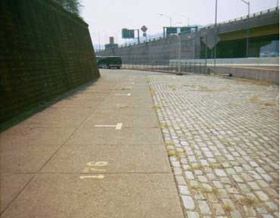
For example, crews building a highway in Pittsburgh in 1987 excavated a lock with its wooden doors intact from the Pennsylvania Canal, which connected Philadelphia with Pittsburgh in the 1800s. After inspection by historians, the lock and its doors were reburied. “Anyway, Point State Park was never created properly as a historical site to begin with,” he adds, citing the park’s division into two areas separated by an overpass. “That overpass is just a huge psychological barrier to seeing the spot as whole.”
Further archeological digs are part of the state’s 10-year plan for Point State Park, he says. The last excavations were done in 1953, when the original Music Bastion was exposed and then dismantled because it was unstable. After salvaging what they could of the original building materials, including usable bricks that English masons made on the site, the excavating archeologists then reburied the site. Some of those bricks were given away to government officials in charge of the park construction; other artifacts were apparently stolen from the unguarded site.
The current plans call for a stone “tracery” of that portion of Fort Pitt to be installed on the lawn, similar to the way the much smaller Fort Duquesne, the outpost earlier built and abandoned by the French on the site, is marked. “I think it’s a brilliant solution for now,” Masich says. A group calling itself the Fort Pitt Preservation Society is proposing an eleventh-hour solution that would preserve the bastion and moat, but the state has not responded.
“The plan to bury the bastion is an abysmal idea, a historical sacrilege. Pittsburgh is throwing away its roots if it buries this,” said Richard Lang at the official announcement of the society’s proposal, on January 4. He was the crew chief of the 1953 excavation.
Preservation Pittsburgh, an advocacy group, has joined the society in calling for a delay in covering the bastion and moat as efforts are made to salvage them. Whatever the solution, a fuller picture for the public of Fort Pitt and its place in history has yet to be realized. Lisa Schroder, the director of the Riverlife Task Force, admits that there are no specific proposals to develop an interpretative program to educate park visitors about the historic site and preserve what little there is left of the fortress.
The burial of the bastion and moat, meanwhile, continue, and except for weather delays it should be completed by early February.