
George Washington Triumphant
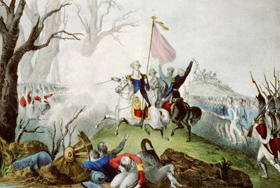
The last week of 1776 was a pivotal moment in the American struggle for independence. For half that year the army of the newly autonomous United States of America had been beaten everywhere it made a stand. By Christmas Eve the English generals Cornwallis and Howe would have felt confident that their tactical and numerical superiority had all but extinguished the American cause. Yet by the end of the day on January 3, 1777, the situation had changed dramatically. General George Washington, leader of the rebellious forces, had won a stunning series of victories in New Jersey, culminating in a brief but decisive fight in the town of Princeton on the third day of the new year.
On its own the Battle of Princeton did not drastically alter the course of history. As the final stroke in a series of blows against England, however, it helped hold off the progress of the British strategy and allowed the United States to finish its first year of fighting on a triumphant high note. It was one of General Washington’s finest hours.
The string of Continental victories began on Christmas, when Washington and his troops, having been driven out of New Jersey, left their squalid camps on the Pennsylvania side of the Delaware River, came back across it in a violent storm, and, after a wretched forced march, surprised the Hessian garrison in Trenton, capturing more than 900 men. This stunning reversal temporarily saved the Continental cause, but the rebels could not hope to hold the ground they had taken. Though they had overwhelmed the Hessians, General Charles Cornwallis was stationed nearby with a huge army at his back.
When Cornwallis heard of the debacle at Trenton, he led his men on a 50-mile march to retake the city. He brushed aside the warning of his quartermaster, Sir William Erskine, who told him, “If Washington is the general I take him to be, his army will not be found there in the morning.” When the British arrived at Trenton, Erskine was proved right. The Continentals were already gone. Washington had evacuated his army in perfect secrecy, under cover of darkness, leaving a few men to tend fake campfires, and muffling the wheels of his cannon with blankets. But the withdrawal was not really a retreat. In fact it took the Continentals deeper into enemy territory–toward Princeton.
On the morning of January 3, Continental General Hugh Mercer’s force came upon the 17th and 55th regiments of the English army, commanded by Lt. Col. Charles Mawhood. Mawhood was headed toward Trenton; Mercer was headed away from it. They met near an orchard outside Princeton. The two armies exchanged volleys. The American line wavered and broke, and the British charged with fixed bayonets. Washington then spurred his white horse into motion and rode into the battle. He shouted at his men, urging them to stand and fight. They did. As American reinforcements came up and their cannon began to fire, the British hesitated. Soon they were retreating.
They withdrew to Nassau Hall, the massive stone edifice on the campus of the College of New Jersey, as Princeton University was then named. The British could not have imagined that the American troops would be able to breach the massive walls of the building, but when the young artillerist Alexander Hamilton trained his guns on it and James Madison led an infantry charge against the front door, the English refuge fell.
Washington’s subordinates were stunned to see him emerge from the battle unharmed. Onlookers had been certain he’d be wounded in his dash to rally his men. After an aide expressed relief that Washington had survived unscathed, the general, unshaken, replied, “Away, my dear colonel and bring up the troops. The day is ours!” And so it was.
Washington’s audacious strategy had won the Revolution its first major series of victories. In a short, 30-minute encounter, American troops had killed or captured hundreds of English redcoats. Washington could have inflicted even heavier losses on the retreating British, but he chose to end the battle rather than give Cornwallis and his reinforcements time to arrive. One biographer of Washington asserts that as a result of Trenton and Princeton, “The United States of America now existed in fact as well as on paper.” The ranks of the Continental Army swelled as word of its victories spread. The Revolution was not complete, but it was newly alive and strong.