
Travel: Revisiting the Black Experience in Vietnam
On April 4, 1967, Dr. Martin Luther King, Jr., changed both the civil rights movement and the antiwar one by giving a speech at Riverside Church in New York in which he fused the two together. It had become clear to him, he said, that “we were taking the black young men who had been crippled by our society and sending them eight thousand miles away to guarantee liberties in Southeast Asia which they had not found in southwest Georgia and East Harlem.” Indeed, young black men who had grown up in an era of racial change were taking their ideas about equal rights and Black Power with them to the front lines. A new museum show examines what happened when they got there.
The show is “Soul Soldiers: African Americans and the Vietnam Era,” at the Senator John Heinz Pittsburgh Regional History Center, in Pittsburgh. “The Vietnam War provoked one of the deepest cultural divides in our nation’s history,” says Andy Masich, president and chief executive of the center. “Soul Soldiers addresses the parallel issues of fighting a war in Vietnam and struggling for civil rights in America by examining the effects of this era in the battlefield and on the home front.” Samuel W. Black, the exhibit’s curator, adds, “The way I look at this history is not to find a new topic but to take an old topic and look at it with a new perspective.” To prepare for “Soul Soldiers” he did scholarly research, talked to veterans, and worked in partnership with organizations including Black Vietnam Veterans, Inc.
The resulting multimedia exhibit features oral histories, photographs, and music, as well as close to 200 artifacts that reveal some of the surprising ways African-Americans expressed themselves while surviving the war. There is a uniform with the words “black and proud” meticulously stitched on a pocket, and there are banners made by black soldiers to display at their barracks. You can read from letters and diaries, including a heartbreaking, colorfully illustrated letter a family received from their son the same day they got the telegram reporting his death. In a section on casualties you can view a metal spike that was lodged in Sgt. John Clark’s foot after he stepped on a booby trap. Clark had to stand motionless for almost 20 minutes with the spike in his foot as his comrades disarmed the trap. He earned a Purple Heart.
After a short introductory video, the exhibit starts out with a focus on black activism in response to the war. Most people familiar with the Kent State shootings may be surprised to learn that at a similar protest just a couple of weeks later at the historically black Jackson State College in Mississippi, two black students were shot and killed.
Each section of the exhibit is anchored by the story of an individual black veteran, for example Michael Flournoy, a Pittsburgh resident who was drafted while in a Louisiana jail, where he had been sent because of his work on behalf of the Congress for Racial Equality. Flournoy wonders if he was drafted because of his activism. He was stuck in KP duty for 14 months until an older black soldier took him under his wing and encouraged him to tone down his militancy. He eventually rose to the rank of staff sergeant.
Soldiers like Flournoy often expressed their politics and pride in subversive ways. Whereas white soldiers commonly displayed Confederate flags, black soldiers made African-themed banners or wove bracelets they called “shackles” out of bootstraps. There was still informal segregation in the Army, and black soldiers responded to it by giving their living quarters informal names like, Hekalu, which is Swahili for “temple.”
Many black soldiers asked, in the words of James Curt Standifer in a diary on display, “Why would me, a brother of soul, whose war was on the streets in the states be here fighting?” But others saw in the Army a rare opportunity for advancement. Fredric Davison, a World War II veteran, became the first African-American general appointed in a combat situation.
Samuel Black dedicates one section of the exhibit to “new definitions of patriotism.” It tells the stories of everyone from career soldiers to Muhammad Ali, who refused to serve on religious grounds. “To me, Ali is an expression of patriotism,” Black says.
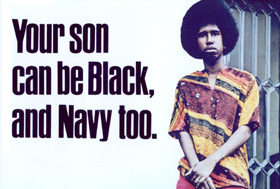
Other highlights include the work of Wallace Terry, an African-American reporter for Time magazine who documented black life in the Army from 1967 to 1969, and a recruiting poster showing a man in an Afro and a dashiki alongside the motto “You can be black and Navy too.”
There is a wall of covers of albums by black musicians that commented on the war and multiple listening stations where you can hear the “soundtrack of the era”—songs like “Backlash Blues,” by Nina Simone, “All Along the Watchtower,” by Jimi Hendrix, and “War,” by Edwin Starr, who was himself a veteran. Of course Marvin Gaye’s What’s Going On is there, along with a photo of his brother Frankie, whose service in Vietnam inspired the album.
Martin Luther King, Jr., described Vietnam as “a white man’s war, a black man’s fight.” The exhibit reminds us of the diversity of the experiences of African-Americans on the front lines and the variety of their opinions about the military. In his contribution to the book that accompanies the exhibit, Soul Soldiers: African Americans and the Vietnam Era, the poet Terrance Hayes writes, “Some black men seize upon the promises of America and some turn from them. . . . But I should not speak as if the choices we make are that simple. Often these feelings . . . exist within the same man.”
“Soul Soldiers” runs until October 2007, after which it may travel. For more information contact the Senator John Heinz Pittsburgh Regional History Center at www.pghhistory.org or (412) 454-6000.