
Franklin Roosevelt to Run for President
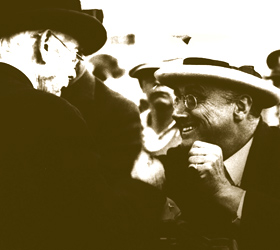
When New York’s governor, Franklin Roosevelt, announced his presidential candidacy on January 23, 1932—75 years ago today—the reaction was very mixed. Time magazine noted that “of the squire of Hyde Park who wants to be President there are abroad in the land two strong and conflicting views. One view is that the U.S. is blessed among nations to have available for the White House a man whose life and works have been so admirable. The other view is that the sum total of his 50 years are not sufficiently significant, in thought, word or deed, to warrant his elevation to the highest position in the land.”
To his supporters Roosevelt was an effective, progressive governor who had cajoled the legislature into passing bills to build new hydroelectric dams along the state’s waterways and thereby provide cheap electricity to working-class citizens. He was a public-policy innovator who had created statewide pensions for the aged, expanded the provisions of the Workmen’s Compensation Act, expanded the state’s progressive income tax to provide more funds for unemployment relief, cut rural taxes, and created new reforestation programs that won praise from leading conservationists.
To his detractors he was a glib, wide-smiling dilettante, a country squire who played at politics where other men practiced it seriously. In the aftermath of the announcement, Walter Lippmann, onetime counselor to Woodrow Wilson, cofounder of The New Republic and a leading progressive newspaper columnist, summed the governor up as “a highly impressionable person, without a firm grasp of pubic affairs and without very strong convictions.” He was, in Lippmann’s estimation, “an amiable man with many philanthropic impulses, but he is not the dangerous enemy of anything. He is too eager to please. . . . Franklin D. Roosevelt is no crusader. He is no tribune of the people. He is no enemy of entrenched privilege. He is a pleasant man who, without any important qualifications for the office, would very much like to be president.”
Like it or not, most Democrats realized right away on January 23 that Roosevelt was destined to be the party’s nominee. As he spent that afternoon poring over hundreds of congratulatory telegrams in the dusty, overstuffed study at the Executive Mansion in Albany, his advisors let it be known that he already had solid commitments from 678 delegates to the Democratic National Convention, an outright majority and only about 100 short of the two-thirds necessary to secure the nomination. As The New York Times noted, this was “equivalent to a claim of the nomination on the first ballot.”
So just who was Franklin Delano Roosevelt? He was indeed a country gentleman, a scion of one of New York’s richest families, a distant cousin of Theodore Roosevelt, a former member of the New York state legislature, a onetime assistant secretary of the Navy under Woodrow Wilson, and the Democratic party’s unsuccessful nominee for Vice President in 1920. Stricken in 1921 with polio, which left him paralyzed from the waist down, he had spent the better part of a decade in a vain attempt to recover use of his legs and a more successful effort to recover his spirit. He had reentered politics in 1924 to support New York Governor Al Smith’s first ill-fated presidential bid and in 1928 had taken Smith’s place in Albany when the governor ran and lost as the Democratic party’s nominee against Herbert Hoover.
Roosevelt’s political enemies rightly remembered him as a not terribly serious young man who had hungered for public office without having many convictions. But they vastly underestimated his personal growth and maturation in the years after his initial paralysis. Assembling a “Brain Trust” (originally “Brains Trust”) of Ivy League economists and political scientists, he held weekly meetings in the drawing room of the governor’s mansion, meetings that sometimes lasted well past midnight, when his tired advisors would hurry to catch the last train back to New York City. Schooling himself in political economy and government, he began developing a new, if somewhat undisciplined, sense of the role of the state in ordinary people’s lives.
Had they been paying closer attention, Roosevelt’s Democratic party rivals—who now included his former political sponsor, Al Smith—would have heard tones of serious resolve and innovation. “What is the state?” he asked in his 1931 message to the New York legislature, demanding increased funds for unemployment relief. “It is the duly constituted representative of an organized society of human beings—created by them for their mutual protection and well being. The state or the government is but the machinery through which such mutual aid and protection is achieved. . . . Our government is not the master but the creature of the people. The duty of the state towards the citizens is the duty of the servant to its master.”
In the context of the time, an era in which governments assumed little responsibility for the general welfare, and in which the courts treated corporations as “individuals,” thereby valuing freedom of contract above freedom to collectively bargain, this was a radical statement.
Roosevelt won the 1932 election, of course, and four years later Americans enjoyed a host of protections that had previously fallen outside the range of government action: federal old-age pensions and assistance for poor families, mortgage and bank-deposit insurance, unemployment insurance, disability payments, relief work, publicly financed electricity, strong regulation of the banking sector, and a vast system of public works.
Though Roosevelt’s policies bobbed and weaved throughout his 12 years as President—a process that made some of his advisers wonder whether the New Deal could even be said to exist as a cohesive program—he consistently moved toward a more expansive vision of state obligation and civic entitlement. By 1944 he was arguing that “individual freedom cannot exist without economic security” and calling for a “second Bill of Rights” to include “the right to a useful and remunerative job in the industries, or shops or farms or mines of the nation; the right to earn enough to provide adequate food and clothing and recreation. . . . The right of every family to a decent home; the right to adequate medical care and the opportunity to achieve and enjoy good health; the right to adequate protection from the economic fears of old age, and sickness, and accident and unemployment; and finally, the right to a good education.”
Seventy-five years since he first declared he would run for President, many of Roosevelt’s most cherished goals remain partially unmet. But they continue to provide liberals with a vision, and a startlingly simple idea of what government should mean for the citizenry.