
How Did Ronald Reagan Become a Conservative?
In 1965 the political satirist Tom Lehrer recorded a live concert album featuring musical numbers lampooning the leading public figures of the day. One of the record’s best songs, “George Murphy,” took Californians to task for electing a prominent song-and-dance man to the U.S. Senate. The song opened, “Hollywood’s often tried to mix/ Show-business, with politics/ From Helen Gahagan/ To, Ronald Reagan?” At which point the audience breaks into laughter. Of course, Ronald Reagan had the last laugh. The very next year he crushed Gov. Edmund “Pat” Brown in California’s gubernatorial election.
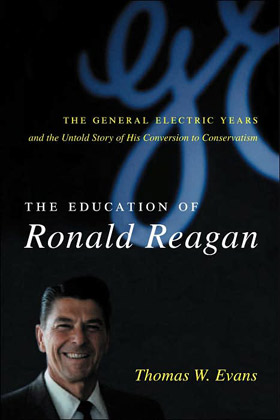
As Thomas W. Evans reminds readers in his new book, The Education of Ronald Reagan: The General Electric Years and the Untold Story of His Conversion to Conservatism(Columbia University Press, 302 pages, $29.50), by the eve of his first bid for elective office, Reagan was already an accomplished political figure. Rather than ask how a B-grade actor could possibly become governor of America’s largest state, we should wonder how (and why) Reagan made the long march from New Deal liberalism to Barry Goldwater conservatism. The answer, Evans suggests, lies with Reagan’s eight-year stint, from 1954 to 1962, as a company spokesman for General Electric and, particularly, his political cultivation by Lemuel Boulware, GE’s vice president of employee, public, and community relations.
It’s widely known that Reagan began his career as a liberal, but it’s still jarring to see just how liberal he was. As president of the Screen Actors Guild in the late 1940s he walked in step with other AFL and CIO officials in opposing the Taft-Hartley Act and right-to-work laws. In 1948 he played a leading role in labor’s drive to secure a victory for President Harry Truman in California, and that year he also supported Hubert Humphrey, the liberal mayor of Minneapolis and a great civil rights champion, in his successful bid for the U.S. Senate. In 1950 he even backed Rep. Helen Gahagan Douglas (with whom he would later be lumped in Tom Lehrer’s song), the left-wing actress turned congresswoman, in her unsuccessful Senate campaign against Richard Nixon. There was little sign in those days of the man who would become the lion of modern conservatism. Nor was there any sign of the man who would later break the air traffic controllers’ union, open his 1980 campaign in Philadelphia, Mississippi (the site of the triple murder of three civil rights activists in 1964), and support Richard Nixon in national and statewide elections.
While the standard narrative about Reagan’s political conversion focuses on his clash with Communist union infiltrators in the 1940s and 1950s and his relationship with the family of his second wife, Nancy Davis, a prominent Republican clan, Evans points instead to Reagan’s relationship with Boulware, a leading business conservative who oversaw a vast operation aimed at convincing GE’s employees that the company, not the union, had their best interests at heart. Though Evans’s book relies on fresh sources from the GE archives and examines a period in Reagan’s life that most biographers gloss over, at times it reads less like a study of Reagan than a biography of Boulware.
Without endorsing “Boulwarism,” but without offering much criticism of it either, Evans recounts GE’s extensive use of employee publications, its efforts to influence the local press in cities that were home to GE plants, its system of “book clubs” for employees and their spouses (where the reading list invariably featured watered-down works by conservative economists and theorists), and its popular Sunday night television show, General Electric Theater, hosted by Reagan, all of which helped bolster the company’s standing with its workers and the general public, to the detriment of organized labor. By the early 1950s, with his movie career in a steep decline (his later features include such unmemorable films as Law and Order and Castle Queen of Montana, and he no longer enjoyed top billing), Reagan was ready to eagerly accept Boulware’s invitation to host GE’s TV show and tour its plants on behalf of management. In part, he needed the money—a considerable $125,000 a year, later raised to $150,000. The former union president became a company spokesman.
In his presentation of Boulware, Evans tends to overstate his case. Though he tries to paint the man as a management innovator, in fact there was little new about GE’s softer brand of union-busting. From Henry Ford onward, business executives had employed various forms of corporate welfare to buy the affections of their workers. What was new about Boulware was that he didn’t voice any intrinsic hostility to organized labor (“We believe in the union idea,” he told a business audience. “. . . We think some among even the best of employers might occasionally fall into short-sighted or careless employee practices if it were not for the presence or direct threat of unions.”) Instead he, and eventually Reagan, used the language of free markets and negative liberty to argue against high taxes, social spending, and other shibboleths of the nation’s powerful industrial unions.
Reagan was a popular draw among GE employees, though more than a few were unimpressed. “How much are they paying you for this shit?” asked one skeptic during a routine plant visit. In 1959, while still the GE spokesman, he became once again the head of the Screen Actors Guild, and he proved a tough negotiator with the studios even as he warned GE workers against the perils of their own union. At the same time he perfected what later became known simply as “the Speech.” Delivered in 1964 to raise money for Barry Goldwater, the Speech signaled Reagan’s complete conversion from New Deal stalwart to New Right crusader. In 1962 he had switched his party registration, but it hardly mattered. He hadn’t supported a Democratic presidential candidate since 1948.
In the final analysis, Evans’s book leaves Reagan as elusive as ever. He was a prodigious writer, but as his aide David Gergen once noted, he tended to spend agonizing amounts of time committing his speeches and policy memorandums to memory. He simply couldn’t shake the actor’s calling. All of which makes Evans’s argument a matter of speculation. No matter how well he documents Reagan’s rhetorical and philosophical shift, it’s never clear who—the spokesman or his patrons—was writing the speech.