
R. Crumb Sings the Blues
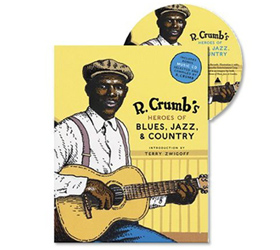
A most unusual document has been released that no lover of American music should be without: R. Crumb’s Heroes of Blues, Jazz, & Country (Harry N. Abrams, 240 pages plus audio CD, $19.95). In it the great cartoonist Robert Crumb chronicles what many would argue is the finest era of popular music, the period roughly from 1926 to 1935, with a series of beautiful pen-and-ink drawings and watercolors.
Between 1926, when electric recording made the accurate reproduction of sound a real possibility, and the onset of the Great Depression three years later, thousands of blues, jazz, and country 78 rpm records poured from the big record companies. There had been a steady trickle of them up until then, but now the medium in which they were produced found its fullest flowering and was no longer treated as a crude novelty.
The piano, sounding little better than a xylophone in the days of acoustic recording, could now be heard with great clarity in every register. The banjo, which had been indistinguishable from a Jew’s harp in the old Edison recordings made in the first two decades of the century, was now rich and eerie. Jazz recordings especially, with their punchy trombone bass lines moderating the sometimes jubilant and sometimes heartbreaking conversations of trumpet and clarinet benefited from the new method by an order of magnitude. Previously individual instruments could be heard independent of the ensemble only with great difficulty (and not at all, usually, if you were trying to listen to the piano); now it was almost always possible to pick out any melody you cared to hear. But the biggest difference between acoustic and electric recording, a difference that was to change the course of American popular music, was the new medium’s ability to pick up the shadings and subtle inflections of the guitar and of the human voice.
In that brief period, agents from the bigger record companies like Columbia, Okeh, and Victor were sent with their field recording equipment to some of the loneliest places in the country in search of talent. The records followed at a staggering pace, raising bluesmen, pastors, families, fiddlers, jug blowers, and fingerpickers from the murky depths of obscurity into the half-light of local celebrity. Bluesmen like Blind Blake and Blind Willie McTell, string bands like Fiddlin’ Powers and Family and the East Texas Serenaders, and jazzmen like Sam Morgan and Oscar “Papa” Celestin were all given voice and, in the span of a few years, sang the song of a nation.
It is hard to overstate the power over the popular imagination the records have had since they were released. They formed the basis of Harry Smith’s Anthology of American Folk Music, which Moe Asch put out on his Folkways record label in the late 1940s, a document that almost single-handedly started the folk music revival of the fifties and sixties. They inspired many of the great rock bands of the late sixties.
They also had a profound influence on the brilliant cartoonist R. Crumb, and not only musically (he took up the banjo in his late twenties and almost stopped drawing entirely for a whole year to go on tour with his string band) but also aesthetically. Some of his best strips document in glorious detail the day-to-day existence of an itinerant bluesman or a down-and-out black pianist. Even his bouncy, frenetic lettering was largely borrowed from old Paramount blues record ads.
It makes sense, then, that Crumb would have hit on the idea, in 1980, of celebrating the genius of these strange, forgotten people with a series of trading cards. Through his record collecting network (he had by this time amassed one of the largest collection of 78s in the world) he had met Nick Perls, the owner and operator of Yazoo records. Yazoo was a small operation based in New York that put out very fine LP reissues of the old sides; Crumb’s idea was to draw, using old photos as a reference, about a hundred of the greatest figures of prewar jazz, blues, and country, shrink them down to the size of a card, and have each Yazoo LP include one, as in an old pack of gum.
The art of the trading card was nothing new to him; he had spent a very gloomy winter in the early 1960s slaving away at the Topps bubblegum-card factory on the Brooklyn waterfront. Perls loved the idea but thought it might make more commercial sense to sell the cards separately as a boxed set, rather than give them away as a premium with his LPs. R. Crumb’s “Heroes of Blues, Jazz, and Country” was the result, and all the drawings and watercolors that made up the collection have just been reprinted in the extremely attractive new book of the same name.
The musicians are divided into three categories: “Heroes of the Blues,” “Early Jazz Greats,” and “Pioneers of Country Music.” Each picture comes alongside a short, informative, and well-written biographical sketch. Most of the pictures are drawings; the Jazz Greats, however, are done in watercolor, and although they are still marvelous to look at, they suffer in the brilliant light of Crumb’s pen and ink. You’ll find many people you recognize and many you don’t. Interspersed among giants like Louis Armstrong, Bix Beiderbecke, Big Bill Broonzy, the Carter Family, and Jimmie Rodgers are the relatively obscure-Tiny Parham, the East Texas Serenaders, the Mississippi Sheiks-and the unbelievably obscure-Mumford Bean and his Itawambians. There are some well-known figures you won’t find, most notably Robert Johnson, whose picture wasn’t published until 10 years after Crumb drew these. Still, he gets an awful lot of them, and they are gorgeous.
Certain details will stay with you: the tortured, mournful eyes of Charlie Patton; the easy, good-natured smile of Blind Blake; the eccentric fury of the Weems String Band; the self-assured, calm, slightly diffident gaze of Tiny Parham. Of course hearing the actual music these men and women played magnifies the pleasure of looking at the drawings a hundredfold, and for that reason the book comes with a blues, jazz, and country compilation CD drawn exclusively from Yazoo LPs, selected and compiled by Crumb himself. The music is wonderful, and you can hardly listen to it without coming to the conclusion that the grooves of those 78s contain the truest and most authentic expression of American feeling ever recorded.
Buy the book, then, not only because it is an homage by one of our greatest artists to some of our greatest musicians, but also to find out what Steve Martin meant when he wrote, “I still walk down the street today and see Crumb caricatures everywhere, except they are living breathing humans. In some way we are all Robert Crumb caricatures, as we parade in our fashions and hairdos.”