Trusted Writing on History, Travel, and American Culture Since 1949
SEARCH 75 YEARS OF ESSAYS!
June 2007
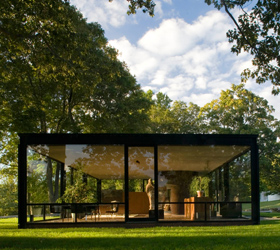
Privacy may seem almost obsolete in this age of MySpace, YouTube, and camera phones, but Philip Johnson’s Glass House still strikes people as alarmingly revealing. Even with no neighbors in sight, not many people would be comfortable living in a house with almost no interior walls and a mostly transparent exterior. Yet the architect called the Glass House home for more than 50 years.
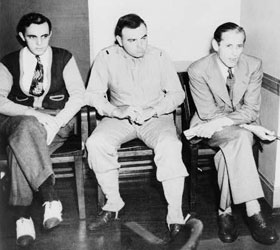
Shortly after midnight on June 13, 1942, a German submarine lifted off the bottom, where it had been waiting, and surfaced near the sleepy eastern Long Island town of Amagansett. It soon put ashore four men wearing German uniforms. They had with them explosives and other demolition equipment sufficient for a two-year career in sabotage, plus $175,200 in cash—more than $2 million in today’s money.

Michael Chabon’s wonderful new novel, The Yiddish Policemen’s Union(HarperCollins, 432 pages, $26.95), is a fusion of two forms of genre fiction that novelists with literary reputations as good as his don’t normally work in. It is a novel of alternate history and also a Chandleresque hard-boiled detective story.

It is probably the Great Communicator’s most famous line, one he uttered on June 12, 1987—20 years ago today—while standing in front of the Brandenburg Gate at the Berlin Wall. And the speech is still well worth reading or listening to. But it is also a reminder of a great natural experiment in economics and political philosophy.
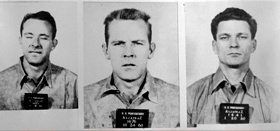
Forty-five years ago today, on June 11, 1962, three men amazed the world by escaping from “escape-proof” Alcatraz prison in San Francisco Bay. Their intricate and audacious breakout scheme contributed to the decision to shut down the prison, which had stood as a severe symbol of the American criminal-justice system for 29 years.
Isla de los Alcatraces was named by a Spanish explorer in 1775. The “Island of the Gannets” (a gannet is a sea bird) was a rocky outcrop swept by wind and fog. It was the site of the first lighthouse on the West Coast.
Before automobiles took over, the railroad was the only way to get to the Grand Canyon, unless of course you walked or rode in on horse or donkey. In fact, the railroad—the Atchison, Topeka and Santa Fe—with its first run, in 1901, helped turn the Grand Canyon into a major tourist attraction. There were two daily runs between the town of Williams and the Canyon’s South Rim, and as many as six special trains might carry Presidents, kings, or movie stars to the natural wonder. However, by 1927 more people were driving their cars there, and in 1968 the train made its last trip to the Canyon, with only three passengers.
Twenty-nine years ago today, on June 6, 1978, California voters approved by a two-to-one margin a revolutionary ballot initiative known as Proposition 13. Aimed at curbing the growth of state government, the measure slashed property taxes by an average of 57 percent, limited property-tax rates to one percent of market value, capped the annual growth of property assessments at 2 percent, and outlawed any future state tax hikes that didn’t receive two-thirds support in the legislature.