
Michael Chabon’s Strange America
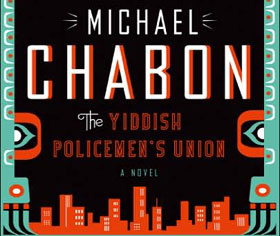
Michael Chabon’s wonderful new novel, The Yiddish Policemen’s Union(HarperCollins, 432 pages, $26.95), is a fusion of two forms of genre fiction that novelists with literary reputations as good as his don’t normally work in. It is a novel of alternate history and also a Chandleresque hard-boiled detective story.
To call it Chandleresque understates the case. The Yiddish Policemen’s Union has many registers—the writing is gorgeous—but it contains clear homages to Chandler’s narrative voice, and to some of his moral vision as well. Creating the homicide detective Meyer Landsman, a plausible, formidable, never ridiculous, nominally Yiddish-speaking version of Philip Marlowe, is the least of Chabon’s achievements but is nonetheless impressive, for the pulp genre Chandler and Dashiell Hammett made famous has seemed almost played out for a long time now, the subject of frequent parody and, more damagingly, of a vast amount of mechanical imitation.
By the 1980s almost every provincial city in America had a hero modeled on Philip Marlowe, and the hard-boiled detective novel seemed very tired. Chandler himself was admired as an American original, but literary authors trod his ground only with tongues in cheek. Chabon has reworked and reanimated the Chandleresque by setting it in an alternate historical world, one that branches from ours at around the time Chandler was writing his best work. Its Yiddishized inflections and images are very satisfying: Jewish doctors in a 40-year-old photo who have shot a grizzly bear “brim with the odd, bespectacled manliness of that golden period”; the knot of a rep necktie “presses its thumb against his larynx like a scruple pressing against a guilty conscience”; “every generation loses the messiah it has failed to deserve.”
Alternate history, a species of science fiction, assumes a different past flowing from some crucial branching point, and it usually takes place in a present correspondingly different from our own. Most commonly, Hitler has won one war, or Lee another, or Spain’s invincible Armada really was invincible, and everything after is grotesquely different. Almost no writer of the first rank has ever worked this vein. Kingsley Amis is one partial exception, back in 1976, with The Alteration, but the only other example is Philip Roth, in 2004, with The Plot Against America.
That book has one similarity to The Yiddish Policemen’s Union: In both alternate histories the relationship between America and its Jews works out less happily than it did in reality. In Roth’s fiction, Franklin Roosevelt loses his bid for a third term, in 1940, to Charles Lindbergh, and an isolationist United States develops some pretty nasty politics; in Chabon’s alternate world, FDR’s Secretary of the Interior, Harold Ickes, secures a coastal strip of southern Alaska as a refuge for many of the Jews Hitler has menaced. Millions live who in actual history died, and there is no Israel roiling the Middle East, which may sound like an improvement on what did happen but in Chabon’s novel may not be (he presents evidence on both sides of that question).
In Chabon’s alternate world Russia collapsed and World War II ended with a 1946 U.S. nuclear strike on Berlin. What we call the Holocaust was known as the Destruction, and it killed only two million. More Jews perished in 1948, when Israel was destroyed within three months of its creation, its Jewish population murdered or driven into the sea. A few of the survivors made it to Alaska, and in 2007 the population of the Jewish portion of Alaska has reached 3.2 million. But not for long. In 2008 comes the Reversion, when the stateless Jews who live in their piece of Alaska will lose their right of residence and the Sitka district will return to the Tlingit Indians, who were pushed aside when the Jews began to arrive in the early 1940s. Very few of the Sitka Jews can discern what their fates will be in a few months. A small minority have papers that will allow them to remain on U.S. territory after the Reversion, and rumors claim that as many as 40 percent may receive the right to live somewhere in the United States. But those rumors are worthless, which is all anyone knows for sure.
Most of Sitka’s Jews live by fishing and logging, speak Yiddish rather than English, and remember and possess tastes and political views from the world Hitler destroyed. The Alaskan salmon they catch are at one point called “aquatic Zionists,” for they seek to return, at a terrible cost, to a place of which they know almost nothing. It is an apt phrase, for in the face of the Reversion an apparently hopeless Zionism grows up in Sitka, along with other forms of despairing Messianism.
The Yiddish Policemen’s Union can be read as either anti-Zionist or powerfully pro-Zionist. On the anti-Zionist side, the Jews of Sitka are land-hungry and have in the past massacred some of the Tlingit, who to some degree stand in for the population pushed aside by the Jewish immigrants to Palestine in real history. Most of the Alaskan Jews who come Meyer Landsman’s way are criminals. The Sitka equivalent of the Mafia is run by the Verbovers, a Hasidic sect Chabon has invented, who, like the rest of the Jews of Sitka (the “frozen chosen”), have a richly Eastern European culture fused with that of Chandler’s mid-century Los Angeles and set on a real and harsh frontier. It is fascinating to be plunged into Chabon’s invention of a thriving 2007 Jewish culture that is neither Israeli nor American. All these people are very, very far from Israelis or modern American Jews. The differences are in some ways very appealing; the Eastern European Jewish part of them is something that in reality successful Zionism, and successful Americanization, helped destroy. Chabon undoes that destruction.
However, on the pro-Zionist side, the major work of destruction was done not by Zionism or assimilation but by Hitler’s Germans, in this alternate history as in the real one. Many of the Jews of Chabon’s Sitka are pretty tough, but having no state of their own, they are wholly defenseless in ways most modern American Jews have entirely forgotten. The United States no longer wants Chabon’s Alaskan Jews, and the vast majority of them have nowhere else to go, a very bad situation that recalls the core of the Zionist argument. It is not a problem that preoccupies Meyer Landsman, though; he refuses to think about it and instead stubbornly insists on finding out whodunit while his world collapses around him.
Who killed a heroin-addicted derelict and chess player? The mystery is intricate and satisfying, its unraveling reveals far more than one can initially imagine it will, and Chabon plays by the rules of a Chandler murder mystery while entirely reinventing the form while inventing a lot else too. No piece of the mystery can be revealed without spoiling the book, which by its close is, in addition to a brilliant fusion of the two genres already mentioned, a love story, a reflection on September 11, a book about chess, one about fathers and sons, and also one about the Jewish predicament in political modernity and about the immense latent strengths and possibilities of both mid- and late-twentieth century American popular literature. It at first seems much more a detective tale than an alternate history, but the more one thinks about it, the less that seems true. It is a lovely book, to be read slowly and savored.
It is certainly the best novel of alternate history yet written. Roth’s The Plot Against America, in some respects marvelous, maddeningly refuses to imagine its altered history lasting more than a couple of years, at which point true history returns unchanged; as a consequence, that book is a failure, as a genre novel at least, if not as a reflection on Roth, surely one of our greatest authors. The Yiddish Policemen’s Union, however, confirms that Chabon is a major American writer. That he has recently been slyly working in low genres may keep a few snobbish readers from realizing how good he is for a little while longer, but probably not for much longer.