
Travel: Getting Inside Philip Johnson’s Glass House
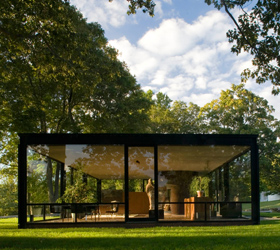
Privacy may seem almost obsolete in this age of MySpace, YouTube, and camera phones, but Philip Johnson’s Glass House still strikes people as alarmingly revealing. Even with no neighbors in sight, not many people would be comfortable living in a house with almost no interior walls and a mostly transparent exterior. Yet the architect called the Glass House home for more than 50 years.
Now you can experience the place, and you may be surprised as soon as you enter it, discovering that it was not Philip Johnson that was exposed but the natural beauty around the place. Perched atop a crest, the house provides a panorama of wooded hills, rolling meadows lined with stone walls, and a placid pond. As Johnson once said, “I have very expensive wallpaper.”
“The effect of the Glass House is fully realized not from the outside but from the inside,” says Christy MacLear, the site’s executive director. “You have to step inside the Glass House to understand how its design and living experience is touched directly by the majestic landscape.”
Two years after Johnson’s death, at 98, the public can now step inside the New Canaan, Connecticut, home for the first time. It officially opened to the public this month. Johnson bequeathed the house and the surrounding 47-acre property to the National Trust for Historic Preservation in 1986, and he and David Whitney, his long-time partner, who also died in 2005, played active roles in planning its going public.
The house remains almost exactly the way they left it. Its minimalist furnishings are virtually unchanged from the day Johnson moved in, in 1949. The ceiling is still faded from his use of the fireplace, which shares space with the bathroom in a large brick cylinder in the middle of the house.
Since its completion, the flat-roofed one-story home has been a landmark of modern architecture. Aesthetics, not function, drove Johnson’s designs, especially at the Glass House. Some guests didn’t know what to make of its walls of quarter-inch glass divided and supported by black steel pillars. “Just shut up and look around,” he would tell them.
Philip Johnson was one of the most celebrated architects of twentieth-century America, and his thick, round-framed glasses made him instantly recognizable. He served as the first director of architecture at the Museum of Modern Art and co-curated the museum’s groundbreaking 1932 show on modernism. He designed such notable buildings as the Crystal Cathedral, in Garden Grove, California; PPG Place, in Pittsburgh; and the AT&T Building (now the Sony Building), in Manhattan, which landed him on the cover of Time magazine in 1979. He received architecture’s highest awards, including the Pritzker Prize and the American Institute of Architects Gold Medal. The Glass House is probably his best-known work of all. It’s so well-known that many visitors are likely to be surprised to learn that it’s one of 14 structures on the property.
The cluster of buildings has been called Johnson’s architectural survey of the second half of the twentieth century, since he added at least one new building each decade after the Glass House. The estate was in constant evolution, as he experimented there with ideas he would later use on major commissions. “It is a 50-year diary of Philip Johnson’s career and interests,” MacLear says. “For people who are being introduced to modern architecture, this is a great site.”
When you visit the Glass House, you get a 90-minute tour that lets you into four other buildings on the property: the Brick House, the Painting Gallery, the Sculpture Gallery, and “Da Monsta.”
The Brick House, which was Johnson’s guest house, was completed simultaneously with the Glass House to form a single composition. It’s another one-story structure with a flat roof, but its solid brick provides counterpoint to the open, transparent Glass House. Despite its closed design, skylights and porthole windows allow considerable light in. The Brick House is not a dark and dreary place.
Johnson and Whitney were avid patrons of the arts, with many artist friends. Andy Warhol visited often. Johnson donated more than 2,000 works to the Museum of Modern Art, becoming its second-largest donor, and Whitney was a curator who organized gallery and museum exhibitions. Johnson built the Painting Gallery in 1965 to showcase and store their contemporary art collections, and he put up the Sculpture Gallery five years later.
Like the Brick House and the Glass House, the Painting Gallery and the Sculpture Gallery coexist in stark contrast to each other. The Painting Gallery, inspired by classical tombs, is embedded in a hillside. Inside, three circular nodes of manual sliding panels allow its collection of paintings, drawings, and photographs to be easily moved. The Painting Gallery has a bunker-like atmosphere; the Sculpture Gallery has the feel of a greenhouse, with light pouring in through its glass-and-steel roof. With white walls and a wide brick staircase that meanders down five levels, the gallery feels a little like a Greek seaside village.
The last addition to the Glass House property, Da Monsta, was completed in 1995. Johnson had intended that sharply curving building to be the property’s visitor center, but concern among people in the town and the neighborhood led to the creation of an off-site visitor center in downtown New Canaan, with a multimedia exhibition and a museum shop. Visitors take a 10-minute van ride from the center to the property on Ponus Ridge Road.
The National Trust for Historic Preservation faces the challenge of preventing a property that was a constant work in progress from becoming frozen in time. “Rather than recreating the lives of Philip and David, we are focusing on both the process of and education about modern preservation. We’re creating programs, commissions, and a fellowship to cultivate the talents and new ideas of architects, artists, and designers,” MacLear says. “That keeps the property true to their spirit as well as vibrant going forward.”
Hilary Lewis, an architectural historian and Philip Johnson scholar, points out that architectural criticism of the Glass House is still evolving. “Now that the property will be available to a broad audience, and with the passage of time since its completion over a half-century ago, I believe the true criticism will begin,” she says. “What may come out most in the future is an appreciation for the integration between structures and landscape, which is hard to comprehend from photography alone. Seeing images of the Glass House is in no way equal to experiencing it.”
Demand for the Glass House tours has been so heavy that they are already sold out through 2007. Tickets are now being sold for the 2008 season, which will run from May through October. The tours are strictly limited to 10 people, to minimize damage to the property and disruption of the neighborhood. Photography and sketching are allowed only during a two-hour end-of-the-day tour, which leaves at 3 p.m. For tickets and information visit www.philipjohnsonglasshouse.org or call (866) 811-4111.