
Land of Lincoln: How He Belongs to the Ages
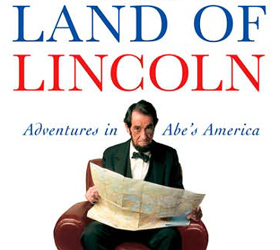
Since Abraham Lincoln’s assassination in 1865, the torrent of books about him has never let up. It started with the fascinating but unreliable biography by his former law partner, William H. Herndon; in just the past few years it has included, most prominently, studies of his management style in dealing with his cabinet (Doris Kearns Goodwin’s Team of Rivals), his oratorical brilliance (Douglas L. Wilson’s Lincoln’s Sword), and even his sexuality (C. A. Tripp’s The Intimate World of Abraham Lincoln). Now Andrew Ferguson, a senior editor at The Weekly Standard, has written Land of Lincoln: Adventures in Abe’s America (Atlantic Monthly Press, 288 pages, $24) about our fascination with Lincoln itself.
Note that the title puts the emphasis on the nation, not the man. It is, Ferguson writes, “the country that Lincoln created and around which . . . he still putters, appearing here and there in likely and unlikely places.” Its relationship with its sixteenth President is complex, to say the least, and Ferguson opens the volume with an example that shows just how complex—the recent dedication of a statue of Lincoln in Richmond, Virginia, the former capital of the Confederacy. Many local businessmen, politicians, and journalists supported the statue as a welcome tourist attraction and expression of civic pride. But other citizens were appalled by the idea. “To worship Lincoln, right here, is an insult to the Confederate soldier,” one of them tells Ferguson, who later visits a conference held by a group of what might be termed Lincoln deniers, featuring Thomas DiLorenzo, author of the 2002 book The Real Lincoln, a revisionist history that portrays the man as a dishonest, swaggering tyrant.
Such vilification is the clear exception. Most Americans seem to perceive Lincoln as a sort of secular saint, the man who saved the Union, who freed the slaves, who gave his life for his country. When Ferguson visits the Abraham Lincoln Presidential Library and Museum, in Springfield, Illinois, which opened in 2005, he paints it as a kind of hagiographic Lincoln Disneyland, heavy on visual entertainment and short on facts and figures. He speaks with Louise Taper, one of the foremost collectors of Lincolniana, whose holdings extend far beyond books and papers to include Lincoln’s chamber pot, the monogrammed cuff link he wore the night he was shot, and a lock of his hair. Ferguson portrays Taper as having little interest in Lincoln, the man; she’s much more interested in Lincoln’s stuff.
The author explores the many ways Americans have made money off the Lincoln myth. Dale Carnegie, in his 1936 bestseller How to Win Friends and Influence People, used Lincoln as an example that all successful people should follow. “Let’s pull a five-dollar bill out of our pocket,” he wrote, “look at Lincoln’s picture on the bill, and ask, ‘How would Lincoln handle this problem if he had it.’” As Ferguson puts it, “WW$5D?” He attends a corporate consultant’s workshop for middle managers that presents Lincoln as an example of how to lead your fellow employees. And he joins Lincoln impersonators as they don stovepipe hats and fake beards to spout “Honest Abe” bromides at conferences and conventions.
Land of Lincoln is a fascinating and entertaining survey of the numerous ways Lincoln runs through American culture. It shows that for many people the idea of Lincoln and the idea of America have grown inseparable. And as that has happened, Lincoln himself has sometimes gotten lost. “He’s been hated and loved, pondered and studied, honored and mourned so intensely for so long that it doesn’t seem to matter why,” Ferguson writes. “He’s reached the zenith of American celebrity. He’s famous for being famous.”