
The Real Escape from Alcatraz
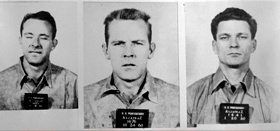
Forty-five years ago today, on June 11, 1962, three men amazed the world by escaping from “escape-proof” Alcatraz prison in San Francisco Bay. Their intricate and audacious breakout scheme contributed to the decision to shut down the prison, which had stood as a severe symbol of the American criminal-justice system for 29 years.
Isla de los Alcatraces was named by a Spanish explorer in 1775. The “Island of the Gannets” (a gannet is a sea bird) was a rocky outcrop swept by wind and fog. It was the site of the first lighthouse on the West Coast.
Building atop an old fortification, the U.S. Army constructed a prison there between 1909 and 1911 to hold soldiers serving disciplinary sentences. Though the surrounding waters discouraged escape, they also made the prison expensive to maintain. All drinking water and supplies had to be brought from the mainland.
The Army gave up on the venture in 1933. But amid the well-publicized crime wave that had begun in the 1920s and accelerated during the Depression, the Roosevelt administration saw a chance to make a statement at Alcatraz about law and order. Attorney General Homer Cummings recommended that the place be turned into a grim, high-security dead end for the nation’s worst offenders. And so it was.
In the ensuing years, the Federal Bureau of Prisons sent two kinds of inmates to Alcatraz. The first were high-profile offenders such as the gangster Al Capone and the Rosenberg spy-case convict Morton Sobell. The second were incorrigible prisoners who had acted violently in prison or tried to escape from custody.
Among the latter were the four inmates who cooked up the 1962 scheme. Allen West, Frank Lee Morris, and the brothers John and Clarence Anglin were all three-time losers who had spent the better parts of their lives behind bars. West was doing his second stay at Alcatraz, for car theft, burglary, carrying a machine gun, and previous escapes. Morris and the Anglins had pulled off bungled bank heists. Alcatraz officers described Morris as “bitter, vicious and criminally inclined.”
West was thought to be the mastermind of the plot, but he was unable to fit through his escape hole in time and was left behind. The other three joined the handful of men who ever made it off the island.
The first escape attempt had come in 1936, two years after the prison opened. An inmate named Joe Bowers was shot to death trying to climb a fence. There were 13 more attempts during the years that followed. The score heavily favored the authorities: 25 men caught, 6 shot and killed, 2 drowned, and 5 missing and presumed drowned. Morris and the Anglins were destined to join that final category.
Anyone planning to break out of “the Rock” faced a formidable challenge. It was a small prison, with an average of only 260 inmates. Alcatraz had a third as many guards as prisoners, compared with a twelfth as many at other federal prisons. None of the cells abutted a perimeter wall, so a prisoner who got out of his cell still had to escape the cell house. The strict and unvarying daily routine included 12 formal inmate counts. Guards with guns manned galleries at the ends of the cell house. Electromagnetic metal detectors scanned inmates at numerous locations.
If a prisoner managed to escape the cell house or one of the industry buildings, he still had to cross a body of water that was perpetually cold and roiled by strong currents. Reaching the nearest land involved a swim of more than a mile.
West, Morris, and the Anglins understood that by the 1960s Alcatraz was aging. Some rules had been loosened; not all the guard positions were filled; the building was beginning to crumble. They used sharpened spoons to bore holes through the concrete at the back of their nine-by-five-foot cells (each prisoner had his own cell). They managed to dislodge enough of the wall around a small ventilation grate to be able to squeeze through it into a utility passage behind. They disguised their work for more than six months by fashioning fake walls and grills from cardboard and paint.
The art kits available to prisoners came in handy again as they constructed dummy heads out of cement powder, toilet paper, and other ingredients. They painted the masks flesh tone and added hair smuggled from the prison barber shop. The intent was to convince the guards they were sleeping, buying time to get away.
They scheduled the break for the night of June 11, after the last count at 9:30 p.m. The Anglin brothers and Frank Morris made it into the utility corridor and climbed pipes to the top of the cell block, where they had already loosened bars protecting a ventilation duct. They managed to reach the roof and climb down more pipes on the outside of the building. At the shore they unfurled a crude raft fashioned from more than fifty stolen or borrowed inmate raincoats, donned homemade life preservers, and entered the water.
In the morning a guard who reached through the bars to slap one of the inmates awake was amazed to see the prisoner’s head roll to the floor. A massive search was initiated, to no avail. Authorities found a paddle, two life vests, and a notebook with information about friendly contacts on the outside. They never located the men’s bodies. They listed them as “presumed drowned.”
Did the prisoners reach land? Authorities argued that the tidal currents streaming under the Golden Gate Bridge at the time would have made it nearly impossible for them to swim to shore. But in December of 1962 an inmate slipped through a window in the cell house kitchen and managed to swim to the base of the Golden Gate Bridge, where, suffering from hypothermia, he was recaptured. In 1955, as a stunt, the fitness guru Jack LaLanne had swum from Alcatraz to Fisherman’s Wharf while handcuffed.
When the incident was made into the 1979 movie Escape from Alcatraz, starring Clint Eastwood as Morris, it was implied that the men’s indomitable spirits had allowed them to reach freedom. We’ll probably never know.
The widely publicized security breach hurried the decision by Attorney General Robert Kennedy to close the expensive and deteriorating prison. The last prisoners departed in the spring of 1963. The island was symbolically claimed and occupied by Native American activists between 1969 and 1971, was turned over to the National Park Service, and has since become one of its most popular sites, attracting more than a million visitors a year for a fascinating and oddly moving tour. Visitors can see the cells from which the escapees fled and replicas of the dummies they left behind.
The job of housing the most notorious and recalcitrant prisoners was taken over by the “supermax” federal penitentiary at Marion, Illinois, which opened in 1963. In 1994 federal authorities built an “administrative maximum” prison in Florence, Colorado. The residents there include the terrorist mastermind of the 1993 World Trade Center attack, Ramzi Yousef; the “Unabomber,” Theodore Kaczynski; and the FBI-agent-turned-spy Robert Hanssen. No one has escaped from “the Alcatraz of the Rockies”—yet.