
“Mr. Gorbachev, Tear Down This Wall!”
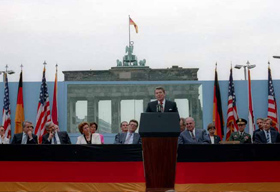
It is probably the Great Communicator’s most famous line, one he uttered on June 12, 1987—20 years ago today—while standing in front of the Brandenburg Gate at the Berlin Wall. And the speech is still well worth reading or listening to. But it is also a reminder of a great natural experiment in economics and political philosophy.
One of the reasons economics and the social sciences are so “soft” is the difficulty of rigorous experimentation. A scientist can subject one set of laboratory mice to a certain regimen, a second set to another, and then see how each fares. But what we can ethically do with mice we often can’t do with human beings.
No country, for instance, let alone an economically advanced and ethnically cohesive one, would allow itself to be divided in two, with one half under a capitalist democratic regime and the other under a Communist totalitarian one, just to see how things worked out. But when Germany surrendered its sovereignty in 1945, the international politics of the early Cold War era ended up doing exactly that. Under the Potsdam Agreement of July 1945, Germany was carved by the victors into four occupation zones. The Western zones became the Federal Republic of Germany (West Germany) in May 1949, and the Soviet Zone was turned into the German Democratic Republic (East Germany) in October of that year.
Also under the Potsdam Agreement, the German capital of Berlin, which lay deep in the Soviet Zone, was divided among the four powers. In 1948, as the Cold War rapidly deepened, the Russians tried to end the Allied occupation of West Berlin by blockading access to the city by both road and rail, expecting to starve it into submission. But the Berlin Airlift was able to supply the city until the blockade was abandoned, giving the West one of the major propaganda victories of the early Cold War.
As Germany recovered from the devastation of World War II, the results of the natural experiment became more and more obvious. The capitalist economy of West Germany soon became known as the “German miracle,” as it expanded rapidly to become, once again, the strongest economy in Western Europe. East Germany’s planned economy, while better than most of its Eastern European counterparts, was comparatively stagnant, weighed down by below-market exports to the Soviet Union (which remained in control, despite nominal sovereignty for East Germany), excessive military expenditures, and bureaucratic mismanagement. Much of the war damage began to disappear rapidly in West Berlin but remained visible in the Eastern part of the city, a vivid symbol of economic and political failure.
And of course the vibrant, free society of West Germany contrasted ever more sharply with that of the oppressive, police- and informant-haunted East. In 1953, when the East German government announced a 10 percent increase in work quotas for a construction project and cuts in pay for any workers who did not meet the new quotas (behavior remarkably reminiscent of nineteenth-century American capitalists’ dealings with labor), the result was a general strike. The strike was ruthlessly suppressed by Russian tanks at the cost of more than a hundred lives (again reminiscent of nineteenth-century American capitalists, who often relied on state police to end strikes).
The contrast between the two parts of the German nation produced a sort of social osmotic pressure across the border between them. Germans, given the opportunity, much preferred the capitalist West to the Communist East and sought to move there in ever-increasing numbers. The border between East and West Germany proper was guarded with barbed wire, watch towers, and massive military forces on both sides, making crossing it very difficult indeed, but that the city of Berlin was a different story.
Although it was divided politically, movement between East Berlin and the rest of the city was relatively unrestricted. Many people had families on both sides of the line and traveled to jobs across it on a daily basis. The division between East and West Berlin ran right through buildings and ignored the city’s subway system, which had been built decades earlier and continued to function despite the division.
Thus if one was willing to abandon all but what one could carry, fleeing to the West in Berlin was, at least compared with elsewhere in the Soviet Eastern European empire, easily accomplished. Between 1949 and 1961, some 2.5 million East Germans—more than 15 percent of the population—fled to the West, voting with their feet for economic and political freedom. Worse, a disproportionate share of the refugees were from the most educated and capable segment of the population. The result of the natural experiment, measured in migration, was clear.
It was, of course, a profound embarrassment to the governments of East Germany and the Soviet Union, both of which claimed to rule in the name of the people. But the only possible solution was nearly as embarrassing: building a wall across Berlin and dividing the subway system. However, in 1961 the East German government decided it had no choice, and on August 13 it began constructing what it termed—in a phrase George Orwell would have loved—the “Anti-Fascist Protection Rampart.”
At first it was simply a barbed-wire fence 96 miles long, carefully erected a few feet inside East German territory. The next year a second fence was built about a hundred yards inside the first, with buildings torn down as necessary between them, creating a cleared zone. Those trying to escape could now be easily spotted and shot, for the Eastern border guards had orders to kill anyone they saw trying to cross into West Berlin. In 1965 work began on a concrete wall, and a decade later an improved wall was built, completed in 1980. It is this last wall that is usually seen in photographs.
The Berlin Wall accomplished its purpose in preventing people from escaping to the West. Only about 5,000 managed to do so between 1961 and 1989. At least 192 died trying. But by the time the wall achieved its final form, the Soviet Union and its East European empire were rotting within, although that was not yet apparent, even to the intelligence services of the West. The new economic world opened up by the microprocessor, developed in 1971, could not be exploited by the increasingly creaky and arteriosclerotic Soviet system. Reform was ever more necessary, but the Soviet government was not able to undertake it.
Leonid Brezhnev, the Soviet leader since 1964, had become increasingly feeble and out of touch and was responsible for the disastrous decision to invade Afghanistan in 1979. Brezhnev died in 1982 and was succeeded by Yuri Andropov, former head of the KGB, who was already mortally ill and died only 15 months later. He was succeeded by Konstantin Chernenko, who also died after little more than a year.
The attitudes of Western leaders about how to deal with the Soviets and their East European empire also changed. The invasion of Afghanistan ended the era of “détente,” as the United States imposed a grain embargo and other sanctions. And new leaders, especially Prime Minister Margaret Thatcher of Great Britain, Pope John Paul II, and Ronald Reagan, who became President in January 1981, wanted to challenge the Communist empire, both morally and, by building up Western forces, militarily.
Reagan called the Soviet Union an “evil empire” in 1983, rhetoric that would have been impossible even a few years earlier and that caused much tut-tutting on the left. By the late 1980s, with the young, vigorous, and very reform-minded Mikhail Gorbachev now in charge of the Soviet Union, perestroika (reform) and glasnost (openness) became the new Soviet policies. The Soviet Union desperately needed to reduce its military expenditures in order to reform. Its East European empire, held only by military might, was an increasing burden.
John Kenneth Galbraith once said that “all successful revolutions are the kicking in of a rotten door.” In the summer of 1989, only two years after Reagan’s challenge, the kicking began. In August, Hungary opened its border with Austria, and 13,000 East German tourists poured over it. In September, demonstrations erupted all over East Germany, with people shouting “Wir wollen raus” (“We want to get out”)—but the phrase soon changed to the far more ominous, for the East German government, “Wir bleiben hier” (“We are staying here”). The longtime head of the East German government, Erich Honecker, resigned on October 18, 1989. On November 9, a government minister declared on live television that the travel ban to West Germany would be lifted “immediately.” Thousands of East Germans mobbed the checkpoints in Berlin and though the border guards had not had time to be informed, no one was willing to give the orders to shoot, and the wall essentially ceased to exist, except as a physical artifact. It was torn down over the next few weeks by hundreds of thousands of ecstatic Germans on both sides.
The Cold War was over and its most visible symbol gone. Did Ronald Reagan’s challenge in the wall’s very shadow and in front of its most famous door, the Brandenburg Gate, make that possible? No. But it surely hastened the day. It might, perhaps, be said to have been the first kick against that rotten door.
[Addendum: There is an interesting post over at the Power Line blog in which the speechwriter writes about how the speech came to be written. There is also a clip of the heart of the speech. It's worth a visit.]