
Nazi Saboteurs Land on Long Island!
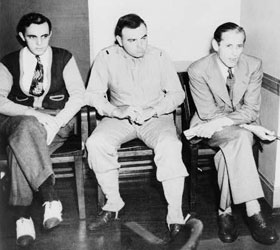
Shortly after midnight on June 13, 1942, a German submarine lifted off the bottom, where it had been waiting, and surfaced near the sleepy eastern Long Island town of Amagansett. It soon put ashore four men wearing German uniforms. They had with them explosives and other demolition equipment sufficient for a two-year career in sabotage, plus $175,200 in cash—more than $2 million in today’s money.
The German government had decided that a major sabotage operation would be the most efficacious way to harm the nascent American war effort and damage American morale. Four days later, another team of four saboteurs landed at Ponte Vedra Beach, near Jacksonville, Florida. But the entire operation was a fiasco virtually from the first minute, and by June 27, 65 years ago today, all eight men were in the hands of the FBI.
Luck plays a major part in any military operation, especially one such as this, and luck was not with the Germans that foggy night at Amagansett. They had been wearing uniforms so that if caught in the act of landing they would be treated as prisoners of war. But as soon as they changed into civilian clothes—thus becoming unlawful combatants—and buried their uniforms and equipment to be retrieved later, a 23-year-old coastguardsman named John Cullen, on beach patrol, encountered them.
The saboteurs all spoke English well, having lived in the United States for considerable periods before the war. Indeed, two of the eight were naturalized American citizens. And they had been carefully trained both in sabotage techniques and in blending into the local population to escape detection. Regardless, they made a total hash of it when the coastguardsman showed up. The leader of the saboteurs, George Dasch, told Cullen they were fishermen who had run aground. When one of the four men, incredibly, spoke in German, Cullen knew something was up. Dasch gave him $260, saying, “Forget about this. Forget you ever saw us.” Cullen took the bribe to assuage the men’s fears, faded back into the fog, and ran to the Coast Guard station to give the alarm.
By the time the Coast Guard got to the spot where Cullen had encountered the saboteurs, however, they had made their way to the Amagansett train station and boarded an early morning train to New York City. There they took hotel rooms. The Coast Guard was, however, able to find the buried equipment.
Once in New York City, Dasch got cold feet. He talked one of his compatriots, Ernest Peter Burger, into alerting the American authorities and called the FBI, giving his name as “Pastorius.” He told them he had recently come from Germany and would call FBI headquarters in Washington the following week.
The four men who were put ashore in Florida had better luck. After they changed into civilian clothes and buried their equipment for later retrieval, they made their way to Jacksonville undetected and from there went by train to Cincinnati. Two then went to Chicago and two to New York.
On June 19 Dasch traveled to Washington, checked into a hotel, and called FBI headquarters. He told them he was Pastorius, and where he could be found. He was immediately taken into custody and told the FBI all he knew. (Their plan had been to sabotage aluminum and magnesium plants and canals, waterways, and locks, as well as to plant bombs in Jewish-owned department stores.) On June 20, the other three saboteurs who had landed on Long Island were taken into custody. The two saboteurs who had traveled from Florida to New York were arrested on June 23, and the two in Chicago on June 27. Almost all their money was recovered and later deposited in the Treasury.
Brought to Washington, the eight were tried before a military commission (after the Supreme Court had unanimously decided that such a means of dealing with unlawful combatants was proper). President Roosevelt wanted a high-profile trial to send a message to Germany about what happens to saboteurs, and that was exactly what he got. The story of the capture and trial was front-page news all over the country.
The trials, held in the Department of Justice building, ran from July 8 to August 4. The prosecution was headed by the Attorney General himself, Francis Biddle, and the Army Judge Advocate General, Maj. Gen. Myron Cramer. The defense lawyers were also distinguished; they included Col. Kenneth Royall, who would later serve briefly as President Harry S. Truman’s Secretary of War, and Maj. Lauson Stone, the son of Chief Justice Harlan Fiske Stone.
With the evidence overwhelming and two of the eight defendants cooperating, the results of the trials were never in doubt. On August 4 all eight men were condemned to death, to be executed in the electric chair at the District of Columbia jail. Biddle and the FBI director, J. Edgar Hoover, both asked Roosevelt to commute the sentences of the two saboteurs who had made the capture and conviction of the others possible. Dasch was sentenced to 30 years and Burger to life in a federal penitentiary. The other six were executed on August 8, less than two months after their landing on American soil. Many of those the men had contacted before their apprehension were arrested, and some were tried and convicted of treason or other crimes.
There were no further incidents of attempted sabotage during the war, although late in the war two men whose mission was spying, not sabotage, were landed by submarine in Maine and captured about a month later. Evidently Roosevelt’s message had been received loud and clear, for it was learned after the war that the Germans had never again tried to put saboteurs ashore.
In 1948 President Truman granted Burger and Dasch clemency, provided that they agreed to deportation to the American Zone of occupied Germany.
In the end the affair was a minor one, thanks to a little luck and a case of cold feet. Had luck gone the other way and had Dasch had more backbone, serious damage to the war effort might well have resulted.