
Why Does America Have Such Strange Borders?
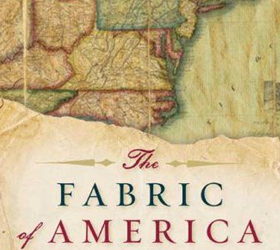
“The acknowledgment of a definite line of boundary to the South Sea,” John Quincy Adams wrote, calling the Pacific Ocean by its former name, “forms a great epocha in our history.” He was referring to an 1819 treaty with Spain that not only gave Florida to the United States but set a national boundary that ran roughly up the far edge of the Louisiana Purchase and then followed the 42nd parallel all the way west, giving the U.S. control of land straight through the northern Rockies to the ocean. “For the first time, the United States ran from coast to coast,” Andro Linklater points out in his new book, The Fabric of America: How Our Borders and Boundaries Shaped the Country and Forged Our National Identity (Walker, 304 pages, $25.95). It’s a wide-ranging, readable look at the physical, political, and social implications of, and stories behind, America’s state and national boundaries.
Adams was proud of the hard bargaining that had led to one of the most important additions to U.S. territory ever. But he knew that with new borders came new problems. Would the vast new territory permit slavery? How far north did the U.S. land extend in the Northwest? The Missouri Compromise a year later settled the first question, at least temporarily, by setting the northern limit of slavery in the territories at 36 degrees, 30 minutes north. The second almost brought the nation to war with Britain, as those who pushed for a far-north border rallied under the slogan “Fifty-four forty or fight.” The two countries finally settled on the 49th parallel as the boundary with Canada through to the coast.
Linklater emphasizes the difficulty with which most boundaries in the New World were set. In Europe, frontiers were usually associated with rivers and other natural landmarks and had long been delineated. Here, borders were drawn arbitrarily along lines of longitude and latitude and remained to be accurately surveyed and marked. This presented a formidable challenge in the eighteenth century. It is telling that our first President was a surveyor.
The main protagonist of the book is Andrew Ellicott, the top surveyor and one of the most important astronomers of early America. Linklater gives vivid accounts of the team of surveyors and axmen that Ellicott led through the wilderness of western Pennsylvania to determine that state’s northern and western boundaries. Fighting rugged terrain, swarms of mosquitoes, and thick stands of poison ivy, Ellicott determined his position by precise astronomical observations of the moon, stars, and planets, followed by hours of complicated calculations. Measurement with modern instruments determined that the boundaries he painstakingly laid down in the 1790s were accurate to within a foot a mile, and that the corner he established for the state was off by only 23 feet.
The Fabric of America includes an interesting discussion of what the author calls the “fragility of the idea of the United States compared with the robust reality of the states.” In the early Republic, the term “United States” was used with a plural verb. The vague boundaries of the states, based primarily on royal charters drawn up in ignorance of New World geography, resulted in decades of disputes and even bloodshed, but the loyalties of the inhabitants were clear. Troops from New Jersey, on arriving at Valley Forge during the Revolution, initially refused to swear an oath to United States because, they said, “New Jersey is our country.” In 1782 Thomas Jefferson still referred to Virginia as “my country.”
The author points to the formation in 1783 of the Northwest Territory, the first swath of land specifically under federal rather than state control, as instrumental in increasing the power of the federal government. “In the short term, the national domain beyond the Ohio River simply offered the central government the prospect of a source of income, but in the long term it was to be the arena in which an American identity was formed.”
The westward march of official boundaries brought law and property protection to frontier settlements, giving pioneers security in titles and ownership. But it also brought taxes. The resistance to these impositions by cash-poor settlers led to incidents like Shays’ Rebellion, the armed uprising of western Massachusetts farmers in 1786, and contributed to the failure of the Articles of Confederation. “Perversely,” Linklater notes, “the states’ very efficiency in administering their territories and paying their debts succeeded in producing an impression of chaos.” Out of this situation came the Constitution and strong central government.
While Pierre L’Enfant is widely recognized for his contribution to the layout of Washington, D.C., Linklater points out that L’Enfant, who had accompanied the Marquis de Lafayette to America during the Revolution, had “no scientific training, no technical background, and no experience in drawing up accurate, scale maps.” He was dependent on Andrew Ellicott when it came to turning his grandiose scheme for the nation’s capital into a physical reality.
Linklater gives a fascinating account of the huge project, including Ellicott’s notion of calling the longitude of the capital zero degrees, thereby establishing a new prime meridian to replace the one established in Britain. The scheme had merit in allowing exact measurement from a base point, but the idea didn’t take hold.
The author has a bone to pick with the turn-of-the-century historian Frederick Jackson Turner, who emphasized the importance of the wide-open frontier in shaping the American character. “The frontier is productive of individualism,” Turner wrote. “The tendency is anti-social.” Linklater asserts that “what made the settlement of the West such an iconic American experience was precisely that it took place under the umbrella of the U.S. government.” Although pioneers may have viewed the tax-gatherer as “a representative of oppression,” as Turner held, they also depended on government to protect claims and property and thereby allow individuals to gain the benefit of their improvements. “Without the government and its laws, there would have been no Chisholm Trail,” Linklater states.
Economists have lately been asserting that we’re reaching the peak of a housing bubble. Americans have borrowed on their equity, refinanced, and driven the price of real estate skyward. Linklater reminds us that buying and selling land has been an American preoccupation throughout our history. He shows how rampant speculation has taken hold in each new section of national territory, fueled by dreams but dependent upon reliable and accurate boundaries.
“States have . . . often been whimsically enough formed. We have left the matter of boundaries to surveyors rather than to statesmen,” Woodrow Wilson lamented in an essay in 1890. But perhaps it was just as well.