
250 Years and Still Publishing
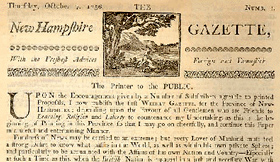
“Fondness for news may be carried to an extreme, but every Lover of Mankind must feel a strong Desire to know what passes in the World.” So wrote Daniel Fowle 250 years ago this week in the first issue of The New Hampshire Gazette, the oldest existing newspaper in the United States.
Fowle thought readers would want to make a particular effort to stay informed “in such a time as this, when the . . . nation is engaged in a just and necessary war.” In October 1756 Britain was carrying on the French and Indian War, its fateful armed conflict with France for dominance in North America. The mother country’s clumsy attempts to pay for the war by taxing her colonies would create friction over the coming two decades, culminating in the American struggle for independence.
Fowle, whom a contemporary described as “pacific in his disposition, agreeable in his manners, liberal in his sentiments, and attached to the cause of his country,” had endured his own struggle over basic liberties. In 1754, while a printer in Boston, he had expressed his dissatisfaction with a tax on rum by publishing a biting satire. His essay “Monster of Monsters” depicted the two houses of the Massachusetts government as competing ladies’ clubs. Street urchins who peddled the anonymous pamphlet denied knowing its source, claiming it had “dropped from the moon.” The upshot was a five-day term in the rat-infested Boston lock-up, to which Fowle responded with a second manifesto, “A Total Eclipse of Liberty.” Two years later he moved his press to Portsmouth and started his weekly.
Press freedom had emerged only gradually in North America. Benjamin Harris had published the colonies’ earliest newspaper in 1690. His Publick Occurrences Both Forreign and Domestick debuted with a detailed account of the barbarous treatment of French prisoners of war by Indians allied with the British. As a result, his first issue had also been his last. He had offended the royal authorities, who forbade any publication lacking official license. It was 14 years before another publisher dared put out a newspaper in America.
The editors of early-eighteenth-century papers played it safe by printing stories lifted from English papers, notices of deaths, and official proclamations. Six-month-old news and toadying editorial postures attracted few readers, and circulation lagged.
Benjamin Franklin began publishing The Pennsylvania Gazette in 1729 and stretched the limits of censorship by couching his mild criticisms of the government in stylish wit. John Peter Zenger struck a famous blow for press freedom in 1735 when he was acquitted of seditious libel by asserting that what he had written in his New York Weekly Journal was simply the truth. By the time Fowle started his Portsmouth paper, governmental curbs on press freedom were beginning to loosen.
By the 1770s The New Hampshire Gazette was one of 37 newspapers in the colonies, almost all of them weeklies. Lacking reporters, they lifted news from one another to fill their four-page editions. They helped fuel the growing restiveness of the population, and Daniel Fowle himself leaned toward the rebel cause. In Boston he had been the first to publish the words of Samuel Adams. His Gazette greeted the 1770 Boston Massacre with the notice “Bloody work in Boston.” A week later his paper proclaimed, “This BLOOD calls aloud for VENGEANCE.” Though we imagine news of the April 1775 dust-up at Lexington and Concord to have been heard round the world, The New Hampshire Gazette was one of only two colonial journals to feature it on the front page, and the only one to include a headline (“BLOODY NEWS”).
Political winds were shifting quickly in those tumultuous days, and Fowle soon found himself attacked from another direction. In early 1776 the New Hampshire Provincial Congress reprimanded him for printing an “ignominious, scurrilous, and scandalous piece” questioning the need for independence from Britain. As a result, he briefly suspended his paper.
He died in 1787 at the age of 72. He had already handed over his newspaper to an apprentice. The Gazette was first recognized as the earliest surviving paper in the country in 1839 when an older journal ceased publication. It became a weekly supplement to the daily Portsmouth Herald beginning in the 1890s. It merged into the Herald altogether in 1960, but the masthead stated, “Continuing the New Hampshire Gazette.”
In 1989 Steven Fowle, a cousin many times removed of the founder, returned the Gazette to independent publication. He put it out intermittently over the next 10 years and has been issuing it as a regular biweekly ever since. A number of other American papers have staked claims to longevity records, applying various criteria, but the bonafides of The New Hampshire Gazette are as sound as any (Fowle has even trademarked the phrase “the nation’s oldest newspaper”).
Steven Fowle was a child when his father told him the story of a distant ancestor who had gone to jail for freedom of the press. He has lived up to Daniel’s independent spirit, leading off each issue with a “Fortnightly Rant” that takes to task the follies and foibles of government.
“Evolving technology has made it much easier to put out a paper on the scale of Daniel Fowle’s,” he says. He composes each issue using two computers and a scanner and hires out the printing. “Not having a large capital investment means we are free to criticize at will.”
Indeed, one of his goals is to counteract the increasing homogenization of the media caused by corporate mergers and buyouts. In that spirit he has followed the course set by Daniel Fowle in the premier issue of October 7, 1756, when he stated, “It is presumed that none will be offended if this paper discovers the Spirit of Freedom which so remarkably prevails in the English Nation.”