
America’s Big Surrender
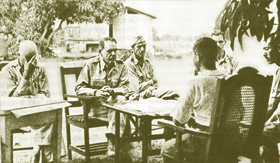
Sixty-five years ago today, on April 9, 1942, Maj. Gen. Edward P. King rode toward the Japanese lines in the Philippines to carry out the largest surrender of U.S. forces in history, ending the three-month siege of the Bataan peninsula. A Georgian whose grandfather had fought in the Civil War, King was acutely aware that April 9 was the date on which Robert E. Lee had set out on a similar journey to Appomattox Courthouse in 1865.
King’s capitulation was the prelude to the infamous “Death March,” one of the most brutal chapters of a cruel war. But on that sweltering Thursday morning, the general, acting on his own initiative, was interested only in preventing the wholesale slaughter of his men.
The Philippines had been an American possession since 1899. The “pearl of the Orient,” with its lush climate, had long been a favorite army posting. Tension with Japan had mounted during 1941, but the attack on Pearl Harbor had nonetheless shocked the Americans stationed on the islands. A mix-up left a force of B-17 bombers on the runway at Clark Field north of Manila. Ten hours after the raid on Hawaii, the planes were destroyed by Japanese aircraft. The sudden strike, which gave the enemy domination of the air and sea, crippled America’s ability to defend her Far Eastern possession.
Japan’s plans called for a quick, 50-day campaign to conquer the islands. The assignment went to Lieut. Gen. Masaharu Homma, a brilliant military tactician who was markedly pro-Western in his sentiments and was an aesthete known as the “poet general.”
The goal for Homma’s 100,000-man 14th Army was to capture the island of Luzon and gain control of Manila Bay, the finest port in Asia. To do so, he needed to neutralize American and Philippine forces on the island of Luzon and reduce the island fortress of Corregidor, the “Gibraltar of the Pacific,” which dominated the harbor entrance.
The Japanese landed on Luzon’s northern end on December 22, 1941. One of the Americans’ prewar scenarios, War Plan Orange, called for a withdrawal to Bataan peninsula, across the bay from Manila, for a strictly defensive stand. Gen. Douglas MacArthur, the Allied commander in the Philippines, found the idea hard to swallow and at first tried to meet the foe on the beaches and at forward lines.
The American troops, aided by hastily trained Filipinos, were quickly overwhelmed. The retreat to Bataan began, but the delay meant that the peninsula could not be stocked with the provisions needed for a long defense. Combined with the inability to resupply by sea, this fact doomed the defenders. In fact, the top command had already conceded that the Philippines were indefensible. “There are times when men have to die,” Secretary of War Henry L. Stimson said in December.
MacArthur’s field commander was Jonathan Wainwright, a lean, hard-drinking general known to all as “Skinny.” Wainwright completed the withdrawal of 12,000 American and 66,000 Philippine soldiers and more than 25,000 civilians into the 25-mile-long thumb of land on January 1. The peninsula was well-suited for defense, with a mountainous spine, plentiful ravines, and a protective rainforest canopy. The troops had a decent supply of ammunition. What they lacked was food.
The gravity of the situation became apparent when the officers immediately put their men on half rations. Over the course of the three-month siege, the troops ate mules, monkeys, snakes, grubs, and silkworms. The poor rations made combat and maneuver difficult and contributed to the steady spread of disease.
In spite of these hardships, the Bataan defenders put up a fierce resistance to Homma’s force. While holding their front, they fought off an amphibious landing at their rear. They inflicted heavy casualties on the Japanese and forced on Homma the humiliation of requesting reinforcements.
On January 15 MacArthur promised reinforcements for his own troops. “Help is on the way,” he proclaimed. “Thousands of troops and hundreds of planes are being dispatched.” It wasn’t true. As MacArthur found out two weeks later, President Franklin Roosevelt had decided to concentrate the initial war effort on Europe. “Never before in history,” MacArthur observed, “was so large and gallant an army ‘written off’ so callously.”
On March 11, MacArthur complied with orders to leave his Corregidor headquarters on a PT boat and make his way to Australia. Wainwright became the commander in the Philippines, with King taking over for him on Bataan.
Everyone knew it was only a matter of time now. With supplies of quinine gone, hundreds fell ill with malaria. Gangrene, dysentery, and beriberi swamped the hospitals. Rations were cut even further. Surrender was never mentioned, though. Hong Kong had fallen, and the Dutch East Indies, and Singapore. Bataan held out.
On April 6, Japanese forces broke through the American lines, and for the next two days chaos reigned on the peninsula. Philippine troops streamed south or melted into the jungle. Units evaporated. Japanese guns moved within range of the overcrowded hospitals.
The American high command still ruled out surrender. From Australia MacArthur said of the Bataan force, “If it is to be destroyed it should be upon the actual field of battle taking full toll from the enemy.”
General King saw it differently. “If I do not surrender to the Japanese,” he stated, “Bataan will be known as the greatest slaughter in history.” He took the entire responsibility on himself for countermanding orders from above. On the morning of April 9 he surrendered unconditionally. Wainwright disapproved of the decision at the time but later said it “required unusual courage and strength of character.”
Homma was anxious to get on with the work of shelling Corregidor from the Bataan highlands. First he had to move the opposing forces out. He had prepared for only a fraction of the prisoners who were now his responsibility. His negligence and the mass confusion that ensued contributed to the savage conditions that the prisoners were forced to endure.
The world would not learn until two years later the grim details of what participants stoically called “the hike.” The 75-mile march to Camp O’Donnell cost the lives of as many as 750 Americans and perhaps 5,000 Filipinos. Japanese guards beat and murdered prisoners along the way. Many more captives died in O’Donnell itself, a pestilent and overcrowded hellhole.
Wainwright held out on Corregidor for another month before he too was forced to capitulate. Both Wainwright and King expected courts-martial for disobeying the no-surrender order. But when they were freed three and a half years later they were treated as heroes.
General Homma, the victor, was stripped of his command after the American surrender. His superiors thought him too lenient, too easy on the native Filipinos, too slow in achieving his objective. He spent the rest of the war as a disgraced civilian, and in 1946 he was condemned by a U.S. military commission and executed as a war criminal.
The horror portioned out to the survivors sometimes overshadows the achievement of King, Wainwright, and the “battling bastards of Bataan,” both Americans and Filipinos. Poorly equipped and starving, they fought the Japanese war machine to a standstill for more than four months, forced the enemy to pay a heavy cost for its gains, and inspired a nation stunned by the defeat at Pearl Harbor.