
Andrew Mellon: An Unhappy Giant
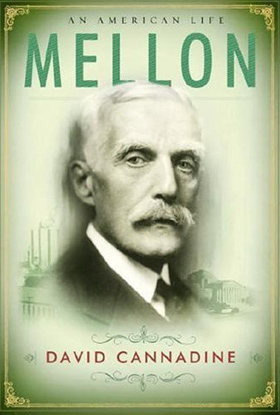
Andrew Mellon (1855-1937) was the most historically significant secretary of the treasury since at least Salmon P. Chase during the Civil War and perhaps since Alexander Hamilton himself. Appointed by Warren Harding in 1921 he served until 1932 and was so influential that Senator George Norris joked that “three presidents served under Mellon.”
Mellon was, perhaps, the very first supply-sider. In his book Taxation: The People’s Business (1924), he wrote, “It seems difficult for some to understand that high rates of taxation do not necessarily mean large revenue to the government, and that more revenue may often be obtained by lower rates.” During the early years of his tenure as treasury secretary, Mellon persuaded Congress to cut income tax rates substantially, lowering them to 25 percent for the rich and eliminating from the tax rolls altogether millions at the other end of the socioeconomic scale.
He also introduced the first overall budget process for the federal government. Before Mellon, each department simply submitted its requests to Congress on its own. The Budget and Accounting Act of 1921, largely his work, created a Bureau of the Budget in the Treasury Department. Government departments now had to submit requests to the Bureau; it put together revenue estimates and a comprehensive federal spending plan.
But that was by no means his only claim to fame. The son of a Scots-Irish immigrant father who began as a lawyer and judge and then became a highly successful banker in rapidly burgeoning Pittsburgh, Mellon from a very early age demonstrated a remarkable talent for business. So remarkable, in fact, that the elder Mellon turned over the running of the bank to his son when the latter was only 27, even though there were two older sons. Mellon proceeded to turn a considerable fortune into a huge one. To give just one instance of his talent for making money, he saw great promise when few others did in Charles M. Hall’s process for extracting aluminum from ore by means of massive amounts of electricity. He bankrolled the company that is now Alcoa.
He also had a passion for art, like his close friend Henry Clay Frick. Mellon, like Frick, acquired one of the country’s premier collections, and, like Frick, he gave it to the people. Mellon’s collection became the National Gallery of Art in Washington in 1940, three years after his death.
One would think that so hugely significant a figure, one who deeply influenced the American economy both as a businessman and as a public official, and who gave to the nation one of the world’s great collections of art, would have been the subject of many biographies since his death 69 years ago. But in fact David Cannadine’s new Mellon: an American Life (Knopf, 800 pages, $35) is the first. The New York Public Library’s catalogue lists only 11 books about Andrew Mellon, all of them scholarly studies, minor works, or polemics. (Congressman Wright Patman, a populist firebrand, wrote a short book called Bankerteering, Bonuseering, and Melloneering, not a title that promises much objectivity.)
Part of the reason for this strange silence is the fact that Mellon was a very private man and often silent himself. Slat-thin, with blue-gray eyes and an ample mustache, he looked the very model of the early-twentieth-century banker that he was. But he was very shy and personally standoffish even with his children, and he hated public speaking. He “rarely smiled and hardly ever laughed,” Cannadine writes.
Uncomfortable as he was with people in general, his marriage, contracted when he was in his forties, was an unmitigated disaster, ending in a scandalous divorce in 1912. His wife, often infuriated by his tendency to retreat into business, increasingly found that behind his “steely exterior . . . there was either something vaguely unpleasant—or nothing at all. He was a hollow man, with no interior life.”
An equally important reason Mellon has been neglected by historians was that he died too late. He was at the peak of his fortune and political influence in the 1920s, but by 1937 he had become both an anachronism and a scapegoat for the economic calamity that had befallen the country. After his death he seemed to be yesterday’s news.
David Cannadine has done a great job of telling the story of this immensely accomplished, deeply flawed, and unhappy man. Mellon: An American Life is a worthy latest addition to the growing list of recent biographies of such men as Andrew Carnegie, John D. Rockefeller, E. H. Harriman, and Jay Gould that treat these major figures in American history as the real flesh and blood that they were, not just as captains of industry or robber barons, depending on the politics of the author.
Mr. Cannadine, an Englishman, has previously written mostly on British subjects, including The Decline and Fall of the British Aristocracy, which won the Lionel Trilling Prize and the Governor’s Award. He exhibits the Englishman’s occasional failure to quite catch the American nuance, but that is more than balanced by his outsider’s clarity of vision.