
Anita Hill: Vindicated by History?
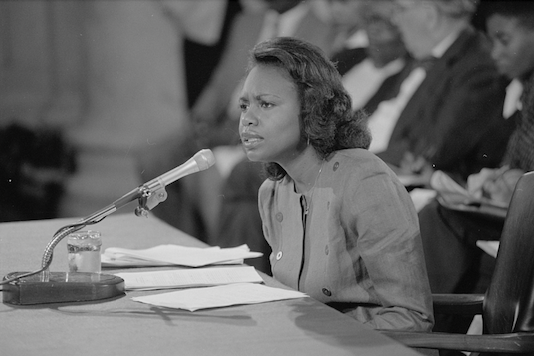
On October 11, 1991, fifteen years ago today, a witness gave testimony before the Judiciary Committee of the United States Senate of a kind never heard there before or since.
The Senate panel was deliberating on the nomination of Clarence Thomas, a 43-year-old appellate judge, to fill the seat on the U.S. Supreme Court left vacant by Thurgood Marshall. As in most confirmation hearings, the stakes were high and the atmosphere was tense. But on October 11, the hearings became more contentious than anyone would have imagined.
Anita Hill, a 35-year-old law professor at the University of Oklahoma and a former colleague of Thomas’s, sat before the committee and alleged a long history of sexual misconduct by the nominee. The Washington Post described Hill’s demeanor as “poised and unflappable,” but the words she spoke were sensational.
During their time working together at the Department of Education and the Equal Employment Opportunity Commission, Hill said, Thomas had made multiple advances to her. When she had rebuffed them, he had not been deterred; instead, he had begun to harass her, bragging in graphic language about his sexual talents and describing his obsessive interest in pornography.
Even before Hill’s testimony, powerful forces had lined up both in support of and in opposition to Thomas’s nomination. Thomas was a conservative choice for the bench, tapped to replace a reliable liberal. As a member of the Supreme Court, he would shift the court to the right for a generation. Many Democrats were bent on defeating him, and just as many Republicans were determined to see him confirmed. The allegations against him thus introduced explosive new evidence into an already volatile debate. Denying Hill’s charges, he was visibly shaken and angry. Where she was cool and collected, he was fiery, denouncing her testimony as an attempted “lynching” in which he was “caricatured by a committee of the U.S. Senate rather than hung from a tree.” The fact that both Thomas and Hill were black enabled people on both sides of the issue to accuse their opponents of racism.
After Hill’s testimony, the Judiciary Committee called additional witnesses in an effort to determine the veracity of her story. It heard from friends and coworkers of hers who said she had told them of Thomas’s actions before, if only privately. Two of the witnesses, Susan Hoerchner and John Carr, suggested that she had not publicly accused Thomas in the past for fear of undermining her career. None of them, however, could claim to have observed the alleged misconduct. In opposition to these witnesses, Thomas’s supporters called a series of women who had also worked with him at the E.E.O.C. They questioned Hill’s credibility and said Thomas had never treated them inappropriately. The charges seemed grave enough to threaten the nomination, but they were proving exceedingly difficult to confirm.
With his opponents still working to make their allegations stick, Thomas’s supporters attempted to discredit Hill. Strom Thurmond, the senior Republican on the Judiciary Committee, asked Pennsylvania Senator Arlen Specter to question her aggressively. Complying, Specter suggested that she might have perjured herself by attempting to conceal her preparatory discussions with Democratic opponents of the nomination. On October 12, in an attempt to make Hill seem delusional, one of Thomas’s law school classmates, a management consultant named John Doggett, signed an affidavit declaring that in the early 1980s she had fantasized about his being interested in her. In only a few days, the hearings had taken on a nastier and more personal tone than any in recent history. One of Thomas’s opponents, Arthur Kropp, president of People for the American Way, lamented, “This process is going to poison the water for a long time.”
In the end, Hill’s critics carried the day. By a vote of 52 to 48, the Democratic-controlled Senate made Clarence Thomas the second African-American justice in U.S. history. But after the tumult of the hearings, the debate over Hill’s testimony did not end quietly or quickly. A national conversation had started about the issues she raised. It was especially intense among women; a substantial portion of them faulted Hill for not having stood up to Thomas earlier. Many others sympathized with her and resented her harsh treatment by the Senate committee. Some felt that the male-dominated Senate had distrusted her testimony because its members couldn’t understand the suffering of a sexually harassed woman. Wanda Baucus, the wife of Montana Senator Max Baucus, had called Senator Specter in an attempt to intervene. “Committee members were saying things I just thought were contrary to the human nature that women know and experience and share with one another,” Ms. Baucus told the Washington Post. “I realized that these men had not been informed that these kinds of things do go on.”
The debate over Hill’s testimony has continued in the pages of books and newspapers ever since. And while a plurality of Americans were at first disinclined to believe her story, a consensus has slowly emerged that Thomas was very likely guilty of the allegations she raised against him. In 1994 two Wall Street Journal reporters, Jane Mayer and Jill Abramson, published Strange Justice, a thorough investigation of Hill’s claims and Thomas’s rebuttals. In it they revealed fresh information that bolstered Hill’s charges, including new witnesses who had not been called in 1991, as well as further evidence of Thomas’s fascination with pornography. Mayer and Abramson concluded that there were “virtually no pieces of evidence that would suggest [Hill] was either a liar or a fantasizer.” That Thomas was finally confirmed, they wrote, “raises fundamental questions about the political process that placed him on the court.” Other works have given further credence to Hill’s testimony, among them a book by David Brock, one of her earliest and most vicious critics, who reversed course in 2002 and claimed: “Thomas was complicit in an effort to discredit another witness against him [Hill] with negative personal information.”
Since joining the Supreme Court, in 1991, Clarence Thomas has maintained a largely quiet and undistinguished presence on the bench. He rarely asks questions during oral arguments, nearly always deferring to his similarly conservative and more loquacious colleague Antonin Scalia. But if Thomas was bowed by his confirmation process, so was the United States Senate. As Senator John Danforth, a top backer of his, has reflected, the debate over the nomination was largely an “extralegal process,” based more on personal attacks than legal questions. The nomination proved to be a climactic event in a partisan battle for the Supreme Court that for sheer ugliness has yet to be surpassed.