
Branch Rickey Changes Sports—and America—Forever
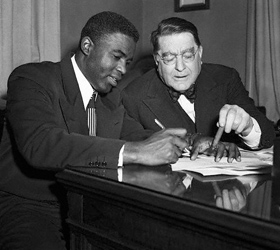
For one of the most momentous events in the history of baseball, it happened in a quiet way. Sixty years ago today, on April 10, 1947, the Brooklyn Dodgers were playing the Montreal Royals, one of their own minor league teams. A talented 28-year-old Montreal infielder had just hit into a double play when Arthur Mann, the assistant to the president of the Dodgers, showed up in the press box. On the instructions of his boss, Branch Rickey, Mann delivered a short note to the assembled reporters: “The Brooklyn Dodgers today purchased the contract of Jackie Roosevelt Robinson from the Montreal Royals.” Robinson, whose at bat had just cost his team two outs, was making history. That 15-word press release told the world that Robinson was to be the first black player on a major-league baseball team in the twentieth century.
Robinson was an ideal candidate for the epochal role. His athletic talent was indisputable. As a college student at UCLA, he had competed successfully at football, basketball, baseball, and track. As a professional ballplayer he had won comparable distinction. In the year before his signing, playing for Montreal, he had batted .349 and stolen 40 bases. His fielding percentage of .985 was the best of any second baseman in the minors. He had recently come close to batting .400 against the Dodgers in exhibition games. During spring training his hitting had attracted the attention of the Dodgers’ manager, Leo Durocher. Durocher had approached Rickey with the idea of promoting the young athlete to the majors. Rickey had consented.
In signing Robinson, Rickey and Durocher were not primarily trying to make civil rights history. First and foremost they just wanted a talented ballplayer. Durocher is probably best known today for his aphorism “Nice guys finish last.” At the time of his death, in 1991, he was called “baseball’s best example of the win-at-all-costs manager.” He simply considered Robinson too valuable to pass up for reasons of race. Rickey agreed. Of course, both men understood the stir they were about to make. Rickey said to Robinson, “I want you to be the first Negro player in the major leagues. I’ve been trying to give you some idea of the kind of punishment you’ll have to absorb. Can you take it?”
Robinson, however, was not just a highly talented athlete. He was a World War II veteran who had retired as a lieutenant, so when he signed with the Dodgers he already had significant experience crossing his country’s color line. When Branch Rickey asked him if he was prepared to face racism, he could confidently say he was.
At first his signing was actually overshadowed by another development on the team. Durocher, the Dodgers’ manager, was caught up in a salacious story. Because of a number of vaguely described “unpleasant incidents,” including a high-profile feud with one of the Yankees’ owners and a scandalous affair with the married actress Laraine Day, Durocher had been suspended for the whole 1947 season by baseball commissioner A. B. “Happy” Chandler. Rickey would rehire him for 1948, but for now Dodger fans were up in arms about his punishment.
Even with Durocher out, Robinson got off to a good start with the Dodgers. And after the manager’s return, Robinson’s career continued to thrive. An accomplished infielder and a good, solid hitter, he was not the kind of player who made headlines by slugging home run after home run. When he retired from the game, in 1957, he had a very solid lifetime batting average of .311. As Rickey had predicted, however, his path to acceptance had not been easy. There were death threats against him, pitches thrown at him, racist taunts, and even incidents of spiking—the Cardinals’ Enos Slaughter once “slid far from the base path to slash at Robinson’s ankle” with the metal of his cleats.
He endured these indignities and became a truly great ballplayer. Yet according to his wife, Rachel, he “didn’t see baseball as the peak of his life.” He hoped to play a more expansive role in national events. He never became a full-time activist, but he used his fame as the first black major leaguer to advance civil rights throughout his career.
In the 1950s he wrote to President Dwight Eisenhower urging him to act more boldly on the issue. Eisenhower responded with a statement declaring, “Every citizen of every race and creed deserves to enjoy equal civil rights and liberties, for there can be no such citizen in a democracy as a half-free citizen.” The radical black leader Malcolm X would later call Robinson a sellout and deride his integration of baseball as a hollow, symbolic achievement. But in the final analysis, Robinson’s greatest impact clearly was in the realm where he started his career, sports. After he broke baseball’s color line, other black athletes started to play professional football the next year, and basketball followed in 1949. He also paved the way for Latino athletes, whose rise to national prominence began with Roberto Clemente’s emergence just a few years later.
Today members of racial minorities dominate professional sports, with nonwhite athletes more the norm than the exception. Upon Robinson’s death, Elston Howard, the first black to play for the New York Yankees, reflected on the second baseman’s contribution: “He did it for all of us, for Willie Mays, Henry Aaron, Maury Wills, myself.” In the present day, we might add Michael Jordan, Alex Rodriguez, and Tiger Woods to the list of Robinson’s heirs.