
The Confusing Moment When Israel Was Conceived
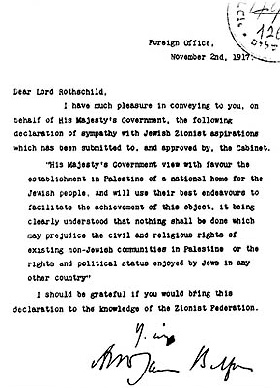
Ninety years ago today, on November 2, 1917, Arthur James Balfour, the British foreign secretary, sent to Lord Rothschild, an influential figure in the British Zionist Federation—a group advocating the creation of a Jewish homeland—what became known as the Balfour Declaration. The document is widely considered to have been the first step toward the birth of the nation of Israel. It also was the cause of worldwide puzzlement and disagreement about just what England was promising to whom.
The whole Balfour Declaration is only 129 words long:
Foreign Office
November 2nd, 1917
Dear Lord Rothschild,
I have much pleasure in conveying to you, on behalf of His Majesty’s Government, the following declaration of sympathy with Jewish Zionist aspirations which has been submitted to, and approved by, the Cabinet.
“His Majesty’s Government views with favour the establishment in Palestine of a national home for the Jewish people, and will use their best endeavours to facilitate the achievement of this object, it being clearly understood that nothing shall be done which may prejudice the civil and religious rights of existing non-Jewish communities in Palestine or the rights and political status enjoyed by Jews in any other country.”
I should be grateful if you would bring this declaration to the knowledge of the Zionist Federation.
Yours,
Arthur James Balfour
The declaration proper, the middle paragraph, is only 67 words. But a staggering number of pages on its consequences have been written since—which would have astonished the British cabinet in which Balfour served.
When the declaration was made, Britain didn’t yet control the land it was proposing as a “national home” for the Jewish people, though it soon would, and the nation had many concerns more pressing than the future of a small portion of what was then Turkish-controlled territory. The outcome of World War I was still very much in doubt, and Britain hadn’t yet conquered Palestine, still a possession of the Ottoman Empire. British forces were in the midst of a battle on the southern edge of Palestine, having twice that year attacked but failed to take Gaza. But within a week Gen. Edmund Allenby would crush the Turkish army in southern Palestine, and on December 11 he would enter Jerusalem. By September 1918, the British controlled all of Palestine.
Unfortunately, by then a lot of people thought Britain had promised them that contentious patch of territory. In a letter dated October 24, 1915, Sir Henry McMahon, His Majesty’s high commissioner in Egypt, had written a letter to the Sharif of Mecca that most Arabs thought promised them Palestine as part of an Arab state to be created after a British victory over the Ottomans, in return for Arab support in the war. And to further complicate matters, the Sykes-Picot Agreement of May 1916 had indicated that most of Palestine was to be administered by a partnership of nations, after negotiations with Russia and other powers.
Why would Britain promise the same territory to so many different parties? A lot of ink has been spilled over that question. Some have pointed out that Britain had pledged “the Jewish people” a “national home,” not a state; had explicitly protected the “civil and religious rights” of non-Jews in Palestine; and had excluded from the territory promised to the Arabs “portions of Syria lying to the west of the districts of Damascus, Homs, Hama, and Aleppo.” Others have countered that though the Balfour Declaration spoke of a national home rather than a state, a fair number of British officials at the time thought a state was exactly what was meant.
Britain later wavered on that point, but before much of the wavering began, the League of Nations translated the Balfour Declaration into a Mandate for Palestine on July 24, 1922. The new Mandate referred to the Balfour Declaration explicitly and proclaimed both “the historical connection of the Jewish people with Palestine” and the justice of “reconstituting their National Home in that country.”
On September 21, 1922, President Warren G. Harding signed a proclamation, passed by both houses of Congress, that echoed the language of the Balfour Declaration by stating that “the United States of America favors the establishment in Palestine of a national home for the Jewish people, it being clearly understood that nothing shall be done which may prejudice the civil and religious rights of Christian and all other non-Jewish communities in Palestine, and that the holy places and religious buildings and sites in Palestine shall be adequately protected.”
Jewish immigration to Palestine picked up, as did Palestinian Arab hostility to the prospect of a Jewish state there. In the wake of World War II, on November 29, 1947, the new United Nations divided up the Palestine Mandate that the now-defunct League of Nations had created. The plan, which envisioned separate Jewish and Arab states, took effect on May 15, 1948, and the newly created Jewish nation proclaimed itself the State of Israel. This outcome was sufficiently dramatic, and momentous, that its origin began to matter to a lot of people. As many saw it, Jews now had the national home in Palestine that the Balfour Declaration had promised them 30 years before.
As it happens, the Balfour Declaration was not the first time a European power had contemplated promising Palestine as a homeland for the continent’s Jews. Way back in 1799, while besieging Acre (now Akko, in Israel), Napoleon had drafted (but not issued) a proposal for a Jewish state in Palestine. Nor was Palestine the only area anyone had considered as a good place for a Jewish homeland. In 1820 an American-born diplomat, Mordecai Noah, had suggested establishing one on Grand Island, north of Buffalo, New York (24 years later, Noah proposed Palestine). In the early twentieth century, one Jewish group brought immigrants to Galveston, Texas, in hopes of establishing a non-sovereign Jewish refuge in the western United States. In 1935 another Jewish group proposed Australia, Ecuador, or Suriname for such a purpose. Theodor Herzl, generally considered the founder of modern Zionism, had wanted either Palestine (“our ever-memorable historic home”) or Argentina (“one of the most fertile countries in the world”).
In 1903 the British Colonial Secretary, Joseph Chamberlain, offered Herzl’s Zionist group 5,000 square miles of the Mau Plateau in what is today Kenya, and the Zionist Congress debated the idea seriously before rejecting it. The idea of Uganda did not die easily; Winston Churchill brought it up again during World War II. In 1934 Stalin created a Jewish Autonomous Oblast—a Jewish national district—in Birobidzhan, an area on the border of China. And by 1939 Japan had decided to attempt to make something like a national home for Jews in Manchuria, in what was called the Fugu Plan.
But Palestine was the place where a Jewish state was eventually created, and the Balfour Declaration became, if only in retrospect, the first step on the path that culminated in the creation of Israel.