
Fast-Food Nation or Gourmet Nation?
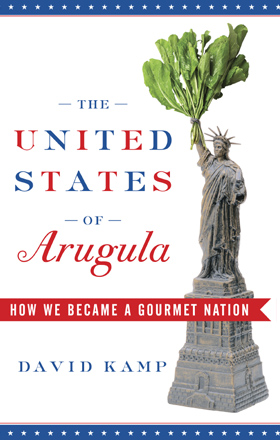
Is America at its culinary heart the land of fast food, of meals that are at once bland, uniform, and grossly unhealthy, as so many Europeans and disapproving Americans insist? Not according to David Kamp, author of The United States of Arugula: How We Became a Gourmet Nation (Broadway, $26). Kamp is beamingly upbeat about how our eating habits have evolved.
A writer for Vanity Fair and GQ, he chronicles changes in the American diet with humor and enthusiasm. He presents real analytical cultural history too, but he doesn’t conceal his simple exuberance for a food world that moves “with the lets-top-ourselves alacrity of Apple Computers and the anything’s-possible ambitions of 1960s NASA.” He declares, “It is, in short, a great time to be an eater.” In a nation of fad diets and obesity epidemics, Kamp’s history succeeds in provoking pride, understanding, and, most important, appetite.
The United States of Arugulatells the story of what its author calls a “lifestyle shift,” the expansion of high-level culinary enjoyment from a small elite of beef- and cream-stuffed restaurant-goers to a nation full of middle-class gourmets. After a brief survey of the first 170 years of eating in the United States, Kamp turns to the late 1940s. Americans were increasingly dining on frozen and canned foods then, and the few fancy restaurants served predictable menus of rich standards and overcooked vegetables. Cooks were all anonymous laborers, and food writers were relegated to the “home-economics ghetto” of newspapers’ women’s pages. But for all its mundane stiffness, American dining was on the brink of a revolution.
Three visionaries launched the revolution—Julia Child, James Beard, and Craig Claiborne. Child, the six-foot-two wife of a foreign service officer, was 50 and had no restaurant experience when she committed herself to introducing Americans to French cuisine. She hacked, flambéed, and warbled her way through her public television shows and several books on French cooking. James Beard, the son of an Oregon innkeeper, became the primary advocate for traditional American fare. Deeply passionate about food, he wrote books on grilling that helped bring male attention to what was widely seen as women’s work. Craig Claiborne, a Mississippi native, elevated American dining to an intellectual and artistic endeavor with his widely read New York Times restaurant reviews and recipe articles.
Kamp’s easy prose animates these trailblazers. Through his emphasis on their inexperience, their quirks, and their shortcomings, he demonstrates just how open the culinary frontier was in the postwar early-gourmet era. Claiborne, for instance, took his first step toward celebrity by simply telephoning The New York Times and asking the paper to do a story about him.
Yet as the cast of American chefs expands in the 1970s and ’80s to include organic farming proponents like Alice Waters and celebrity entrepreneurs like Wolfgang Puck, Kamp refuses to elevate his subjects too high. He quotes the food writer Barbara Kafka: “It’s like there was no food in this f---ing city until that miraculous apparition [Beard] came along . . . or there was no cooking at home until Julia [Child]!” He also follows the chefs into some of their darker moments, exposing Craig Claiborne’s alcoholism with tragic clarity. With its attention to its heroes’ ascents and declines, The United States of Arugula seems at times to be a culinary equivalent of VH1’s Behind the Music, chronicling the humble beginnings, remarkable breakthroughs, and bitter failings of the newest brand of pop celebrities.
Like Behind the Music, The United States of Arugula tracks influence as well as personal sagas to map out the drastic changes in our eating habits. Fifty years ago, only the most adventurous Americans would dine on sushi, pesto, or even an arugula salad; now millions purchase these meals from gourmet grocery chains like Whole Foods. There’s almost no place in America where people don’t snack on tortilla chips, re-energize with Starbucks coffee, and relax with Sam Adams beer. What was formerly gourmet has become so commonplace that we hardly notice it. It is this casual culinary revolution, launched by the big three and countless other innovators, that gives Kamp his faith in American eating.
Thankfully, he shows none of the snobbery that so often drives Americans from gourmet food. He happily points out that it was formerly low-end Italian food that suddenly became extremely trendy in the balsamic vinegar-drenched 1980s. He argues that our democratic discomfort with social hierarchy has led us to alter traditional European cuisines, so that that we tend to lump aristocratic repasts with the most common peasant meals at our French restaurants. Most uplifting of all, he refuses to dismiss food celebrities commonly seen as having sold out, extolling the tremendous kitchen skills of Emeril Lagasse and trumpeting Starbuck’s positive effect on the quality of American coffee. In the faddish and acerbic world of gourmet cuisine, David Kamp must be a brave man.
It is disappointing, therefore, that his history of earlier American cuisine falls short. To establish a nadir from which our tastes rose to their current heights, he discounts nineteenth-century American food, neglecting a previous culinary revolution when German immigrant cuisine—frankfurters, hamburgers, potato salads, and especially light lager beers—ascended to dominance in a nation with a primarily English food heritage.
American cooking was highly esteemed long before the mid-century dreariness Kamp rightly attacks. When visiting Europe Mark Twain pined for American food and even criticized Europe’s supposedly “feeble, characterless, undrinkable coffee” compared with “the rich beverage of home.” In Venice Twain wrote up a list of 81 dishes he planned to gorge on when he got home. James Beard dedicated himself to preserving traditional American recipes, from barbecue to oyster stew. Kamp doesn’t seem much interested in the fascinating hybrid of English, African, German, and Native American cooking this country enjoyed before the rise of industrialized agriculture. Strange in a book on American eating habits.
Yet this is all the criticism one can muster against such an outstanding work. Kamp succeeds, without a doubt, in linking changes in diet to history. He relies on exceptional storytelling to weave gourmet figures into generational tapestries, tying together personal and cultural history. The United States of Arugula vividly portrays several eras of American culture while leaving the reader genuinely pleased with the changes in our national diet.