
Following in the Footsteps of John Adams
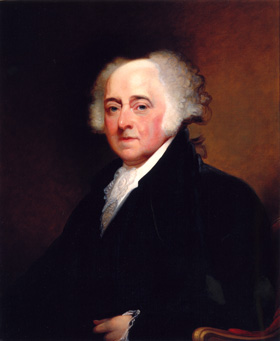
Despite enormous contributions in the Revolution and as our second president, John Adams has no impressive Washington, D.C. monument in his honor or currency bearing his likeness as do other founding fathers. This month, however, the spotlight finally shines on John Adams when HBO broadcasts its seven-part miniseries, based on David McCullough’s Pulitzer Prize-winning biography. The more than $100 million nine-hour series stars Oscar-nominated actors Paul Giamatti and Laura Linney. Tom Hanks serves as one of the executive producers.
The filmmakers shot the series in Colonial Williamsburg and Hungary (where extensive architecture from the period still exists), although most of the action occurred in Quincy, Massachusetts, on the outskirts of Boston. While commercial enterprises have wiped out the colonial landscape in modern Quincy, numerous Adams-related historical sites exist in the Adams National Historical Park.
Much like its namesake, the Adams National Historical Park is an underappreciated treasure, comprising of 11 buildings that include the birthplace and grave of John Adams and his son, John Quincy Adams. Adams Sr. named the estate that would be home to both presidents, “Peacefield,” “in commemoration of the peace which I assisted in making in 1783, of the thirteen years peace and neutrality which I have contributed to preserve, and of the constant peace and tranquility which I have enjoyed in this residence.” The park owns a collection of approximately 100,000 objects, including original furnishings, books, and archival materials donated by the Adams family in 1946.
A trolley takes visitors from the visitor center, located off-site, to each of the buildings, beginning with the five-room saltbox farmhouse where John Adams was born in 1735, the oldest U.S. presidential birthplace. The weathered and unpainted exterior; along with its Spartan interior reflects John Adams’ humble beginning as the son of a simple farmer.
In 1764, the 29-year-old Adams and his bride Abigail moved into another saltbox house only 75 feet from his birthplace, almost identical in shape and size except for the painted clapboard exterior of the newer residence. Their son, John Quincy Adams, was born there three years later. John Adams maintained his successful law practice in the house’s bright front room; here, Samuel Adams, James Bowdoin, and Adams drafted the Massachusetts Constitution in 1779, which served as a model for the United States Constitution. Law books still line the shelves. In the house’s kitchen, Abigail supposedly made “bullet soup” during the Revolution by melting the family’s pewter and making shot.
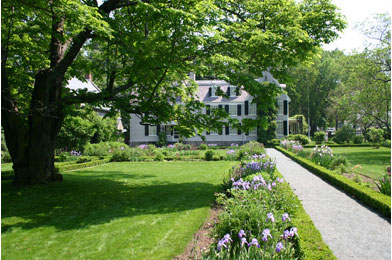
A little more than a mile away, on the next trolley stop, is the large, white 1730s clapboard residence purchased by the Adams’ in 1788, known as “the Old House” by the family. In 1796, Adams named the 80-acre estate surrounding the house “Peacefield.”
The Old House served as the Adams family estate for four generations. It was also home to President John Quincy Adams and First Lady Louisa Catherine Adams, Civil-War-Minister-to-Great Britain Charles Francis Adams, and literary historians Henry and Brooks Adams. Portraits of these great Americans and founding fathers of the country grace the walls.
The Old House was a welcome summer retreat for both presidents while in office. In 1799, John Adams spent nearly seven months away from Philadelphia at Peacefield, conducting matters of state in his comfortable study. When turned out of office by voters after a single term, both father and son used the Old House as a refuge. John Adams died in his study on July 4, 1826, the fiftieth anniversary of the adoption of the Declaration of Independence, after uttering the famous words, “Thomas Jefferson survives.” In fact, his former rival, with whom he had reconciled, had died earlier that day at Monticello.
Adjacent to the Old House sits the stately Stone Library. Built in the 1870s, the medieval-style library houses more than 14,000 volumes that belonged to the Adams family, a bibliophile’s dream with its balcony, ladders, and multitude of book-lined shelves. Charles Francis Adams built the structure to house his father’s and grandfather’s books and presidential papers, creating the nation’s first presidential library. Inside these walls, Charles Francis Adams wrote his father’s memoirs and his son, Henry Adams, wrote his classic nine-volume history of the United States. The library contains the desk that John Quincy Adams used on the floor of the United States Congress, where he served for 17 years after his presidency, and the Mendi Bible given to him by African captives aboard the Amistad whose freedom he secured in a historic Supreme Court case.
The trolley brings visitors back to within a block of the visitor’s center and the United First Parish Church, where both presidents and their first ladies are buried. A magnificent plaster dome caps the Greek Revival church. Inside, John Quincy Adams sat at pew 54. Beneath the sanctuary, a small crypt contains the presidential tombs, draped by American flags and engraved simply with their names.
During the two-hour-long tours, rangers argue that Adams is an unsung figure in American history. “The poor guy didn’t get much credit,” one ranger told our group. Another ranger wasn’t shy to point out that, unlike Adams, both Washington and Jefferson, while espousing the principles of freedom, were slave-owners.
There is a scene in the HBO miniseries when John Adams stands up and delivers his inaugural address. Seated in the background behind him are Washington and Jefferson. It’s a scene that is richly symbolic of how the second president is now taking a much-deserved turn at center stage. Perhaps, it’s a place where he will remain.
The historic homes are open between April 19 and November 10, and the Adams National Historical Park visitor center is open year-round. The United First Parish Church is accessible throughout the day. For more information about Adams National Historical Park, visit www.nps.gov/adam or call (617) 770-1175.