
The Hardest Winter of All
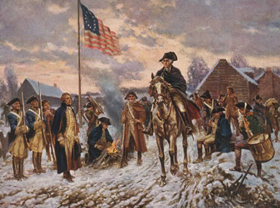
At the feet of Mt. Misery and Mt. Joy in southeastern Pennsylvania, where Valley Creek joins the Schuylkill River, a bustling ironworks operated in the 1740s. But all that remained of it by the time the Continental Army arrived on December 19, 1777, were the skeletons of buildings burned by the British and the name it gave the neighborhood: Valley Forge. The army would know a lot more of misery than of joy in the six months it wintered there. But taking a cue from the land around them, they would mine iron from that misery, wresting food and shelter from a frozen landscape and forging a unified fighting force from a crowd of men lucky to have a pair of shoes, let alone a musket.
The army closed its third year of the war on December 8, 1777, when it repelled a British attack on its camp in Whitemarsh, Pennsylvania. Then the soldiers prepared for winter. The coming weather would prove more temperate than the previous year’s, but the growing pains of an infant government would make an otherwise mild season severe. The Continental Congress’s powers were ill-defined, and the legislature, flustered by invasion and defeat, vacillated between neglect and micromanagement.
It was in the former mode when it allowed military supply to collapse in 1777 and in the latter when it reorganized the Commissary Department in the spring, requiring subordinate officers to bypass their supervisors and report directly to Congress. The commissary general quit in August, replaced by a man with less experience and ability; the quartermaster general quit in October and was not replaced at all before the army retired for the winter. By the end of November most of the Congressional delegates had gone home, leaving as few as 10 men to conduct the winter session.
Rather than return to hearth and family, the Continental Army set out on December 11 for its winter campsite 13 miles away. When the general Baron Johann de Kalb saw Valley Forge, he commented that it must have been selected on the advice of a speculator, a traitor, or a council of ignoramuses. It had not been Washington’s first choice. He had wanted to quarter his army in civilian homes in the area, from which he could communicate easily with Congress, temporarily seated in York, and keep an eye on British-held Philadelphia. But Pennsylvania’s leaders wouldn’t condone any such intrusion on their citizens, so Washington agreed to set up camp 20 miles northwest of Philadelphia in return for supplies from the state and Congress’s promise to consider his reform proposals. De Kalb’s opinion notwithstanding, the site was a good base for the wintering army. On high ground, it was easily defended, well drained, and abundantly supplied with water and wood.
The main column of the army arrived in Valley Forge on the afternoon of December 19, set up tents, ate what they had left in their haversacks, and clustered around campfires. Washington had already issued a minutely detailed plan for building permanent huts, each to house 12 men. Come sunup the next day, the able-bodied set about hewing logs from the surrounding woods and dragging them back to camp in barrows yoked to their own necks, the horses being so few and ill-fed. Without nails or tools they began building barracks, some partly underground, none with more than earthen floors and piles of straw for beds. Thomas Paine, who visited over the winter, commented that the men at Valley Forge “appeared to me like a family of beavers; everyone busy, some carrying logs, others mud, and the rest fastening them together.” Once the huts were finished, around the middle of January, the soldiers rarely left them.
In many cases it was because they couldn’t leave without being naked in public. The year’s constant campaigns had taken a sartorial toll. Army jackets, pants, and blankets had been patched, repatched, and shredded to ribbons. Shoes were scarce enough that blood tracks on the frozen ground led the way to each hut. (New clothes were shipping from France, but meanwhile Congress expected the states to replenish the army’s wardrobe; the states’ responses were sporadic and uncoordinated. Washington’s correspondence is filled with letters to governors begging for clothes. Patrick Henry, the governor of Virginia, sent £15,000 worth of woolens—for Virginians only.) Gen. John Sullivan bemoaned “the whole of [the army] without watch coats, one half without blankets, and more than one third without shoes, stockings, or breeches, and many of them without jackets. Indeed, there are some without coats and not a few without shirts. Even the officers in sundry instances are destitute of proper clothing, some of them being almost naked.” Several of Sullivan’s subordinates resigned because they would not serve him in the nude.
The lack of clothing might have been survivable had there been enough food. But transportation problems, an inept commissary general, and indifferent civilians combined to starve the army. Northern pork earmarked for the troops rotted because supply lines had been cut, while local farmers hoarded their larders or sold their grain to British soldiers. The men at Valley Forge went weeks without meat and often subsisted on lumps of dough baked in their campfires. Hungry, ill-clad, and confined to their dank, airless huts, they fell ill by the hundreds. Dirty washrags spread disease and itch, and no one had any soap. Fully a quarter—2,500—of the 10,000 soldiers at Valley Forge died that winter.
Washington wrote to the Congress on December 23, “I am now convinced, beyond a doubt, that unless some great and capital change suddenly takes place . . . this Army must inevitably be reduced to one or other of these three things. Starve, dissolve, or disperse, in order to obtain subsistence in the best manner they can.” Whether or not he truly believed his men would desert is debatable; he may have exaggerated to compel Congress and the state of Pennsylvania to comply with their promises to consider his proposals and supply his men. That the troops did not disperse is testament to both their loyalty to their commander and his tireless efforts on their behalf.
“Perhaps by midsummer, the soldier may receive thick stockings, shoes, and blankets, which he will contrive to get rid of in the most expeditious manner,” read one of his missives. “By an eternal round of the most stupid management the public treasure is expended to no kind of purpose, while the men have been left to perish by inches with cold and nakedness.” He sent troops on foraging expeditions, forced requisitions for clothes on neighboring towns, and did his best to boost morale with constant contests: $12 to the group in each regiment who built their hut the fastest, $100 for the best roofing idea, $10 for “the best substitute for shoes, made of raw hides.” Only when the last men had moved into their huts did he abandon his own tent for sturdier shelter.
But just when it seemed to Washington that his army might not survive to fight another day, conditions began to improve. Delegates from a Congressional committee visited during the worst of the famine and finally began to comprehend the problems facing the army. They approved Washington’s plans to strengthen the officers’ corps, the cavalry, and army administration, and immediately set about finding a capable man to run the Quartermasters Department. Nathanael Greene, Washington’s most esteemed general, was persuaded to take the position in March 1778, and he gave himself over to the job, scouring the countryside and finding huge stocks of abandoned materiel.
Finally the arrival in camp on February 23 of the magnificently dressed Prussian captain Friedrich Wilhelm Ludolf Gerhard Augustin von Steuben began to transform the demoralized men. In halting French, translated into English by aides, he drilled larger and larger groups of the American army from sunrise to sunset, fine-tuning the niggling details of attention positions and right faces. By the time the ground thawed and the birds returned, the Continentals, though smaller in number and leaner in body, formed a tightly-maneuvering, confident army. Come June 18, they would leave behind the inhospitable plains of Valley Forge to resume the Revolution. And though most would hold only grim memories of their time between the Schuylkill and Valley Creek, the country they were creating would forever remember Valley Forge as the ironworks that wrought a nation.