
Has the United States Always Been Expansionist?
In 1813 one of America’s Founding Fathers wrote ebulliently about his nation’s untainted future. “Many hundred years must roll away before we shall be corrupted,” he declared. “Our pure, virtuous, spirited, federative republic will last forever, govern the globe and introduce the perfection of man.”
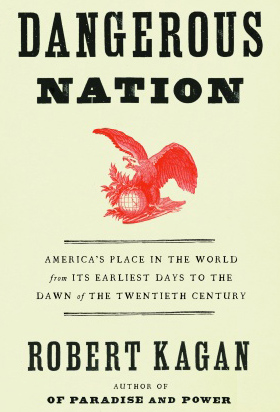
Despite the idealistic tone of these words, their author, John Adams, was not generally perceived as a buoyant optimist. The historian Robert Kagan, in his new book, Dangerous Nation: America’s Place in the World From Its Earliest Days to the Dawn of the Twentieth Century (Knopf, $20), describes Adams as a “normally dour conservative skeptic.” But Adams was expressing sentiments, Kagan says, that are deeply entwined with the history of American foreign policy. In Dangerous Nation, the first part of a two-volume history of U.S. foreign relations, Kagan portrays the United States not as a traditionally isolationist country gradually taking a more open stance toward the world, but rather as a revolutionary state determined from the start to expand and spread its republican way of life.
The author is determined to do away with popular misconceptions of American history. In particular he tackles myths about President Washington’s farewell address and the Monroe Doctrine, which are usually seen as documents limiting the scope of U.S. foreign relations. Washington’s 1796 speech is most famous for its declaration: “It is our true policy to steer clear of permanent alliances of any portion of the foreign world.” In fact, Kagan argues, its “chief purposes . . . were immediate and political.” Washington’s words were intended not to set the course of America’s relations with the world but rather to persuade the public that his political opponents at the moment, who desired a pact with France against Britain, were misguided. America’s first President had no intention of restricting the free action of his young nation. Indeed, he had altogether more ambitious aspirations.
Similarly, the Monroe Doctrine is frequently understood as a policy statement restricting American action to the Western hemisphere, creating a barrier between the United States and Europe. Kagan urges the reader to consider the circumstances under which President Monroe made his declaration. A group of European nations, led by Russia and calling itself the Holy Alliance, was working to repress republican revolutions across the Continent. Monroe intended both to warn Europe against interfering with American liberty and to decry the rise of absolutism there. His initial draft, Kagan observes, was highly aggressive. It “contained a general warning to Americans that their beloved republican institutions were under siege around the world and that their own security was directly implicated in the global ideological struggle.” Only at the urging of John Quincy Adams, the secretary of state, did Monroe soften his tone, eventually producing the milder document Americans know today. And even that was aggressive enough to raise the hackles of European monarchs, Prince Metternich among them.
Kagan takes on these commonly held views in order to make a larger argument about American history. Many Americans would recognize the words of Thomas Jefferson’s first inaugural address counseling Congress to support “peace, commerce, and honest friendship with all nations, entangling alliances with none.” Far fewer are familiar with a policy tradition running in direct opposition to these sentiments, one more aligned with Monroe’s belligerence than with his secretary of state’s caution, supported down the years by such proponents as Alexander Hamilton, Henry Clay, and William Seward. In other words, Kagan says, it is not only in our own times that Americans have been concerned with spreading freedom and democracy. This has been a conscious intention of the country’s leaders since before it was a nation.
Kagan is not shy about indicating where his own sympathies lie. In discussing the political disputes between Jeffersonian Republicans and Hamiltonian Federalists, he makes it very clear that he thinks the Federalists were the right-minded stewards of foreign policy and their opponents misguided allies of France. Later, in examining the frustration and gridlock of U.S. foreign relations in the period before the Civil War, he portrays Northern commercial expansionists as more truly American than Southern aristocrats. He is clearly right that the Federalists, and later the Northern merchants, were more sympathetic to policies of intervention and expansion, but he leaps to suggest that isolation has only rarely been of any legitimate value.
In his elegant introduction, he compares the United States to a familiar character from the movies. He writes: “In the Howard Hawks movie To Have and Have Not, Lauren Bacall says to Humphrey Bogart, ‘I know, I know, you don’t give a hoot what I do—but when I do it you get sore.’ Bogart’s Harry Morgan in that 1944 film was meant to be a symbol for an isolationist America coming out of its isolation, but Bacall’s line could summarize four hundred years of American foreign policy.” Meaning that Americans, like Bogart’s character, have liked to think of themselves as self-interested and passive, only to find their moral and ideological sympathies roused by conflicts abroad. To illustrate this, Kagan has written a thought-provoking book that will certainly give its readers pause when they next learn of conflicts abroad and say they don’t give a hoot.